When Customers Correct Themselves, AI Memory Must Change

AI memory needs a Superseded Fact Ledger that preserves history without allowing outdated facts to control current decisions. Repetition is not authority.
Consider a buyer who says on Monday that the budget is 70 lakh, then explains on Thursday that a financing change lowers the ceiling to 60 lakh. The next call summary still lists 70 lakh because the earlier statement appeared in more messages. The rep recommends the wrong property and the buyer asks why nobody listened.

The Superseded Fact Ledger keeps the customer’s meaning connected to the next action.
AI memory needs a Superseded Fact Ledger that preserves history without allowing outdated facts to control current decisions. Repetition is not authority. A clear correction can outweigh a large volume of older conversation, provided the correction belongs to the same person, field, and buying journey.
New evidence needs precedence, not just storage
Separate a fact’s value from its source, effective time, and status. Mark the earlier value as superseded rather than deleting its history. Record why the new value takes precedence. Distinguish a correction from a hypothetical scenario: “If the loan increases, we could spend 75” should not overwrite a confirmed current ceiling of 60.
A correction should describe its scope. A new budget for one project should not overwrite the budget for a separate investment search. A move date can change without changing the desired possession type. Represent the affected fact and journey explicitly so memory updates do not become broad profile resets. This also lets a human understand why an earlier recommendation was reasonable at the time, even though it would be inappropriate now. History supports accountability; current state supports the next action.
A stale field can outlive a corrected conversation
A stale fact travels quietly. It changes recommendations, qualification, owner assignment, and the next assistant’s opening question. Because the CRM field looks ordinary, the team may blame customer inconsistency rather than memory precedence. The maintenance burden grows when operators edit one record but leave cached summaries and queued messages carrying the old value.
The practical failure is specific: older repetition outweighs a clear correction. The desired behavior is equally specific: current facts retain their change history. Use those two statements as the review boundary. A response should be judged by the state it leaves behind, not only by whether its wording sounds helpful.
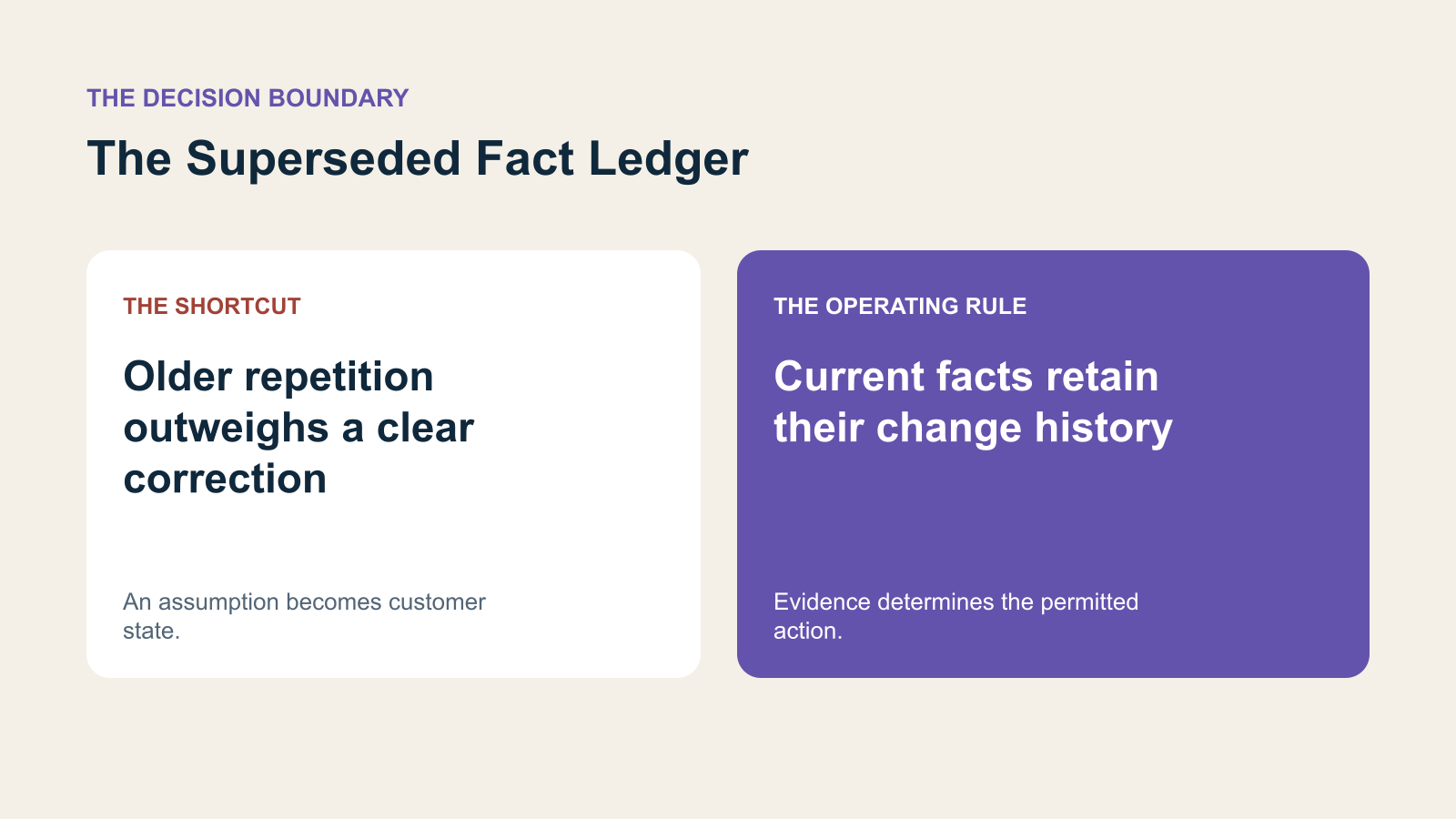
The Superseded Fact Ledger: the wrong shortcut and the evidence-based decision.
The working record behind The Superseded Fact Ledger
The record needs enough structure for another owner to verify the interpretation. For this journey, preserve four parts together rather than scattering them across a transcript, a note, and an action queue. Each part below has a different operating purpose. A populated field is useful only if the next owner can tell what it refers to and whether it is current.
Fact value, qualifier, and effective time
Keep qualifiers with the active value. A budget before charges differs from an all-inclusive ceiling even when both use the same amount.
Speaker, source message, and verification status
Identify who supplied the correction. A new message from another participant may represent disagreement rather than authority to overwrite the buyer's requirement.
Superseded value and correction relationship
Retain the old value as superseded history. Earlier actions can then be explained without allowing outdated information to govern new recommendations.
Dependent summaries, recommendations, and queued actions
Refresh dependent artifacts deliberately. Upcoming-call briefs, queued messages, and recommended options can remain wrong after the main CRM field is corrected.
Corrections must reach every dependent action
For the buyer, retain Monday’s 70 lakh as historical context and Thursday’s 60 lakh as the active ceiling. Re-evaluate open recommendations that depend on budget. Acknowledge the change once, then avoid repeatedly asking for the same correction. If the customer later says “I meant 60 before fees,” store that qualifier rather than silently treating the amount as an all-in total.
A suitable clarification or acknowledgment in this illustrative scenario is: “Should I use 60 lakh as your current ceiling?” The wording is an example to adapt to the approved customer process, not a universal script. Its purpose is to make the next decision clear without claiming that an unverified action has already completed.
The refresh must reach pending work. An assistant may store the corrected budget while an older recommendation message is already queued. A rep brief may have been generated before the change. Treat these as dependent artifacts that require revalidation, not independent sources that can overrule the correction. Start with the artifacts that directly affect the customer: unsent messages, active recommendations, upcoming-call briefs, and unexecuted tasks. Preserve which version each artifact used so the team can diagnose a missed refresh.
The Superseded Fact Ledger
Older repetition outweighs a clear correction. Current facts retain their change history.
The boundary cases that change the correct action
Two people may disagree without either correcting the other. A spouse’s preference is not automatically a replacement for the primary buyer’s instruction. A staff member may also enter a mistaken correction. Preserve speaker and reviewer identities so a newer timestamp does not automatically grant authority. When sources conflict, surface the conflict and ask a targeted question.
Identify fields that materially change customer actions, starting with budget, dates, product choice, and channel preference. Define how corrections propagate to summaries and pending workflows. Give operators a readable history showing old value, new value, source, and affected actions. The history should explain the current answer without making staff search the entire conversation.
Start with one team, one journey, and a named owner for exceptions. Keep the first version small enough that staff can inspect every consequential decision. Use disagreement reviews to improve the context and operating rules before increasing automation. A model cannot compensate for an undefined approval process or an owner who never receives the work.
How to test The Superseded Fact Ledger before expanding it
A useful review set includes ordinary success, ambiguity, a correction, and a failure after interpretation. Label the expected business state before looking at the assistant’s answer. Otherwise reviewers can be persuaded by fluent wording to accept a decision that the original evidence never supported.
- A confirmed ceiling decreases; future recommendations use the new ceiling.
- A hypothetical increase is discussed; the current budget does not change.
- A different decision-maker disagrees; both positions remain visible until resolved.
Review corrections across channels. Let the original statement arrive on a call, the correction arrive on WhatsApp, and a later human note qualify it. Ask which statement should control the current recommendation and why. Include a rejected correction from the wrong subject and a genuine correction from the right customer. A system that always trusts the newest timestamp will pass simple tests and fail the authority and attribution cases that occur in production.
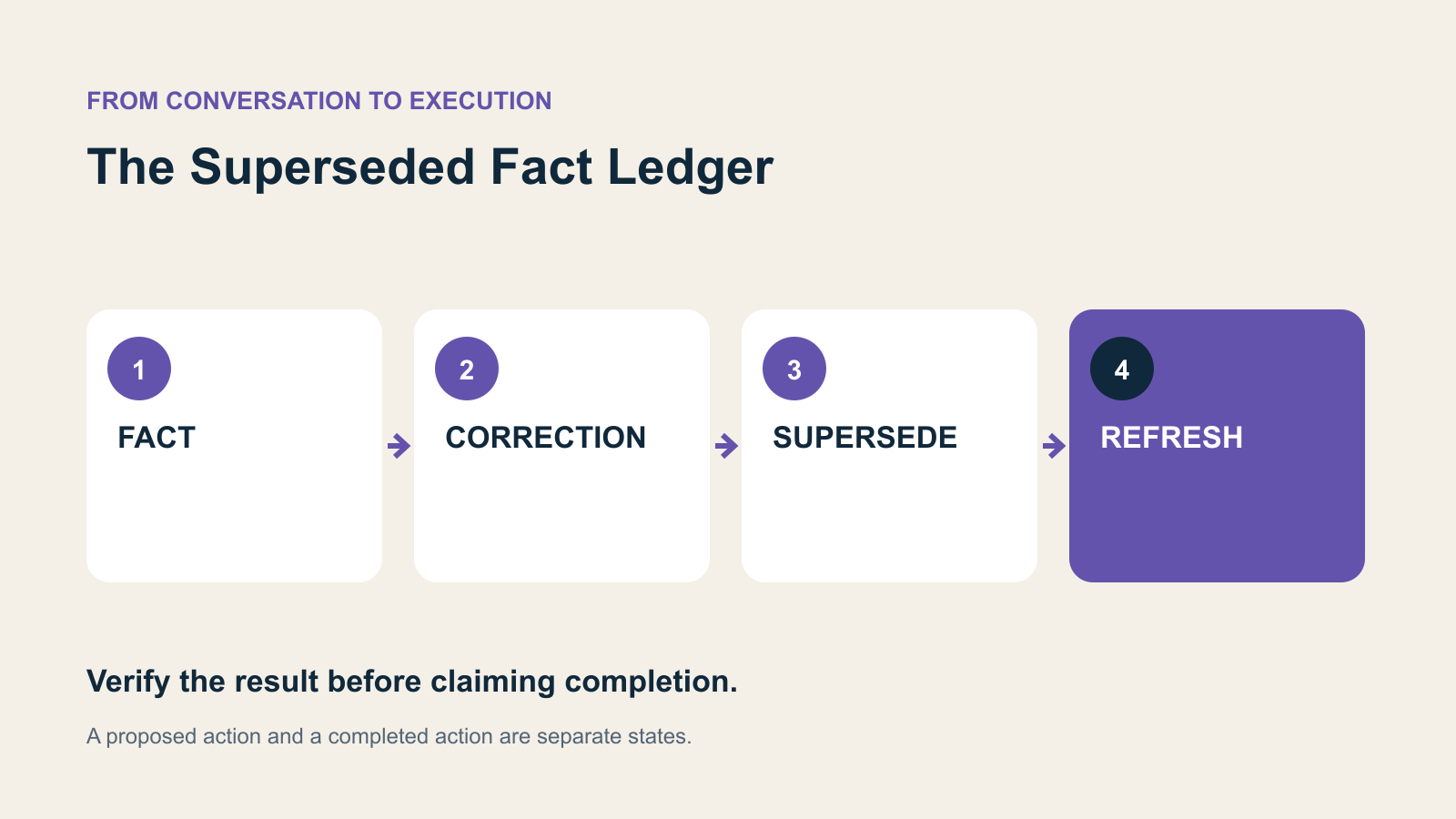
FACT → CORRECTION → SUPERSEDE → REFRESH: review the state transition, not just the response.
Measure decision accuracy alongside customer effort
Track repeated corrections, decisions using superseded facts, and time for a verified change to reach dependent actions. Audit the cases where history was retained but no longer used for current recommendations. A memory system should improve current accuracy without rewriting the past to make earlier actions look justified.
Use an explicitly illustrative audit to make the denominator clear. Suppose reviewers inspect 40 cases that genuinely require The Superseded Fact Ledger, and find 6 unsupported actions. That is 6 divided by 40, or 15% in that sample. It is not a market benchmark or an expected result. Counting 200 unrelated greetings alongside those cases would hide the failure without fixing it. Keep the relevant case count, error count, review rules, and uncertainty visible when reporting the result.
Also inspect the opposite failure: an unnecessary hold when the evidence was already sufficient. Reviewers should distinguish a justified clarification from an avoidable repeat question. An appropriate human review is different from a case abandoned without an owner. Pair the action error rate with customer effort and completion evidence so the team cannot improve one dashboard by moving the cost to the customer or another department.
Connect The Superseded Fact Ledger with the rest of customer operations
Brixi brings CRM, AI assistants, conversation history, omnichannel communication, workflows, and team execution into one customer platform. That gives teams a connected place to design memory rules rather than maintaining a different interpretation in every inbox. The business decision, its supporting conversation, the responsible owner, and the resulting action can be reviewed together.
For this use case, make the implementation review concrete: ask the Brixi team to walk through the original evidence, the current CRM state, the permitted action, and recovery when that action cannot complete. Validate any required source system, permission rule, and approval path during configuration. The recommended operating design in this article should be demonstrated against the actual deployment rather than assumed from a generic AI feature label.
For the wider operating model, read the guide to the AI memory gap. The important connection is between interpretation and accountable execution: the same evidence should prepare the assistant, the responsible human, and the next workflow.
What to inspect after the first quarter
After a quarter, the useful evidence is a change in operating behavior: fewer unsupported actions, fewer repeated clarifications, and clearer ownership of unresolved cases. Treat these as questions to investigate, not promised gains. Compare similar journey types and inspect the difficult cases as well as the average. Improvements should survive a new owner, a changed source record, and an ordinary customer correction.
The deeper bet behind The Superseded Fact Ledger
Customer memory will be judged by its ability to revise beliefs. A platform that remembers everything but cannot retire an old fact is an archive with confident habits. The useful system keeps evidence, effective state, and action dependencies connected as the customer’s circumstances change.
Put The Superseded Fact Ledger into a connected customer workflow
Explore how Brixi connects customer context, CRM, AI assistants, conversations, workflows, and human teams around a reliable next action.