One Customer, Two Active Journeys: Separating Sales and Support Context

A unified customer record still needs a Journey Context Partition. Identity should connect conversations, while purpose separates the decisions they inform.
Imagine an existing software customer reporting a billing problem while evaluating an additional product. The assistant sees the angry support conversation and marks the expansion opportunity uninterested. Another automation sends an enthusiastic upgrade offer into the unresolved complaint. Both systems know the person. Neither understands which journey the message belongs to.

The Journey Context Partition keeps the customer’s meaning connected to the next action.
A unified customer record still needs a Journey Context Partition. Identity should connect conversations, while purpose separates the decisions they inform. Sales interest, service frustration, payment state, and product usage can coexist without being collapsed into a single customer sentiment or funnel stage.
A unified customer is not a single business state
Associate each exchange with a case, opportunity, order, or explicitly unresolved purpose. Allow a message to affect more than one journey only when its meaning supports that relationship. “I won’t expand until the billing issue is resolved” connects the two. “The invoice is wrong” identifies a support problem without necessarily cancelling the separate buying discussion.
Journey partitioning is not a reason to ignore the wider relationship. A service failure can be directly relevant to an expansion discussion, but that relevance should be represented as a link rather than an indiscriminate overwrite. The support case retains its operational status. The opportunity retains its commercial status. An explicit condition can connect them. This makes the situation understandable to managers who need to coordinate teams without forcing both teams into a single funnel stage.
Purpose errors create contradictory outreach
Unpartitioned memory causes both overreaction and inappropriate persistence. Sales may abandon a real opportunity because support sentiment is negative. Marketing may continue upselling because the sales stage looks positive. Staff then explain contradictory behavior to the same customer, and reports attribute the outcome to the wrong owner.
The practical failure is specific: one sentiment overwrites every active journey. The desired behavior is equally specific: shared identity with purpose-specific decisions. Use those two statements as the review boundary. A response should be judged by the state it leaves behind, not only by whether its wording sounds helpful.
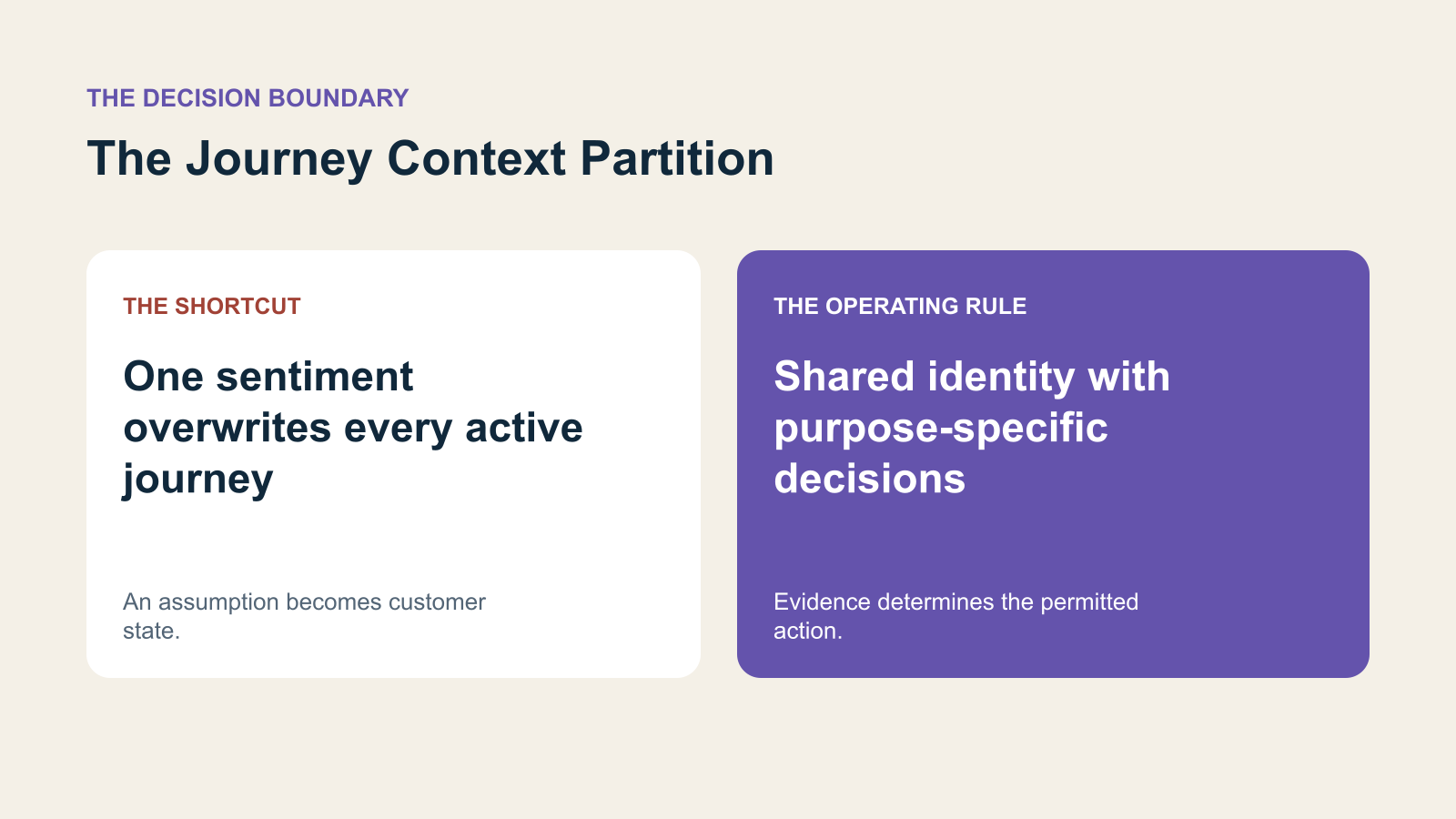
The Journey Context Partition: the wrong shortcut and the evidence-based decision.
The working record behind The Journey Context Partition
The record needs enough structure for another owner to verify the interpretation. For this journey, preserve four parts together rather than scattering them across a transcript, a note, and an action queue. Each part below has a different operating purpose. A populated field is useful only if the next owner can tell what it refers to and whether it is current.
Customer identity and journey identifiers
Use separate references for the support case and commercial opportunity. Shared identity should coordinate them without collapsing their independent states.
Message purpose and affected business object
Resolve the purpose of ambiguous instructions. A cancellation cannot safely modify an invoice, subscription, and proposed upgrade from one unspecified message.
Explicit dependencies between active journeys
Link journeys when the customer makes the relationship explicit. An unresolved complaint can block expansion without automatically making the opportunity permanently lost.
Owner, next action, and contact policy per journey
Keep accountable owners for both purposes. Pausing promotional contact should not pause the requested support updates or leave the billing case unattended.
Connect journeys through explicit dependencies
Keep the billing case open with its finance owner and preserve the expansion opportunity separately. Record an explicit dependency if the customer makes resolution a condition for expansion. Hold relevant promotional activity under the business’s contact policy, while continuing the requested support updates. When billing is corrected, ask whether the customer wants to resume the commercial conversation rather than assuming the original buying intent is unchanged.
A suitable clarification or acknowledgment in this illustrative scenario is: “Do you mean the invoice dispute or the additional order?” The wording is an example to adapt to the approved customer process, not a universal script. Its purpose is to make the next decision clear without claiming that an unverified action has already completed.
Cancellation is a useful stress test. If a customer has an active subscription, an unpaid invoice, and a proposed upgrade, “cancel that” has several possible objects. A useful assistant names the plausible target and asks a narrow question. It should not cancel the highest-value object because that is the default CRM record, or the most recent object because it is easiest to retrieve. The active purpose and explicit references should guide interpretation before any consequential action is authorized.
The Journey Context Partition
One sentiment overwrites every active journey. Shared identity with purpose-specific decisions.
The boundary cases that change the correct action
Some messages are ambiguous across journeys. “Please cancel it” could refer to a disputed charge, a renewal, or an expansion order. Ask which object the customer means before acting. Do not split context so aggressively that the assistant ignores a service failure that clearly affects the purchase. Partitioning should protect meaning while preserving relevant relationships.
Choose customers who commonly have simultaneous cases and opportunities. Give each journey an identifier, current owner, next step, and relationship to other work. Build a review view that shows the shared customer timeline with journey labels. Staff should be able to follow one thread without losing the surrounding relationship.
Start with one team, one journey, and a named owner for exceptions. Keep the first version small enough that staff can inspect every consequential decision. Use disagreement reviews to improve the context and operating rules before increasing automation. A model cannot compensate for an undefined approval process or an owner who never receives the work.
How to test The Journey Context Partition before expanding it
A useful review set includes ordinary success, ambiguity, a correction, and a failure after interpretation. Label the expected business state before looking at the assistant’s answer. Otherwise reviewers can be persuaded by fluent wording to accept a decision that the original evidence never supported.
- A complaint arrives during expansion; the opportunity is not automatically marked lost.
- The customer makes resolution a buying condition; the dependency becomes visible.
- A cancellation lacks an object; no unrelated order is modified.
Test retrieval views as well as classification. A support owner needs the information necessary to resolve billing, including an explicit commercial dependency if relevant. They do not necessarily need every sales note. A sales owner needs the unresolved issue and agreed contact restriction without unrelated private details. Review whether each brief is sufficient for its purpose and whether the shared timeline still allows authorized investigation when the two journeys interact.
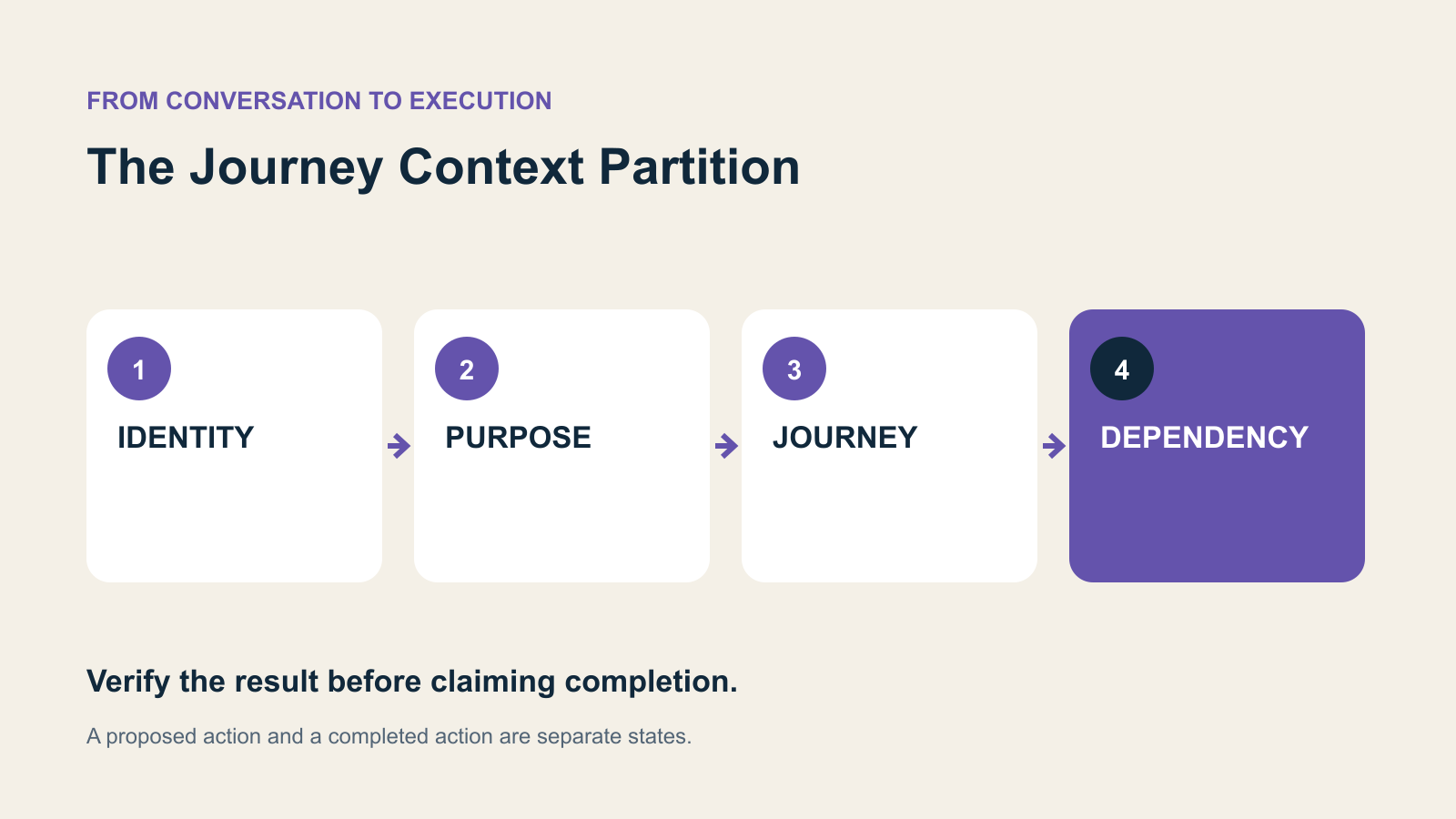
IDENTITY → PURPOSE → JOURNEY → DEPENDENCY: review the state transition, not just the response.
Measure decision accuracy alongside customer effort
Audit cross-journey contamination: support frustration incorrectly changing sales intent, sales progress incorrectly closing service work, or one cancellation affecting the wrong object. Track unresolved journey assignments separately from ordinary classification errors. The outcome is coordinated parallel work, not an artificial requirement that every customer have only one active process.
Use an explicitly illustrative audit to make the denominator clear. Suppose reviewers inspect 40 cases that genuinely require The Journey Context Partition, and find 6 unsupported actions. That is 6 divided by 40, or 15% in that sample. It is not a market benchmark or an expected result. Counting 200 unrelated greetings alongside those cases would hide the failure without fixing it. Keep the relevant case count, error count, review rules, and uncertainty visible when reporting the result.
Also inspect the opposite failure: an unnecessary hold when the evidence was already sufficient. Reviewers should distinguish a justified clarification from an avoidable repeat question. An appropriate human review is different from a case abandoned without an owner. Pair the action error rate with customer effort and completion evidence so the team cannot improve one dashboard by moving the cost to the customer or another department.
Connect The Journey Context Partition with the rest of customer operations
Brixi brings CRM, AI assistants, conversation history, omnichannel communication, workflows, and team execution into one customer platform. That gives teams a connected place to design memory rules rather than maintaining a different interpretation in every inbox. The business decision, its supporting conversation, the responsible owner, and the resulting action can be reviewed together.
For this use case, make the implementation review concrete: ask the Brixi team to walk through the original evidence, the current CRM state, the permitted action, and recovery when that action cannot complete. Validate any required source system, permission rule, and approval path during configuration. The recommended operating design in this article should be demonstrated against the actual deployment rather than assumed from a generic AI feature label.
For the wider operating model, read the guide to the AI memory gap. The important connection is between interpretation and accountable execution: the same evidence should prepare the assistant, the responsible human, and the next workflow.
What to inspect after the first quarter
After a quarter, the useful evidence is a change in operating behavior: fewer unsupported actions, fewer repeated clarifications, and clearer ownership of unresolved cases. Treat these as questions to investigate, not promised gains. Compare similar journey types and inspect the difficult cases as well as the average. Improvements should survive a new owner, a changed source record, and an ordinary customer correction.
The deeper bet behind The Journey Context Partition
The complete customer platform will model a relationship as several connected purposes. One customer timeline is valuable, but one undifferentiated customer state is too crude. AI becomes more useful when it knows which facts should travel across journeys and which decisions must stay scoped.
Put The Journey Context Partition into a connected customer workflow
Explore how Brixi connects customer context, CRM, AI assistants, conversations, workflows, and human teams around a reliable next action.