Multilingual Voice AI for Indian Admissions Teams
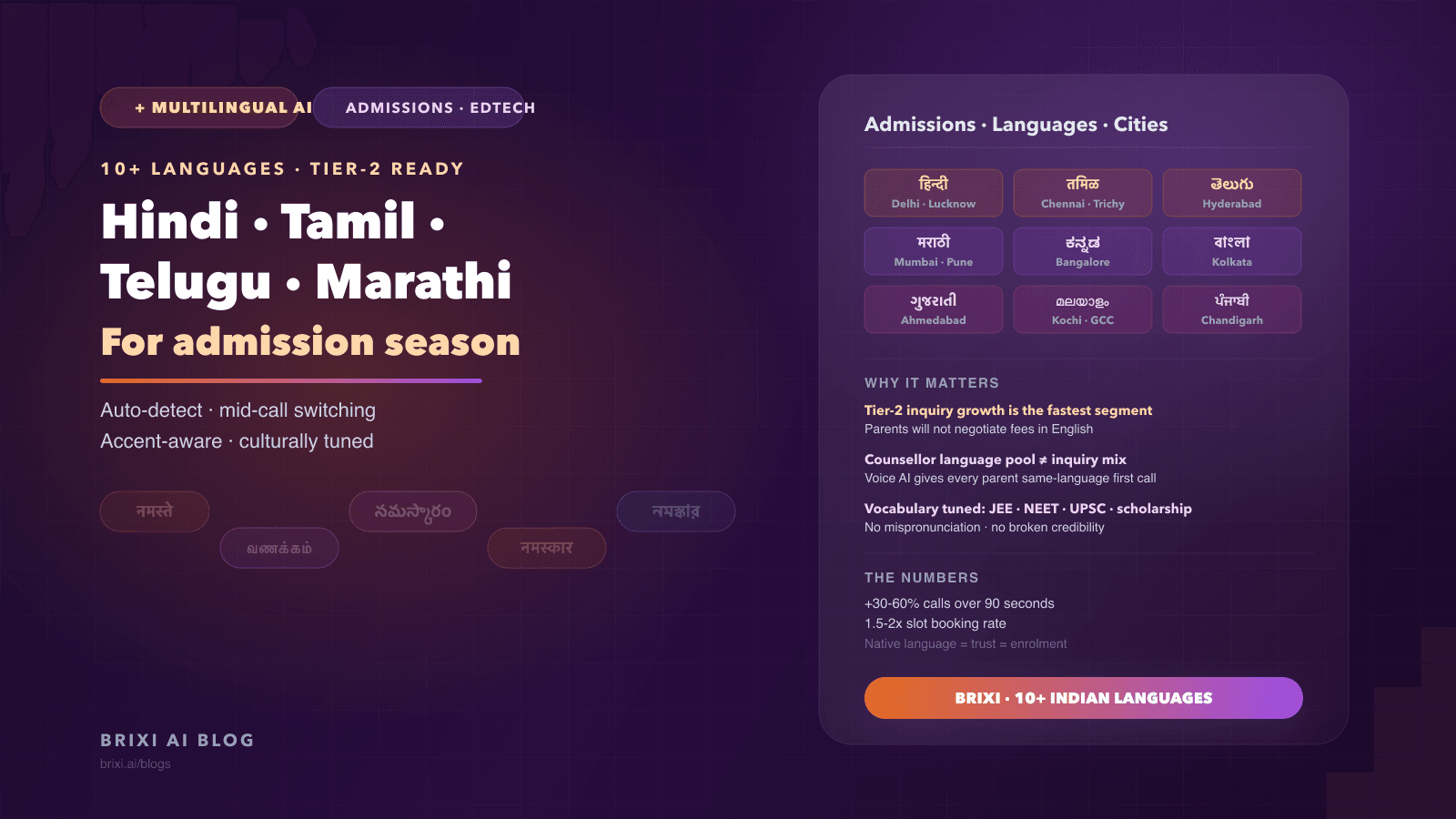
Tier-2 and tier-3 cities now drive the fastest growth in Indian admissions inquiries, and the parents on those calls almost never want to negotiate fees and futures in English. Multilingual Voice AI is the operational fix that lets every counsellor focus on qualified, warm leads instead of language triage.
Ekta runs admissions operations at a mid-size coaching institute in Mysuru. In March, her team pushed a lead-gen campaign across Karnataka, Maharashtra, and Tamil Nadu. By the second week of April, 1,400 inquiries had come in. Her eight counsellors were doing well with the Kannada and English calls. The Tamil stack was sitting at 340 unworked leads by Thursday. There was no Tamil-speaking counsellor available. The campaign had worked. The language coverage had not.
This is the structural problem that grows quietly every admission season. Inquiry volume from tier-2 and tier-3 cities compounds year on year as more families in Coimbatore, Indore, Warangal, and Nashik seek national-quality education. But counsellor hiring does not compound at the same rate, and multilingual counsellors are expensive to recruit, slow to ramp, and the first to burn out in peak season. The gap between the languages parents want to speak and the languages a team can staff is not a hiring problem. It is an infrastructure problem.
What is the Language Distribution Reach Problem in Indian Admissions?
Most national admissions teams build their counsellor bench around Hindi and English, and assume that covers the majority. It does, but "majority" in a national inquiry pool still leaves hundreds of leads in every southern and western campaign cycle speaking a language no counsellor on the current roster handles fluently. The Language Distribution Reach Problem is the name for this structural mismatch: the set of languages your campaigns reach versus the set of languages your team can actually serve.
A useful baseline for any institute admitting students from across India looks roughly like this. Hindi covers North India, Delhi NCR, central states, and a meaningful share from Maharashtra and Gujarat. Tamil covers Chennai, Coimbatore, Madurai, and Trichy. Telugu covers Hyderabad, Vijayawada, and Visakhapatnam. Marathi covers Pune, Nashik, and Nagpur. Kannada covers Bangalore and Mysuru. Bengali covers Kolkata and much of the Northeast. Malayalam covers Kochi, Thiruvananthapuram, and a large Gulf-based parent base. Each of these language groups represents a real funnel segment, not a rounding error.
A team running a national cycle in only Hindi and English is structurally leaving conversion in every non-Hindi southern and western market it spends marketing budget to reach. The math is unforgiving: in deployments we see, first-call hold rates increase by 30 to 60 percent when the language matches the parent from the first ring. A parent who stays on the line past 90 seconds is a meaningfully different prospect than one who politely ends the call.
Why Does Language Match Drive Admissions Conversion More Than Script Quality?
The contrarian claim worth making here: admissions teams spend enormous effort perfecting the English script and almost no effort on the language infrastructure that determines whether a parent in Trichy stays on the call long enough to hear it. A parent whose child is applying to a college in another state is making a high-stakes, emotionally loaded decision. The first signal they use to calibrate trust is not your ranking or your fee structure. It is whether the voice on the other end is speaking in a register that feels like their world.
When that register matches, three things happen that compound in the counsellor’s favour. First, the parent stays on the line longer. Second, they share real information: actual budget range, real timeline, whether the student wants a hostel or is a day scholar, whether a sibling already attended the institute. Third, they are more willing to book a follow-up counselling slot because the first conversation already moved past the basics. None of these things happen at the same rate when the parent is translating their concerns into a language they are less comfortable in.
What Does a Properly Multilingual Voice AI Actually Have to Get Right?
Saying a Voice AI supports ten Indian languages is not the same as supporting them well. There are specific capabilities that separate a platform built for Indian conversations from one that has translated its English templates.
- Automatic language detection from the first spoken sentence, not a "press 1 for Hindi" menu. The agent identifies the language in under two seconds and responds in kind, without breaking the natural rhythm of the call.
- Mid-call language switching without context loss. Indian conversations move between languages within a single call. A parent might start in Telugu, ask a fee question in English, and return to Telugu for timelines. The agent must follow this without forgetting what was said earlier in the conversation.
- Accent-aware ASR trained on regional variation within each language. Delhi Hindi and Lucknow Hindi differ. Chennai Tamil and Coimbatore Tamil differ. A model trained on a single standard accent will mistranscribe a meaningful share of real conversations and lose credibility fast.
- Domain vocabulary handled correctly across languages. JEE, NEET, IELTS, management quota, scholarship, and hostel all carry specific meaning in an admissions context. Each of these terms needs to be recognised and pronounced correctly in every language the agent operates in.
- Region-appropriate TTS voices, not a generic synthesised Indian accent with a thin regional layer. A synthesised voice with English syllable stress in Tamil sounds foreign to a Chennai parent and signals that the institution does not really operate in their world.
The anti-pattern to watch for: a platform that handles all of these criteria adequately in English and Hindi but degrades noticeably in Tamil, Telugu, and Marathi. This is the imported-platform failure mode. Global Voice AI platforms built for North American sales calls added Indian languages as adaptations of their English core. The latency is higher, the voices are less warm, and the domain vocabulary breaks because the training corpus was not built around Indian education. The difference is audible to a parent in the first ten seconds.
How Does the Language Distribution Reach Problem Show Up in CRM Data?
Ekta pulled her CRM data after the April campaign. The Tamil leads had a 12 percent first-call connect rate and a 3 percent counselling slot booking rate. The Kannada leads had a 28 percent first-call connect rate and a 14 percent booking rate. The difference in the connect rate was partly a timing issue. The difference in booking rate was almost entirely a language issue. The Tamil leads who did connect were getting English calls and politely disengaging. The Kannada leads who connected were getting native-language conversations and converting.
This is what the Language Distribution Reach Problem looks like in CRM data: a cluster of leads from a specific geography with anomalously low booking rates relative to their connect rate. The leads are not low quality. The lead source is not underperforming. The language infrastructure is missing. Once you see this pattern, it appears in every admissions team that markets nationally but staffs locally.
The real audit question
Pull your last campaign's booking rate by city cluster, not by lead source. If Chennai, Coimbatore, and Trichy are running at half the booking rate of Bangalore despite similar lead volumes, you are looking at the Language Distribution Reach Problem. The fix is not a new campaign. It is language-matched first conversations at scale.
What Operational Changes Does Multilingual Voice AI Require to Work Correctly?
Deploying a multilingual Voice AI for admissions is not a drop-in replacement for an English-only system. There are operational decisions that determine whether the deployment actually captures the Language Distribution Reach Problem or just adds a feature no one uses.
- Per-campaign language defaults: a Tamil Nadu campaign defaults to Tamil-Hindi-English fallback order. A Maharashtra campaign defaults to Marathi-Hindi-English. Setting this per campaign rather than globally means the first response matches the dominant language of the leads in that geography.
- Caller-preference memory: once a parent has spoken in a specific language, every subsequent call from the system defaults to that language, not the campaign default. This prevents re-triggering language detection on a parent who already established their preference.
- Language-aware counsellor routing: when the Voice AI escalates to a human, the routing logic should match the counsellor to the language of the conversation, not just to availability. Escalating a Tamil conversation to a Hindi-only counsellor undoes everything the Voice AI built.
- Language-tagged transcripts for quality review: managers reviewing call quality need the original language alongside a translation. A quality coaching session based only on English transcripts of Tamil calls loses the regional register and misses real issues.
- Language performance tracking in the funnel dashboard: hold rate, qualification completeness, and booking rate should be breakable by language, not just by geography or lead source. This is the only way to catch degradation in a specific language model before it compounds across a full season.
What Changes After One Quarter of Multilingual Voice AI in an Admissions Funnel?
In deployments we track, the first change that shows up within four to six weeks is qualification completeness. When parents stay on the line and share real information, the CRM records for those leads arrive at the counsellor with budget range, programme preference, and timeline already captured. Counsellors stop spending the first five minutes of a follow-up call re-collecting basics and start at a more advanced point in the conversation.
The second change, typically visible at the eight-week mark, is the counsellor slot booking rate in previously underperforming language clusters. Teams that were seeing 3 to 5 percent booking rates from southern markets start seeing rates closer to their Hindi and English averages. This is the Language Distribution Reach Problem being resolved in the funnel data.
The third change is counsellor morale and capacity. When the Voice AI handles first-touch and qualification in every language, counsellors spend their time on warmer leads with real context. The burnout that typically peaks in May, when multilingual counsellors are fielding 60-plus raw calls a day, is measurably lower when those 60 calls have already been pre-qualified by a Voice AI conversation. Most teams find that their existing counsellor bench can cover a 40 to 60 percent larger qualified pipeline without adding headcount.
The Deeper Bet: Language as a Distribution Strategy, Not Just a Feature
Ekta did not just want to recover the Tamil leads from the April campaign. By June, she had deployed multilingual Voice AI across her next campaign cycle, covering Tamil, Marathi, and Telugu alongside Kannada and Hindi. The Tamil booking rate in May was four times what it had been in April. The change was not in the leads. It was not in the counsellors. It was in the first conversation.
The deeper bet for an admissions team is not that multilingual Voice AI will handle a few more languages. The bet is that language is itself a distribution channel. A team that can run a genuinely native-language first conversation in twelve Indian languages is marketing to a meaningfully larger addressable market than a team that can only convert fluently in two. The geographic reach of the marketing and the geographic reach of the conversion infrastructure finally match.
For institutes competing for students from tier-2 and tier-3 India, this is not a marginal improvement. The families writing the largest cheques for coaching and private college fees increasingly come from Nashik, Trichy, Warangal, and Indore, not from metros where English is a first language. The institute that meets those families in their language, at scale, with a consistent and warm first conversation, is compounding trust in markets that most competitors have not yet learned to convert.
How many languages is your admissions funnel actually converting in?
Brixi Voice AI handles 10-plus Indian languages with automatic detection, mid-call switching, accent-aware ASR, and region-appropriate voices. Built for how Indian admissions conversations actually happen.
Book a DemoFrequently Asked Questions
At minimum: Hindi, Tamil, Telugu, Marathi, Bengali, Kannada, Gujarati, Malayalam, and English. National admissions cycles draw applicants from every region, and each major language represents a real funnel segment. Missing Tamil means leaving Chennai and Coimbatore conversions on the table. Missing Marathi means Pune and Nashik parents get an English call when they wanted a Marathi one. The Language Distribution Reach Problem appears in your CRM data as anomalously low booking rates in specific city clusters, not as a general conversion problem.
Very critical. Indian parents routinely move between a regional language and English within a single call, especially when discussing fees, scholarship terms, and hostel availability. A Voice AI that forces one language per call breaks the natural rhythm of the conversation. The agent needs to follow language switches without losing context from earlier in the call. This is one of the key failure modes of imported global platforms adapted for Indian languages rather than built natively for them.
For first-touch qualification, yes. For decision-stage and emotionally complex conversations, no. The right structure uses Voice AI for the first conversation in the parent's language, captures budget range, programme preference, and timeline, then routes the qualified handover to a counsellor who also speaks that language. This structure allows an existing counsellor bench to cover a 40 to 60 percent larger qualified pipeline without adding headcount, because counsellors spend their time on warmer leads rather than raw volume.
Break your last campaign's booking rate by city cluster rather than by lead source. If Tamil Nadu, coastal Andhra, or Maharashtra clusters are running at half the booking rate of your Hindi and English markets despite similar lead quality and volume, the Language Distribution Reach Problem is the most likely explanation. The fix is language-matched first conversations at scale, not a new campaign or a different lead source. Track hold rate, qualification completeness, and booking rate by language after deploying multilingual Voice AI to measure the correction.