Voice AI for Admission Counsellors: Stop Burning Expert Time on Unqualified Calls
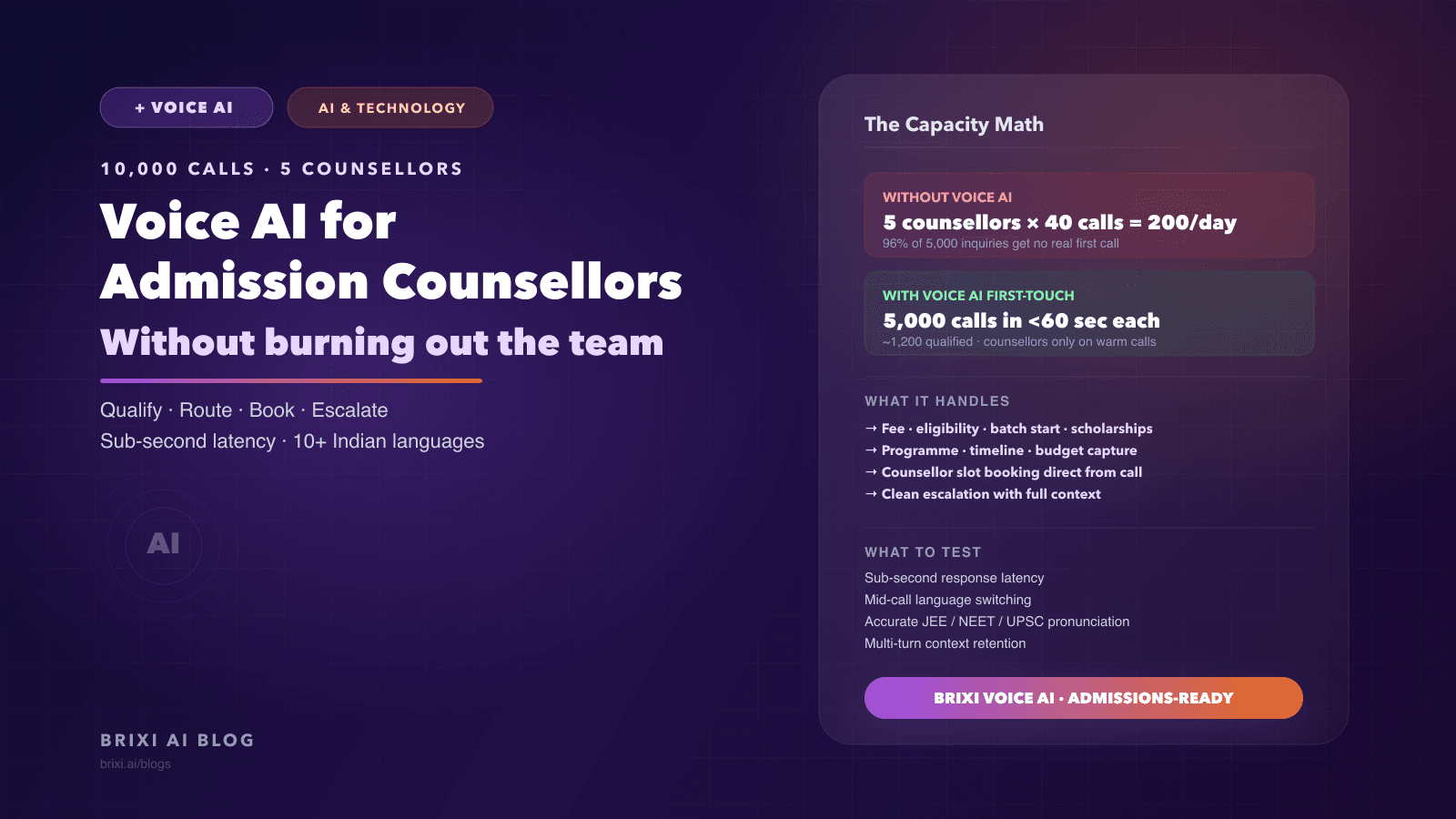
Most admission teams treat every inbound inquiry as equal and send their best counsellors into a twelve-hour triage loop. Voice AI ends that by running first-touch qualification at scale, so human counsellors only spend time on applicants who are genuinely close to a decision.
Bina runs admissions at a mid-size engineering coaching institute in Surat. Every year from late February to early April her team of six counsellors stares at a lead sheet that adds three hundred to five hundred new names before lunch. By the second week of peak season she is watching her best counsellor, who closed forty-two admissions last year, spend most of her day answering "what is the fee for the one-year NEET batch" for the hundredth time. By the third week, counsellors are burning out. By the fourth, Bina is offering spot discounts to anyone who picks up the phone, just to hit targets.
Bina is not running a bad admissions operation. She is running a structurally broken one. The break is not headcount or budget. It is the assumption that every inbound inquiry deserves a human counsellor from the first ring. That assumption is costing her team roughly seventy percent of its available capacity every single day.
This is the core problem voice AI for admission counsellors actually solves. Not automation for its own sake. Not cost-cutting. A structural fix to the triage load that has quietly been destroying counsellor performance for years.
Why Does Every Admission Team Hit the Same Capacity Ceiling?
The arithmetic is straightforward. A well-trained admission counsellor can hold roughly thirty-five to forty substantive conversations a day before quality drops. In peak season, a mid-size edtech or coaching brand receives anywhere from two thousand to ten thousand inquiries a day across all inbound channels. At five thousand inquiries and six counsellors, fewer than five percent of all prospects ever receive a first meaningful call. The other ninety-five percent age out, lose interest, and end up in a competitor's enrolled cohort.
The standard response is to hire contract telecallers. This creates its own problem. Contract callers have no product knowledge, low credibility with anxious parents, and generate a false sense of coverage while burning through leads with low-quality first conversations. The inquiry gets a call, but not a qualified one. The lead is marked "attempted" in the CRM and never followed up properly.
Voice AI for admissions teams is not a patch on top of this model. It replaces the model entirely. The right frame is: voice AI handles the first call for every inquiry, every time, in under sixty seconds. Human counsellors take the handoffs that matter.
What Is the Counsellor Triage Load Principle?
Before going further, it helps to name the underlying mechanism precisely. Call it the Counsellor Triage Load. Every inquiry that arrives in your funnel consumes some fraction of a counsellor's attention, even if it never becomes a real conversation. Unread lead sheets, unanswered callbacks, repeat-caller stacks, wrong-programme inquiries that got past the first filter. All of this is triage load, and it is invisible in most CRMs because it never shows up as a "call made."
The Counsellor Triage Load compounds during peak season because volume and complexity rise at the same time. More inquiries arrive while each counsellor is also managing follow-ups from the previous week's batch. Voice AI removes triage load almost entirely by making it a machine problem, not a human one. What remains for counsellors is a calendar of pre-qualified, pre-informed applicants who are already holding programme details and waiting to decide.
What Does Voice AI Actually Do on an Admission Inquiry Call?
This question matters because many teams have seen bad voice AI demos and assume the category is not ready for real use. Production-grade voice AI for Indian admissions runs a structured first-touch conversation that does four things in three to five minutes.
Answers the high-frequency factual questions immediately
Fee structure, batch dates, eligibility criteria, hostel availability, scholarship deadlines. These account for a significant share of all counsellor call time and have deterministic answers. Voice AI answers them accurately in the applicant's preferred language, without hold time, without the caller having to call back during business hours.
Captures the qualification signals that separate a buyer from a browser
Which programme is the caller interested in. What entrance exam they are preparing for, and what score they are targeting or already hold. When they want to join: this batch, next batch, or next academic year. What fee range they are working within. Whether the caller is the student or a parent making the decision. These six signals are enough to classify an inquiry into qualified, nurture, or disqualified with high accuracy. A human counsellor takes fifteen minutes to extract this information across two calls. Voice AI extracts it in the first conversation.
Books a counsellor slot or routes to a nurture track
When the caller clears the qualification threshold, the voice agent books a slot directly into the right counsellor's calendar, sends a WhatsApp confirmation with programme details, and writes the qualification summary into the CRM. When the caller does not qualify yet, perhaps their exam is three months away or the budget does not fit the current batch, the agent places them in the appropriate nurture sequence and triggers re-engagement when signals change.
Escalates with context when a human counsellor is needed now
Anxious parents mid-decision, scholarship exception requests, complex eligibility edge cases. Voice AI knows its limits. When the conversation moves into territory that needs human judgement, the agent escalates immediately, tells the caller a counsellor specialist will call them within a specific window, and hands over the full transcript and qualification data. The counsellor does not start from zero. The caller does not repeat themselves.
What Anti-Patterns Kill Voice AI Rollouts in Admissions?
Most edtech and coaching teams that have tried voice AI and abandoned it made the same mistakes. Naming them directly is more useful than a list of best practices.
Running the agent only on inbound and ignoring the outbound backlog
The largest volume problem in admissions is usually not inbound calls. It is the outbound call backlog: three thousand leads from the last two weeks who filled out a form and received no follow-up. Voice AI deployed only on the inbound line fixes a small fraction of the problem. Effective deployments run outbound campaigns across the full lead backlog simultaneously, within minutes of go-live, and prioritise leads by recency and source quality.
Training the agent on generic FAQ content instead of real call transcripts
Voice AI trained on a fee PDF and a programme brochure will answer questions from the brochure and sound hollow the moment a caller asks anything real. The most effective training input is a sample of fifty to one hundred actual call recordings from your existing counsellors. These tell the agent how real applicants phrase their questions, what objections come up in the first call, and what language resonates with your specific audience.
Deploying without integration into the CRM and calendar
Voice AI that records calls but does not write structured qualification data into the CRM creates a new triage problem: someone has to listen to hundreds of call recordings and manually update lead status. This is worse than no automation. The system is only useful if every call produces a CRM record, a counsellor calendar entry or a nurture flag, and a WhatsApp follow-up, all without a human touching the loop.
Expecting the agent to close admissions instead of qualify them
This is the most common misunderstanding. Voice AI for admissions is not a closing tool. It is a qualification and routing tool. Teams that set it up to push applicants toward payment links in the first call generate immediate negative feedback, lose goodwill, and abandon the deployment within a month. The agent's job is to earn the right for a human counsellor to make the closing call.
How Does the Counsellor's Role Actually Change?
The common fear is that voice AI shrinks the counsellor role or eliminates jobs. The actual change is different. The counsellor job description shifts from first-touch generalist to specialist closer. This is a more valuable job, not a smaller one.
- Counsellors no longer answer the same fee and eligibility questions repeatedly. That time goes to decision-stage conversations.
- Every counsellor call is with an applicant who already has programme details, has been asked the qualification questions, and is expecting a specialist to help them decide.
- Counsellors can see the full voice AI call transcript before the conversation starts, which means they open with context rather than intake.
- The counsellor's day has a cleaner rhythm: qualified calls in blocks, no dead-call padding, no callback chasing.
- Conversion rates on counsellor calls typically rise because every conversation is pre-warmed and the applicant has already self-selected as a serious prospect.
There are still three conversation types that will always need a human counsellor. The comparison conversation, where an applicant is deciding between your institute and a competitor. The family-anxiety conversation, where a parent is not sure the investment is right. The exception conversation, where an applicant needs something outside standard policy. Voice AI should escalate all three immediately and cleanly.
The contrarian case for voice AI in admissions
The objection most admissions directors raise is that applicants will feel depersonalised by an AI agent on the first call. The data says the opposite. Applicants who get a callback within sixty seconds of submitting a form convert at a significantly higher rate than those who wait four hours for a human counsellor. Speed of first contact matters more than whether the first contact is human. Voice AI wins on speed every time.
What Changes for Bina's Team After a Full Admission Season?
By the end of peak season with voice AI deployed, Bina's team looks different in three specific ways.
First, her best counsellor closed sixty-one admissions last season, up from forty-two. Not because she worked more hours, but because every call she took was with an applicant who was already serious. The Counsellor Triage Load had been removed from her day. She was not answering fee questions. She was not calling back callers who had already enrolled elsewhere. She was closing.
Second, Bina's CRM now has structured qualification data on every inquiry, including the ones that did not convert this season. She has programme interest, timeline, budget, and exam stage on three thousand applicants who said "call me next cycle." Her outbound campaign for the next batch starts from this structured dataset, not from a raw lead sheet.
Third, the discounting pattern stopped. In previous seasons Bina's team offered spot discounts under pressure at the end of each week to hit targets. This season the targets were hit on qualified conversions. There was no pressure to discount because the pipeline had volume and quality simultaneously, not a trade-off between the two.
What Should an Admissions Team Ask Before Choosing a Voice AI Platform?
The evaluation questions that actually separate production-grade platforms from demos are not about feature lists. They are about how the system behaves in real admission calls.
- Can the agent handle a mid-call language switch from Hindi to English to Gujarati without losing context? Indian callers do this routinely.
- What is the response latency on a live call, not a pre-recorded demo? Sub-800 millisecond response time is the threshold where conversations feel natural.
- How does the agent handle an incorrect question, for example a caller who asks about a programme your institute does not offer? Does it correct gracefully or hang?
- What structured data does each call write back to the CRM? A transcript alone is not useful. You need programme interest, budget range, timeline, and qualification verdict as discrete fields.
- Can the agent detect emotion and escalate? A parent who starts crying or raises their voice should never stay with an AI agent for more than thirty more seconds.
- How long does the initial rollout take, and what does the team need to provide? Platforms that require six months of onboarding are not built for the Indian admissions calendar.
The test call is the best evaluation tool. Ask the vendor to run a live call on your actual programme information. Switch languages. Ask about a competitor. Ask for an exception on the fee. Ask a question the agent cannot answer. If it handles all four cleanly, it is ready for your season. If one of them breaks, it will break in front of real applicants during peak.
One Deeper Bet: Voice AI Is Changing What Admissions Data Looks Like
Bina's story has a dimension beyond this season. The structured qualification data that voice AI produces every time an applicant calls is building a dataset that her institute has never had before. Not just whether someone converted, but why they did not. Programme preference mismatches. Fee range distributions by source. Timeline clustering by exam stage. Decision-maker patterns.
This data, built over two or three seasons, is what lets an admissions team shift from reactive outreach to predictive outreach. Bina will know, before the next peak season starts, which inquiry sources produce applicants with a budget fit, which lead sources produce late-cycle browsers, and which segments respond to outbound voice contact versus WhatsApp nudges. That is not a reporting upgrade. That is a strategic advantage built call by call over the course of a normal admissions cycle.
The teams that will hold that advantage in three years are the ones deploying voice AI now, not as a cost-reduction experiment, but as a data collection infrastructure for the admissions function they are building toward.
Ready to give your counsellors a calendar of qualified conversations?
Brixi Voice AI qualifies every inbound and outbound admission inquiry in ten Indian languages, writes structured data into your CRM, and hands counsellors only the conversations worth their time.
Book a DemoFrequently Asked Questions
The voice agent runs a structured first conversation that captures programme interest, exam stage and score, join timeline, budget range, and decision-maker identity. These signals are used to classify the inquiry as qualified for a counsellor call, placed in a nurture track, or disqualified, and the result is written directly into the CRM as structured fields, not just a call recording.
Production-grade voice AI for Indian admissions handles Hindi, English, Gujarati, Tamil, Telugu, Kannada, Marathi, Bengali, and other regional languages. Critically, it handles mid-call language switches, which Indian callers make frequently, without losing conversation context or requiring a restart.
Some will ask, and a well-built agent acknowledges it honestly when asked directly. Most callers, however, care more about getting their questions answered quickly and accurately than about whether the voice is human. Speed of response and quality of information matter more to conversion than the human versus AI distinction, particularly at the first-touch stage.
A focused rollout covering script configuration, programme and fee information, escalation paths, and CRM integration typically takes four to six weeks when the admissions team has its process documented. Teams with less structured baselines should plan six to eight weeks to reach production quality before their peak season.