WhatsApp Drip Campaigns for Admission Funnels: From Form Fill to Fee Payment
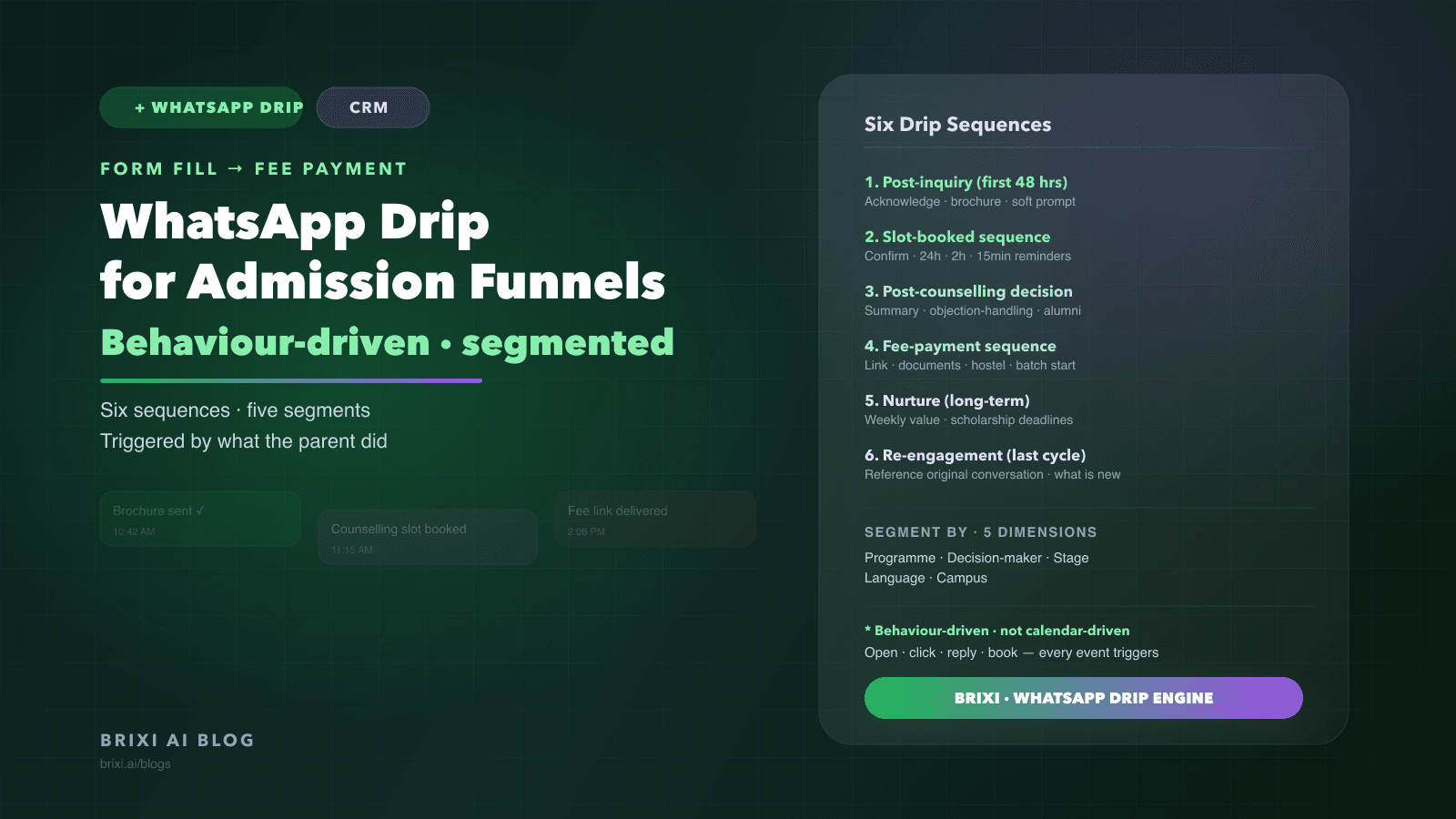
Most admission inquiries die quietly in the gap between the form fill and the fee payment. WhatsApp is where parents actually live during admission season, and a properly designed drip campaign keeps the conversation warm through every decision moment without burning out the counsellor team.
Open the WhatsApp inbox of any parent who is in the middle of an admission decision and you will see something interesting. There are messages from four institutes. Two are sending dry, generic broadcasts that get ignored. One is sending nothing, just the brochure from week one and silence ever since. The fourth is sending timely, useful, personalised messages that respond to where the parent actually is in the decision. Three weeks later, the parent has paid the fee at the fourth institute and cannot quite remember why the others fell off.
WhatsApp drip campaigns are how admissions teams stay present in a parent’s decision-making without sending a counsellor to do it manually. Done well, they take what used to be a series of forgotten follow-ups and turn it into a structured, personalised, behaviour-driven sequence that warms inquiries through the funnel and surfaces serious applicants at exactly the right moments for human intervention.
💬 WhatsApp is not email
A drip campaign that works in email, long, scheduled, content-heavy, fails on WhatsApp. WhatsApp messages are short, conversational, time-sensitive, and read within minutes. The campaign design has to match the medium, or it gets muted and the parent stops paying attention.
The Six Stages of an Admission Drip Sequence
A well-built admission drip is not one campaign. It is six overlapping sequences, each triggered by a specific moment in the funnel, each personalised to the applicant’s programme, language, and context.
1. The post-inquiry sequence (first 48 hours)
The first message goes out within 60 seconds of the form fill: a personalised acknowledgement, the brochure for the specific programme inquired about, and a clear next step. The second message follows two hours later if there has been no response, with a short, value-adding piece of content (a placement report, a faculty profile, a campus video). The third message lands the next morning with a soft prompt to book a counselling slot. After 48 hours of silence, the sequence yields and routes to the nurture track.
2. The slot-booked sequence
When a counselling slot is booked, the drip changes tone. Confirmation message immediately. Reminder 24 hours before. Reminder 2 hours before with the calendar link, the counsellor’s name, and a “what to ask us” prompt. Post-call message thanking the parent and capturing any next-step commitments.
3. The post-counselling decision sequence
After the counselling call, the parent enters the most fragile stage of the funnel. The drip should send a one-page summary of what was discussed, address the specific objections the counsellor noted, share a relevant alumni testimonial, and offer a clear path to the next decision moment. The cadence should be every two to three days, never daily.
4. The fee-payment sequence
Once the parent indicates intent to enrol, the drip turns logistical. Payment link. Document checklist. Hostel form. Batch start date. Each message should arrive at a moment that matches the actual workflow, not all at once, not all on day one, but spread to match how parents actually complete the steps.
5. The nurture sequence (for non-immediate inquiries)
For applicants who are not ready to commit but have not said no, the nurture drip runs over weeks or months. Useful content: exam strategy tips, scholarship deadlines, batch updates, success stories from previous cohorts. The goal is to stay in the inbox without becoming noise, and to surface the moment when intent shifts.
6. The re-engagement sequence (for cold or last-year inquiries)
Inquiries that went cold last season are not lost. Many of them are still considering. A short re-engagement drip at the start of the new admission cycle, referencing the previous conversation, often produces a meaningful share of new bookings without any new acquisition cost.
The Triggers That Make a Drip Feel Personal
A generic time-based drip that sends “message 1 on day 1, message 2 on day 3” feels like spam after the first cycle. A behaviour-triggered drip that responds to what the applicant actually does feels like a counsellor who is paying attention. The difference is in the triggers.
- Form-fill trigger: send the right brochure for the specific programme inquired about, not a generic master brochure.
- Brochure-open trigger: when the parent opens the PDF, the next message references it specifically. “You saw our placement section, here is the live placement report from this batch.”
- Counsellor-call-completed trigger: the next drip message references the call summary, addresses the specific question raised, and sends the relevant collateral.
- Payment-link-clicked-but-not-paid trigger: a gentle nudge, often with a small incentive, sent within 24 hours.
- Document-uploaded trigger: confirmation of receipt and a clear next step, removing the parent’s anxiety about whether the paperwork went through.
- Slot-no-show trigger: a recovery sequence that reschedules without making the parent feel guilty.
🧭 Behaviour-driven, not calendar-driven
The best drips do not run on a schedule. They run on what the applicant did or did not do. A parent who opened the brochure should hear a different message than a parent who has not. A parent who attended the counselling call should hear a different message than a parent who skipped it. This is what separates a drip that converts from a drip that gets muted.
Segmentation That Actually Matters in Admissions
Most edtech teams under-segment their drip audience. They send the same sequence to every applicant who filled a form. This is a mistake. Five segmentation dimensions consistently produce meaningful uplift in admission funnels.
Programme of interest
A JEE applicant should never receive a NEET-focused drip. A part-time MBA inquiry should never see content meant for full-time MBA applicants. Programme-specific content is the most basic segmentation, and the most often skipped.
Decision-maker
A message designed for a parent should sound different from a message designed for a student. Parents care about placements, fees, hostel safety, and faculty credentials. Students care about peer batches, mentor access, exam strategy, and lifestyle. Sending parent-language to a student or vice versa makes both audiences disengage.
Stage in the funnel
A first-touch applicant needs introduction-stage content. A counsellor-called applicant needs decision-stage content. A fee-link-sent applicant needs logistics. The drip has to flex by stage, not by date.
Language
Once a parent has indicated a preferred language, through Voice AI capture, through their inbound message, or through explicit selection, every subsequent WhatsApp message should arrive in that language. Defaulting to English for a Hindi-speaking parent breaks the trust that the first call built.
City and campus
A Hyderabad applicant interested in the Bangalore campus needs different content than a Bangalore-local applicant. Hostel information, travel logistics, regional placement data: these are non-trivial for the first audience and irrelevant for the second.
A Scenario: The Multi-Campus Operator Problem
Consider a coaching institute with campuses in six cities running a single centralised drip. The team built one nurture sequence and blasted it to every inquiry nationwide. The messages were accurate but irrelevant in ways that quietly killed trust. A parent in Patna received hostel fee details for the Pune campus. A student in Chennai got a reference to a regional scholarship that was only open to Maharashtra residents. Neither parent replied, and neither was ever contacted again by a counsellor because the drip kept ticking and the lead looked “active.”
The fix was not to write six new drips from scratch. It was to add city and campus as segmentation dimensions and route each inquiry to the variant that matched the campus they had asked about. The content itself changed in only three places per message: the campus name, the hostel pricing block, and the regional alumni reference. Conversion from counselling call to fee payment improved meaningfully within the first admission cycle because parents stopped receiving information that contradicted what the counsellor had told them on the phone.
📍 The mismatch anti-pattern
The single most damaging thing a drip can do is contradict the counsellor. If the counsellor quoted one fee and the drip sends a different number from an older template, the parent loses confidence in the institution entirely. Drip content should pull live data from the CRM wherever possible, and any message containing fees, dates, or seat availability should be connected to a live field, not a hardcoded value.
Cadence Mistakes That Kill Drip Performance
Most drip campaigns fail not because the content is bad but because the cadence is wrong. A few patterns worth avoiding.
- Daily messages: parents tune out within a week and mark the chat as muted, which kills delivery for the rest of the season.
- Late-night sends: WhatsApp messages after 9pm or before 8am feel intrusive and reduce response rates noticeably.
- Weekend silence: many admission decisions are made on weekends when families have time to discuss. Going dark on Saturdays and Sundays is a missed window.
- Fixed-cadence-regardless-of-engagement: a drip that keeps sending even when the parent has clearly disengaged trains them to ignore future messages.
- No clear next step in every message: every drip message should end with a specific, actionable next step. Book a slot, watch this video, reply with your timeline.
What Changes After a Full Quarter
Teams that run a properly segmented, behaviour-triggered drip for a full admission quarter come out of it with something more valuable than conversion data. They come out with a map of where the funnel actually leaks. The drip surfaces which triggers have low action rates, which segments go cold fastest, and which messages produce replies versus which ones disappear into silence. That data feeds the next quarter’s sequences directly.
A counsellor team that started the quarter chasing 400 inquiries manually ends it reviewing a shortlist of 60 who have clicked the payment link but not completed. The drip handled the other 340 without human time, either converting them or qualifying them out cleanly. The counsellors are now spending time on conversations that are actually close to a decision rather than on cold follow-up calls to people who filled a form nine days ago and have forgotten the institution entirely.
Where Drip Campaigns Move the Admissions Numbers
When a behaviour-triggered, segmented drip replaces a generic time-based one, three numbers consistently improve. The fee-payment conversion rate goes up because parents are reached at the moment of intent. The counsellor productivity goes up because the team spends less time chasing cold leads. And the cost per enrolment drops because re-engagement turns previously-lost inquiries into paid admissions without new acquisition spend.
Stop chasing admission inquiries one by one
Brixi runs behaviour-triggered WhatsApp drip campaigns across your entire admission funnel, segmented by programme, language, and stage, so every parent gets the right message at the right moment without manual counsellor work.
Book a DemoFrequently Asked Questions
Cadence should be triggered by behaviour, not a fixed schedule. A typical engaged applicant might receive three to five messages in the first week, then taper to one message every two to three days. A disengaged applicant should receive far fewer. Over-messaging is the fastest way to get muted.
A broadcast sends the same message to a list at one point in time. A drip is a sequence of messages tied to where each applicant is in the funnel. Drips are personalised by stage and behaviour; broadcasts are not. For admissions, drips outperform broadcasts on every funnel metric.
Start with five dimensions: programme, decision-maker, funnel stage, language, and campus. Build separate drip variants for each meaningful combination. You do not need every permutation; the top five to ten variants by volume cover most of the impact.
Yes. When a counsellor is actively engaged with an applicant, the automated drip should pause to avoid contradicting or overwhelming the conversation. After the call ends, the post-counselling drip resumes with context from the counsellor’s notes.
A typical setup uses utility templates for confirmations, reminders, and document-related messages, and marketing templates for nurture, placement updates, and re-engagement. Mixing the two correctly keeps the campaign compliant with WhatsApp Business policies.
The two metrics that matter most are message-to-action conversion rate per stage, and the change in fee-payment conversion rate compared to a non-drip baseline. If both are moving in the right direction over a few weeks, the drip is producing real funnel impact.