The Admission Season Lead Surge Playbook
Every admission season looks the same: inquiry volume explodes, counsellors get buried, and the team ends the cycle wondering where the pipeline went. The problem is almost never the marketing. It is what happens in the first 48 hours after a lead raises their hand, and it is fixable before the next season starts.
Akash runs admissions operations for a mid-sized competitive coaching institute in Mumbai. In February he has twelve counsellors, a manageable CRM, and a rough conversion rate he is quietly proud of. By the third week of May he has the same twelve counsellors, a CRM that resembles a landfill, and a sinking feeling that a lot of good applicants simply fell through.
What Akash is living through is not a staffing problem. It is a structural one. His team was built for a steady 400 inquiries a month. May delivers 4,000. The processes that worked at 400 do not bend gracefully at 4,000. They shatter, silently, in the spaces between a counsellor's last call and the next one they have time to make.
The uncomfortable truth about admission season lead management is that most of the pipeline loss happens in the first 48 hours after an inquiry arrives, not later in the funnel. Internal audits across coaching institutes, edtech platforms, and college counselling firms consistently show that 70 to 80 percent of inbound admission inquiries do not receive a substantive first response within two days. By the time someone on the team finally calls back, the applicant has already enrolled somewhere else, or gone cold, or stopped picking up.
What is Counsellor Debt and why does it compound so fast?
There is a concept worth naming here: Counsellor Debt. Every unanswered serious inquiry that lands in the CRM during peak season is a unit of Counsellor Debt. Unlike a sales pipeline that flows forward, Counsellor Debt compounds backward. A counsellor who ends Tuesday with 80 unresponded leads wakes Wednesday with those 80 plus the new day's intake. By Friday, the backlog is structurally impossible to clear before the applicants either commit elsewhere or move into the next consideration cycle.
The reason Counsellor Debt is more damaging than a simple pipeline delay is that it is invisible. The CRM shows "open" leads. It does not show which of those open leads has already enrolled at a competitor, or which parent has mentally moved on while still technically listed as "interested." Counsellors spend real time chasing leads that have already made a decision. Serious applicants who are quietly waiting get no attention because the noise of the backlog drowns them out.
Why does admission season break the normal playbook every year?
The failure is not new. Most admissions leaders have watched it happen at least twice and still struggle to prevent it. The reason is that the season's failure modes are each individually plausible and collectively fatal.
Counsellors triage by recency, not by intent
When a counsellor holds 300 open leads, the ones that get called are the ones that messaged most recently, or the ones the counsellor happens to remember from a previous conversation. This is not laziness. It is a natural cognitive response to overload. The problem is that a high-intent applicant who submitted a form three days ago and has not followed up since looks exactly like a low-intent one by that metric. The applicant who keeps pinging gets over-served. The serious one who submitted and waited gets missed.
Speed-to-first-response collapses without anyone deciding to let it
In March, the team replies within an hour. In May, the median first-response time slips to six hours, then a day, then "we will get back to you by evening." Nobody announces this change. It just happens because the volume does not fit the headcount. The cost is measurable: most studies on lead response in high-consideration purchases show that response rates drop sharply after the first hour. In an edtech or coaching context where a parent is filling forms for three or four programmes in a single sitting, the first team to respond with substance wins the conversation.
Channel fragmentation hides the same applicant behind four identities
One applicant fills a website form. The same applicant's mother sends a WhatsApp message from a different number. The father calls the counsellor's direct line. An uncle shows up at the office asking about fees. In a working CRM these are four signals that belong to one account. In a peak-season CRM under pressure, they are four separate leads, often assigned to different counsellors, sometimes actively working against each other with contradictory information.
The anti-pattern of hiring more counsellors for peak season
Many admissions heads respond to volume pressure by hiring temporary counsellors for May and June. This is almost always a mistake. A new counsellor takes two to three weeks to understand the programme portfolio well enough to qualify and advise a serious applicant. By the time they are useful, the season is half over. Worse, a poorly-briefed counsellor actively damages brand perception. A parent who gets a contradictory fee quote from a temporary rep and a different one from a senior counsellor will not enrol. The fix for a volume problem is not more untrained people. It is better use of the trained people already there.
What does a response system that survives 10x volume actually look like?
The teams that hold their conversion rate in peak season without collapsing share a structural pattern. It is not about working harder. It is about redesigning which tasks require a counsellor and which do not.
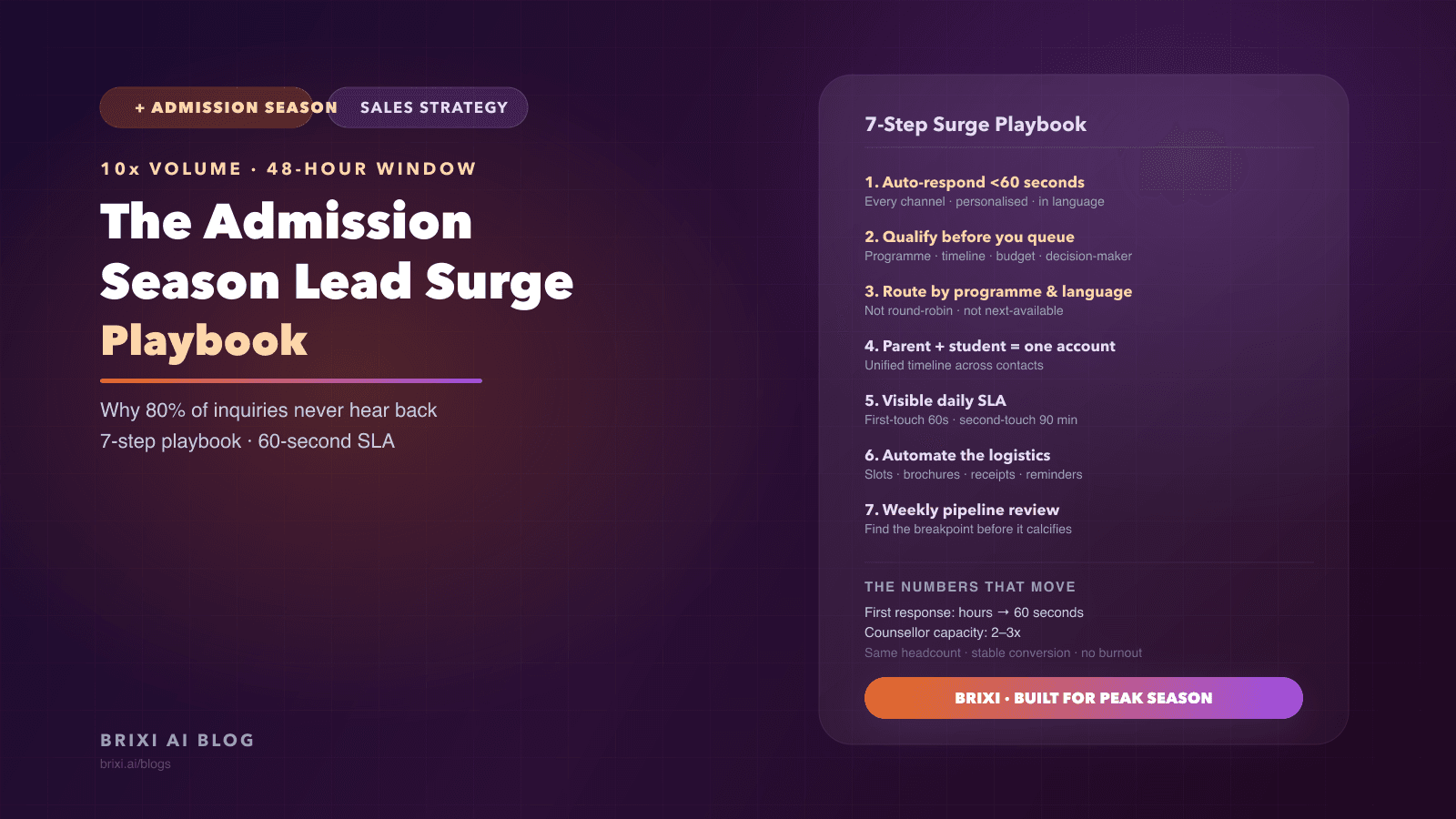
- Auto-respond within 60 seconds on every channel: the first response does not need to be a full counselling conversation. It needs to be a specific acknowledgement that names the applicant, references the programme they enquired about, and offers a concrete next step. An AI voice agent or WhatsApp automation layer can deliver this on every inquiry simultaneously, moving the median first-response time from hours to under a minute.
- Qualify before the counsellor ever sees the lead: a short automated exchange, covering programme interest, preparation stage, timeline, and broad budget, separates serious applicants from casual browsers. Counsellors should only see the top tier. Everything else moves into a nurture sequence that surfaces again when the signals change.
- Route by programme and language, not by availability: a counsellor who has spent three years in the JEE vertical will close a JEE inquiry faster than a generalist. A counsellor who speaks Tamil will warm a Chennai parent better than one who does not. Round-robin routing ignores both signals. Programme-aware, language-aware routing improves conversion without any additional training cost.
- Merge the family into one account: the CRM should consolidate every phone number, email, and WhatsApp thread associated with the same applicant. Every counsellor on every shift sees the full history, not just the messages their own number happened to receive.
- Automate every logistics task: brochure delivery, slot booking, fee receipts, document reminders, and batch information should all run on automation. A counsellor who is manually attaching PDFs and retyping fee structures in WhatsApp is a counsellor who is not talking to an applicant.
How do you run a visible SLA when the team is already overwhelmed?
The most common objection to SLA-based management during peak season is that tracking one more metric feels like more work. The counterintuitive reality is that two SLA numbers, reviewed daily, are the most effective course-correction tool an admissions head has.
First-touch SLA: 60 seconds across every channel. When this number slips, it is almost always a sign that the automation layer has a gap, usually a new form source that was not connected, or a WhatsApp number that was not routed. It is a systems problem, not a counsellor problem, and it is fixable in hours.
Second-touch SLA: 90 minutes for all qualified leads. This is the counsellor SLA, and it is achievable only if the first-touch layer has already done the qualification work. A counsellor calling a lead that has already confirmed programme interest, timeline, and approximate budget is making a focused conversation, not a cold qualification call.
Teams that instrument these two numbers and review them every morning can actually adjust mid-season. Teams that wait for the July retrospective are adjusting for next year.
The real contrast in admission season
One team sees 4,000 inquiries and works 12-hour days to chase them all. The other sees 4,000 inquiries, lets automation handle the first 48 hours of every conversation, and has counsellors spend their entire shift on pre-qualified, high-intent applicants who already want to talk. Both teams have the same headcount. One ends the season burned out with a flat conversion rate. The other ends it with a higher rate and a counsellor team that is not exhausted.
What changes after a full quarter with this structure in place?
In teams that implement the response layer before peak season begins, three numbers move in ways that are hard to dismiss.
Median first-response time drops to under two minutes across every channel, including WhatsApp, website forms, and inbound calls. This alone eliminates most of the early-funnel drop-off that happens when applicants submit to four institutes simultaneously and commit to whichever one responds first.
Effective counsellor capacity doubles or triples. When triage and qualification run on automation, a counsellor who was previously spending half their day sorting leads now spends the full day in conversations that have a real chance of converting. The output per counsellor rises sharply without any change in headcount or working hours.
Counsellor Debt stops compounding. Because serious inquiries get a substantive first response within minutes, they do not pile up as stale open leads. The CRM reflects real pipeline, not a graveyard of opportunities that quietly expired. Counsellors can work from a list they trust, which itself improves call quality.
The less obvious change is what happens to programme fit. When counsellors are not scrambling, they give better advice. A counsellor who has 12 focused conversations in a day will understand the applicant's actual situation better than one who has 40 rushed calls. Better advice produces higher enrolment and lower early dropout, which matters for the institute's renewal and referral economics.
What if the season has already started and the backlog already exists?
If Akash is reading this in the third week of May with 600 unanswered leads in the CRM, the answer is not to install the full system at once. One high-leverage intervention is available immediately: deploy a first-touch automation layer today. Every new inquiry from this point gets an instant, specific acknowledgement. The backlog does not grow faster than it can be cleared.
The second step, which can follow within a week, is basic qualification scoring on existing open leads. Run a simple re-engagement sequence to the backlog over 72 hours. Leads that respond are still in play. Leads that do not respond after two attempts can be moved to a long-nurture sequence without counsellor time. This clears the cognitive load of the fake pipeline without losing anyone who is genuinely still open.
Routing and SLA tracking come third, once the first two are stable. The goal is not perfection by June 1. It is a system that is better by June 15 and solid for next year.
The deeper bet: Akash's real competitive advantage is not the counsellors
Akash's Mumbai institute competes with at least six others targeting the same applicant pool. They all have roughly comparable programmes, comparable fee structures, and comparable counsellors. The differentiator is not talent or marketing spend. It is whether the system behind the counsellors is designed to handle non-linear demand without losing serious applicants in the chaos.
The institutes that outperform on enrolment without outspending on marketing have almost always solved the same problem: they respond faster, qualify better, and give counsellors a pipeline they can actually trust. Everything else, branding, programme design, scholarship structures, is secondary to whether the applicant had a good first conversation within 48 hours of showing interest.
Counsellor Debt is the silent tax on every admissions operation that has not solved this. It shows up as unexplained conversion rate drop, counsellor burnout, and the persistent feeling that the season should have gone better given the leads that came in. Eliminating it is not a technology project. It is a structural decision to redesign when automation stops and when humans start.
Ready to stop losing serious applicants in the first 48 hours?
Brixi Voice AI and WhatsApp automation help admissions teams respond to every inquiry instantly, qualify before counsellors are involved, and hold conversion rates stable when inquiry volume spikes 10x.
Book a DemoFrequently Asked Questions
By automating the first-touch response, the qualification exchange, and every logistics task such as brochure delivery, slot booking, and fee receipts. When automation handles those steps, counsellors spend their time only on pre-qualified, high-intent conversations. In deployments we see, effective counsellor capacity doubles without any headcount change.
Under 60 seconds is achievable on every channel when an AI voice agent or WhatsApp automation layer handles the first touch. A human-only team typically slips to six hours or more in peak season. That delay is the primary cause of early-funnel drop-off, because applicants filing forms at multiple institutes simultaneously commit to whichever one responds first with substance.
Delay in the first response, compounded by the absence of a qualification step. A parent filling admission forms in an evening is comparing responses in real time. If the first response arrives the next afternoon with no specific reference to the programme or the applicant's situation, the conversation has already been lost to a faster competitor. The fix is an automated first touch within 60 seconds, followed by a qualification exchange that gives counsellors real context before the first call.
They should not be tracked as separate leads. They should be merged into a single applicant account that consolidates every phone number, email, and WhatsApp thread associated with that enrolment decision. Every counsellor on every shift sees the full interaction history. Treating the parent and student as separate leads breaks conversation continuity and is a leading cause of the kind of contradictory communication that kills serious enrolments.