Parent or Student? Why Your Admission CRM Needs Two Different Conversation Tracks
Most admission CRMs treat every applicant inquiry the same way, regardless of who is actually on the call. But the parent and the student are buying different things, asking different questions, and converting on different signals. Treating them as one conversation is one of the quietest reasons admission funnels underperform.
Look at any admissions team’s CRM closely and you will find the same quiet anomaly. The applicant record has one phone number and one set of notes, but the WhatsApp thread shows four different writing styles, the call log shows two different voices, and the counsellor’s scribbled comment says "spoke to mother today, then father called back asking same questions." The CRM is treating one applicant as one conversation. The reality is that an admission decision is almost never a single-person decision in India, and the system is silently flattening multiple stakeholders into one record.
This matters because parents and students are not interchangeable. They are evaluating different things, responding to different signals, and converting on different next steps. A counsellor who pitches a parent the way they would pitch a student loses the call. A drip campaign written for a student that lands in a parent’s inbox feels off-key. The team that wins the admission is the one that recognises which conversation it is in and adjusts the entire interaction accordingly.
👨👩👦 One applicant, two buyers
In most Indian admission decisions, the student is the user and the parent is the buyer. They share the goal but have different anxieties, different evaluation criteria, and different decision triggers. A CRM that treats them as one record optimises for neither.
What Parents and Students Are Actually Asking
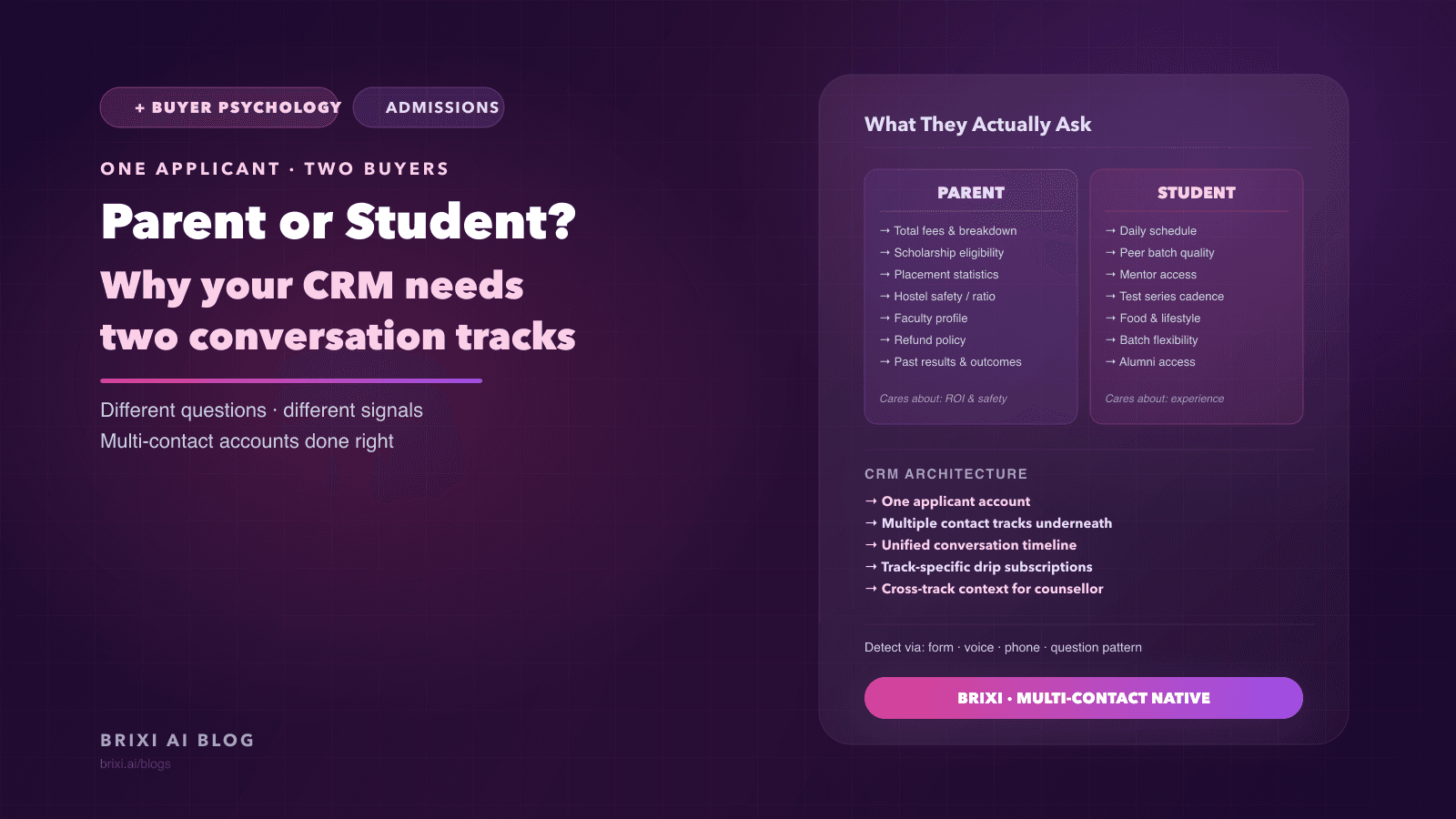
A useful exercise is to listen to fifty admission calls back-to-back and write down the questions in two columns: questions asked by parents, and questions asked by students. The two columns barely overlap.
What parents ask
- What is the total fee, and what is the breakdown?
- What scholarships are available and what is the eligibility?
- What are the placement statistics, and what is the median package?
- How safe is the hostel? What is the gender ratio?
- What is the faculty profile? Are they full-time or visiting?
- What is the refund policy if my child decides to withdraw?
- What are the past results: how many students cleared the entrance last year?
What students ask
- What is the daily schedule like?
- How is the peer group? Will I find people preparing seriously?
- How much one-on-one mentor access do I get?
- What are the test series and how often are they conducted?
- How is the food, the lifestyle, the city?
- Can I switch batches if I find the pace too slow or too fast?
- Do you have alumni I can speak to?
These are different conversations. A counsellor who answers a student’s question about peer batches with a fee breakdown, or who answers a parent’s question about safety with the daily schedule, is missing the actual concern. And the WhatsApp drip that does the same thing in writing is even worse, because there is no way to recover from a tone-deaf message that has already been sent.
How to Detect Who Is on the Conversation
The first job of an admission CRM that handles parent and student tracks correctly is to know who is on the line. There are four reliable signals.
1. The form itself
Most admission inquiry forms ask whether the inquirer is the student or the parent. This is the cheapest, most reliable signal, and most teams collect it but never act on it. The first message that goes out should already be tailored to whoever filled the form.
2. The voice on the call
When Voice AI handles the first call, it can identify within the first thirty seconds whether the speaker is the student or a parent: through speech pattern, vocabulary, and direct questions. The conversation should branch from there. A good voice agent will also ask, naturally, whether the parent or the student is the right person to continue with for specific questions.
3. The phone number on the WhatsApp thread
When a different phone number messages from within the same household, the CRM should recognise it as a related contact on the same applicant account, not as a new lead. The thread should be tagged with "parent" or "student" based on context, and counsellor responses should adjust accordingly.
4. The questions being asked
Even without explicit identification, the questions themselves classify the speaker. A question about scholarships, fees, or placements is parent-shaped. A question about peer group or daily routine is student-shaped. The CRM should infer and tag accordingly.
Designing a CRM Around Two Tracks Without Splitting the Record
The trap most teams fall into is one of two extremes. Either they collapse parent and student into one record and lose the distinction, or they split them into two records and lose the connection. The right design is one applicant account with two contact tracks underneath it.
- One applicant account: a single record per applicant, with the programme of interest, the timeline, and the overall stage in the funnel.
- Multiple contact tracks underneath: parent contact, student contact, and any additional decision-maker (uncle, sibling, sponsor), each with their own phone number, language preference, and conversation history.
- Unified conversation timeline: every interaction across every contact rolls up into a single chronological view of the applicant, so the counsellor sees the full story.
- Track-specific drip subscriptions: parent contacts get the parent drip, student contacts get the student drip, even though both are tied to the same applicant account.
- Cross-track context: when the parent asks a question that the student answered in an earlier conversation, the counsellor sees both and can use it.
🧩 The architecture matters
Most off-the-shelf CRMs do not handle multi-contact applicant accounts cleanly. Either they merge everything (losing context) or they split everything (losing continuity). An admissions CRM has to be designed around the multi-stakeholder reality of an admission decision from day one. Bolting it on later breaks something else.
Counsellor Behaviour That Changes With Two-Track Routing
When the CRM correctly identifies who the counsellor is talking to, the conversation itself changes in three ways.
Vocabulary
A counsellor speaking to a parent uses different words than one speaking to a student. "Career outcomes" instead of "placement." "Fee structure" instead of "course price." "Safety and supervision" instead of "campus life." The vocabulary signals understanding of the audience.
Pacing
Parent calls tend to be longer, more methodical, and need more time to address layered concerns. Student calls move faster and respond to enthusiasm. A counsellor who paces both the same way will feel rushed to a parent and lecturing to a student.
Next-step framing
The right next step is different too. A parent often needs a follow-up call after they have discussed with the spouse. Pushing for an immediate decision is counterproductive. A student often needs a peer-conversation introduction or a campus video, not a fee discussion.
A Concrete Scenario: The Late-Stage Father Call
Consider a situation that plays out dozens of times each admission season at any mid-sized coaching institute. The student fills the inquiry form in January, exchanges WhatsApp messages with a counsellor over three weeks, attends an online orientation, and is essentially sold. Then, in the first week of February, a new number calls in. It is the father. He has just seen the fee invoice for the first time and has three sharp questions: why is the hostel fee billed separately, what is the refund policy if his child switches institutes after one month, and what is the batch strength for the target exam.
In a CRM without two-track routing, this call registers as a fresh inquiry. The counsellor who picks up has no context. They ask for the student’s name, search for the record, and then read from notes written in student-facing language. The father notices the hesitation. The questions get answered eventually, but the experience communicates that the institute does not have its act together on the back end. Two of those three questions were already covered in earlier conversations with the student, which the counsellor cannot see because the father’s number is treated as an unrelated lead.
In a CRM with proper two-track routing, the incoming number is matched to the existing applicant account within seconds. The counsellor’s screen shows the full timeline: student conversations, stage in the funnel, and a note that a parent contact has not yet been engaged. The counsellor greets the father by name, references the fact that the student attended the orientation last week, and immediately pivots to the parent-track vocabulary: fee structure, refund terms, batch outcomes. The call takes twelve minutes instead of twenty-five and ends with the father saying he will confirm by Friday. That Friday confirmation rate is what moves the conversion number.
📞 The anti-pattern: The Amnesiac CRM
The most damaging pattern in admission CRM design is what might be called the Amnesiac CRM. Every new contact on an existing applicant gets treated as a new lead, forcing the family to re-identify themselves and forcing the counsellor to reconstruct context from scratch. Families notice this. It signals disorganisation at precisely the moment they are deciding whether to trust the institute with their child’s preparation.
Common Failure Patterns Worth Catching Early
Some of the most common mistakes admissions teams make in handling parent-and-student conversations are easy to spot once you look for them.
- Calling the student when the parent filled the form: the student is not ready to discuss fees and timelines yet.
- Sending the parent a "career launch story" video that was written for students: the framing is wrong.
- Repeating qualification questions every time a different family member calls: destroys the sense that the institute is paying attention.
- Asking the parent for documents the student already uploaded: basic CRM discipline, but constantly missed.
- Booking a counselling slot without confirming who will attend: leads to no-shows when the wrong family member shows up.
What Changes After a Quarter of Two-Track Routing
Teams that implement proper parent-and-student routing and run it consistently for a full admission quarter tend to notice a pattern that does not show up in the first few weeks. Counsellors stop dreading the second family call. In the old model, a parent calling in at week four of the funnel was a signal of stalled progress, often meaning the student had cooled off or the family had started comparing elsewhere. With two-track routing, the second family call becomes a predictable and manageable step in the process. The counsellor has context, the parent gets substantive answers immediately, and the call moves the applicant forward rather than resetting the clock.
The downstream effect is visible in the data. Applicants where both a parent contact and a student contact have been engaged convert at a meaningfully higher rate than applicants where only one side has been touched. The gap is not surprising once you understand the mechanics: most Indian admission decisions require buy-in from both sides, and a funnel that only works one side of that equation is structurally incomplete.
Where Two-Track Routing Moves the Numbers
In admissions teams that have implemented proper parent-and-student conversation routing, the most visible improvements show up in two places. Counsellor call satisfaction scores go up, because every call addresses the actual concerns of the person on the line. And the time from first inquiry to fee payment shortens, because the right next step lands at the right moment for the right decision-maker. The combined effect is a meaningfully higher conversion rate from the same inquiry pool.
Treat parents and students as the different decision-makers they are
Brixi’s admissions CRM handles multi-contact applicant accounts natively: separate parent and student tracks, unified timeline, and behaviour-driven routing across Voice AI, WhatsApp, and counsellor calls.
Book a DemoFrequently Asked Questions
Because they are evaluating different things and respond to different messaging. Parents focus on fees, placements, and safety; students focus on peer group, mentor access, and lifestyle. A CRM that treats them as one record sends the wrong message to at least one of them.
No. They should be separate contacts under one applicant account. This preserves the connection between them while keeping their conversation history, language preference, and drip subscriptions distinct.
Through the form-fill data, the voice on the call (Voice AI can identify this in the first thirty seconds), the phone number used, and the questions asked. The combination of these signals is highly reliable.
Generally yes. Continuity matters in admissions decisions. But the counsellor should consciously adjust vocabulary, pacing, and next-step framing depending on who is on the line.
Yes, and they should be. Parent drips emphasise placements, ROI, faculty credentials, and safety. Student drips emphasise peer experience, mentor access, exam strategy, and lifestyle. The two drips run in parallel against the same applicant account.
The CRM should support arbitrary additional contacts under the applicant account, each with their own track. In many Indian admission decisions a third contact appears late in the cycle, and the team that recognises and engages them appropriately closes faster.