WhatsApp CRM for Dental Clinics: The Recall Revenue You Are Not Collecting
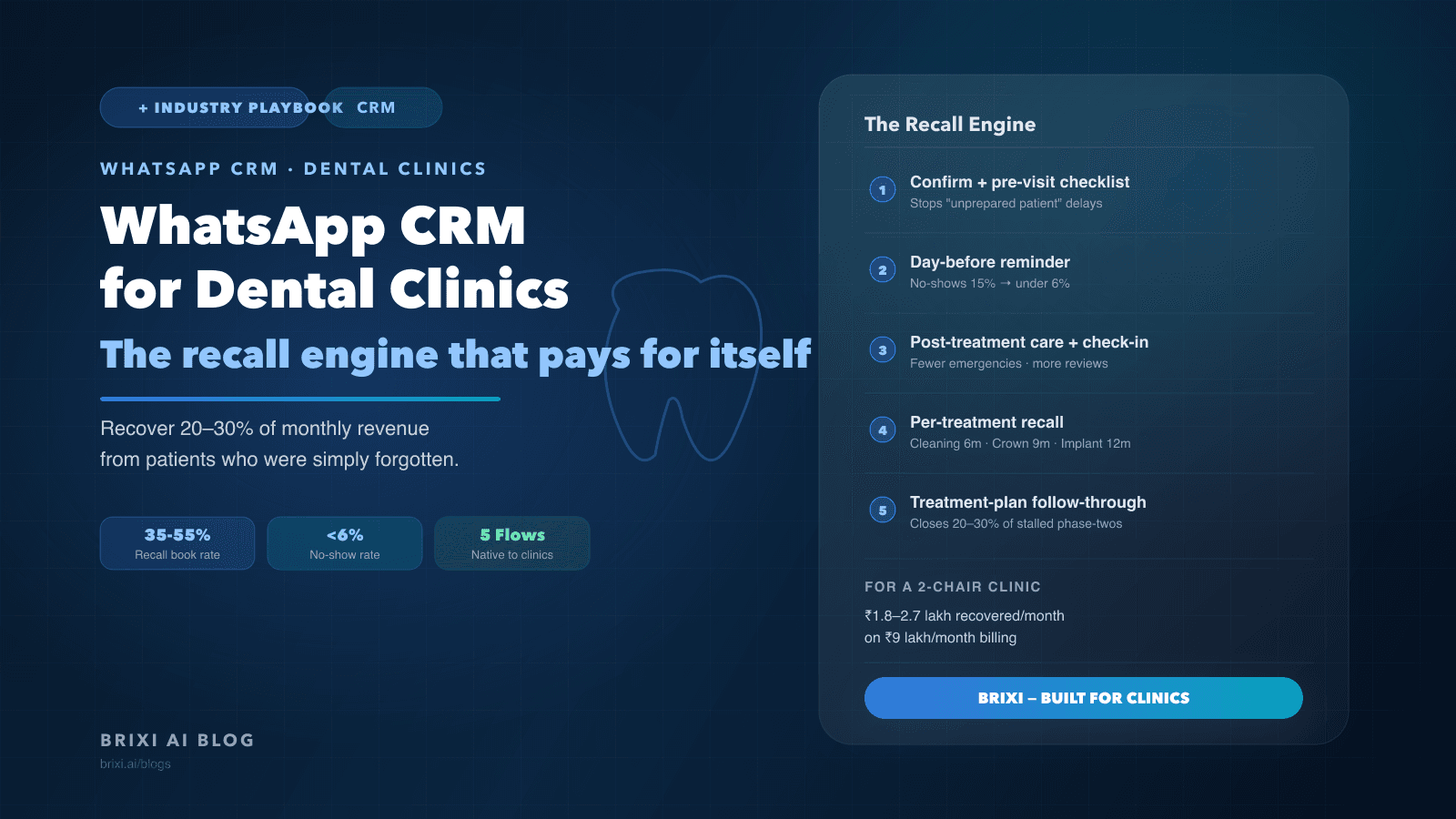
Most dental practices do not lose patients because the care is bad. They lose patients because nobody sends the recall message six months later. A WhatsApp CRM with per-treatment recall and treatment-plan tracking closes this leak quietly, recovering revenue that was already yours.
Hardik runs a two-chair dental clinic in Vadodara. He and his associate see about sixty patients a week, which at his case mix comes to roughly nine lakh rupees a month. His Google reviews are good. His chairside manner is excellent. His receptionist is competent. And yet, every single month, somewhere between one and a half and two lakh rupees in appointments that should have happened simply do not. Not because patients went elsewhere. Because nobody sent the recall.
Dental practices have the most predictable retention math in the service economy. A cleaning patient should return in six months. A crown patient in nine to twelve. An orthodontic patient every four to six weeks. Every closed case is a dated, treatment-specific future booking waiting to be triggered. Hardik knows this. His patients know it vaguely. But knowing it and acting on it are separated by a single operational question: who sends the message, and when?
For most small clinics, the answer is nobody, because nobody has time. The receptionist is managing tomorrow's chair schedule. The doctor is running behind on today's cases. The result is a growing list of patients whose recall window opened quietly and closed just as quietly, taking three hundred to seven hundred rupees of average-per-appointment revenue with it, multiplied by every uncalled patient on the roster.
What Is the Recall Debt Trap and Why It Compounds?
The Recall Debt Trap is what happens when a clinic lets recall windows expire without follow-up. Month one, twenty patients pass their six-month cleaning date with no message sent. Month two, another twenty. By month six, the clinic has a hundred-plus patients whose window has passed and who now feel slightly awkward about booking because "it has been so long." Each month of inaction makes the eventual outreach harder and the conversion rate lower. The debt compounds.
The Recall Debt Trap is distinct from losing patients. These people still consider the clinic their dentist. They just have not been prompted. A single well-timed WhatsApp message from Dr. Hardik, addressed by name, referencing their last cleaning, with a one-tap booking link, converts at rates email never will. WhatsApp messages in India are read within minutes. Email recall runs at five to ten percent open rates. A personalized WhatsApp recall from a named doctor typically books thirty-five to fifty-five percent of contacted patients within two weeks.
Why Is WhatsApp the Right Channel for Dental Recall?
The channel matters as much as the timing. SMS recall produces lukewarm results because patients cannot respond directly, and a phone number from a clinic looks indistinguishable from a spam bank alert. Email recall fails because the patient's inbox is cluttered and healthcare email open rates in India are low. Phone calls from the clinic number get ignored because nobody picks up from unknown numbers anymore.
WhatsApp works because it is the channel patients already use for personal and semi-professional communication. A message from "Hardik Dental, Dr. Sharma" lands in the same interface as messages from family. When it says "Hi Meera, it has been six months since your cleaning with Dr. Sharma. Ready to book your next one?" and includes a button that opens a booking flow, the friction is near zero. The patient does not need to find the number, dial, wait, explain who they are, and check calendars over voice. They tap once.
What Makes Dental Recall Different From a Generic Reminder?
This is the distinction most cheap tools miss entirely. A reminder requires an appointment to already exist. It says: "You have an appointment tomorrow at 3pm." Recall creates an appointment that would otherwise not happen. It says: "Based on your last visit, it is time for your next one. Here is how to book." Conflating the two is the reason most clinics that "tried a WhatsApp tool" report that it did not recover any revenue. The tool was a reminder engine pretending to be a recall engine.
A proper recall engine needs four inputs for each closed case: the treatment type (cleaning, scaling, crown check, ortho adjustment, root canal follow-up, implant review), the prescribed recall window (six months, nine months, four weeks, eight weeks), the responsible doctor, and a re-attempt cadence for patients who do not respond to the first message. A CRM that captures all four and fires messages automatically is categorically different from one that lets the receptionist set manual reminders in a calendar.
Which Five Workflows Should Every Dental Clinic Turn On First?
Workflow one: Booking confirmation with pre-visit instructions
On booking confirmation, the CRM sends a WhatsApp message with appointment details plus any treatment-specific pre-visit notes. Fasting instructions before extractions. Medication hold notes for implant patients. Consent form links for new cosmetic cases. This single workflow cuts "patient arrived unprepared" delays, which in a two-chair clinic waste fifteen to thirty minutes of chair time per week.
Workflow two: Day-before reminder with one-tap reschedule
The evening before the appointment, the patient receives a reminder with a button to confirm or reschedule. If the patient reschedules, the slot releases automatically and the CRM notifies the front desk. Without this workflow, dental no-shows in Indian urban practices average twelve to eighteen percent. With it, four to seven percent. For a sixty-appointment week, that is four to eight recovered chair slots per week.
Workflow three: Post-treatment care and 48-hour check-in
After extractions, root canals, crown preps, and implant placements, care instructions go out automatically within an hour of the appointment ending. Forty-eight hours later, a check-in message asks: "Any discomfort since the procedure?" Patients who reply with a concern are routed to the doctor. Patients who don't reply receive a thank-you and a Google review request. This workflow reduces emergency re-visits and compounds the clinic's review count over time.
Workflow four: Per-treatment recall as the primary revenue engine
The CRM logs every closed case with treatment type, date, and responsible doctor. Six months after a cleaning, the patient receives a recall message from their specific doctor by name. Nine months after a crown, the recall references the procedure. The message includes a one-tap booking link that opens into the doctor's available slots. Practices running this workflow report thirty-five to fifty-five percent of recalled patients booking within two weeks. This is the workflow that directly attacks the Recall Debt Trap.
Workflow five: Treatment plan phase-completion nudge
Multi-visit treatment plans are the second-largest revenue leak in most dental practices. A patient agrees to a four-visit implant sequence, completes phase one, and disappears. The CRM tracks the plan and sends WhatsApp nudges at the prescribed intervals for each remaining phase. Clinics running this report closing twenty to thirty percent of previously abandoned treatment plans, revenue that was consented to and simply fell through because nobody followed up.
What Does the Pricing Math Look Like for a Two-Chair Practice?
Consider the same two-chair clinic as Hardik: sixty appointments a week, nine lakh rupees a month in billing, one receptionist, two doctors.
Generic SMS reminder tool at roughly two thousand rupees a month
Twenty-four thousand rupees a year in direct cost. Handles appointment reminders adequately. No recall engine. No treatment-plan tracking. No per-doctor ownership. The Recall Debt Trap continues to compound, costing the clinic one and a half to two and a half lakh rupees monthly in uncollected recall revenue.
Generic WhatsApp CRM at ten thousand rupees a month
One lakh twenty thousand rupees a year plus substantial admin time to build per-treatment recall windows, configure healthcare-appropriate templates manually, and maintain doctor-to-patient mappings. Reminders and review requests work well. Recall is partial because treatment-specific logic requires custom configuration that a receptionist should not be building from scratch.
Healthcare-native WhatsApp CRM at eighteen to twenty-five thousand a month
Two lakh forty thousand to three lakh rupees a year in direct cost. Recall is native and requires zero configuration beyond importing the patient list and treatment log. Templates are pre-approved for healthcare use. Per-doctor recall is the default. Typical monthly recovery on a nine-lakh-a-month practice is one and a half to two and a half lakh rupees, meaning the tool pays back its annual cost in the first six to eight weeks, and continues doing so every month after.
What Compliance Checks Must a Dental Clinic Run Before Adopting a Tool?
Healthcare messaging has specific requirements. Choosing the wrong tool exposes the clinic to a banned WhatsApp number, failed template delivery, or patient complaints. Before signing up for any WhatsApp CRM, a clinic should confirm the following.
- The tool uses the official WhatsApp Business API, not an unofficial third-party API that operates in violation of WhatsApp policy and can result in a permanent ban of the clinic's number.
- Healthcare message templates are pre-approved in the tool's library. Building approvals from scratch takes weeks and introduces compliance gaps.
- Patient opt-in is captured at the time of booking and stored in the CRM with a timestamp. Sending recall to patients who never opted in is a policy violation.
- The 24-hour session window rule is respected. Recall messages must go out as approved template messages, not free-form session messages, because they are initiated by the clinic rather than the patient.
- Patient data is stored in compliant infrastructure with audit logs. The practice owner should be able to pull a full history of every message sent to any patient.
- Role-based access ensures receptionists can see scheduling and confirmations but cannot access clinical notes or full treatment histories that belong to the doctor's record.
The anti-pattern that burns clinic numbers
Several low-cost WhatsApp tools used by clinics in 2024 and 2025 operated on unofficial APIs. Clinics using these had their business numbers permanently flagged by WhatsApp after patient reports or automated abuse detection. Recovering a banned number can take months and requires starting fresh with a new number, losing all patient message history.
Where Do Cheap Clinic Tools Quietly Fail?
- Recall is implemented as a bulk broadcast, so patients who receive the same message as fifty others feel spammed and mute or report the clinic number.
- No treatment-specific recall windows, so a patient who had an implant gets the same six-month cleaning message as a patient who had a routine scaling.
- No per-doctor ownership, so the recall comes from "Best Dental Clinic" rather than "Dr. Sharma." Response rates roughly halve when patients cannot connect the message to a specific person they trust.
- No treatment-plan phase tracking, so the second and third visits of a multi-appointment case quietly disappear from the system after phase one.
- Templates not approved for healthcare, causing recall messages to fail silently at delivery without any alert to the clinic.
- No audit trail, so when a patient calls to complain they received the wrong information, the owner cannot verify what was actually sent or when.
How Should a Clinic Roll This Out in Thirty Days?
- Week one: migrate the clinic's WhatsApp number to the CRM, import the patient list with last visit date, treatment type, and responsible doctor, and verify all historical records are tagged correctly.
- Week two: activate appointment confirmations and day-before reminders. No-shows typically drop measurably within the first five working days.
- Week three: configure per-treatment recall windows using the native templates and activate the recall engine. The first outbound recall batch usually generates twenty to forty bookings within seven days.
- Week four: enable post-treatment follow-up workflows and treatment-plan phase nudges. Review month-one revenue numbers against the prior month and measure recall response rate.
What Changes After a Quarter of Running This System?
At ninety days, the clinic's operational rhythm has shifted in ways that go beyond the revenue numbers. The receptionist no longer spends thirty minutes a day manually typing reminder messages. The doctor no longer gets surprised by patients who show up having misunderstood pre-procedure instructions. The practice owner has a dashboard showing recall response rates, no-show percentages, and treatment plan completion rates for the first time.
More importantly, the Recall Debt Trap has been broken. New patients joining the system are enrolled in their recall schedule at the point of treatment, so the compounding debt stops. Older patients who were in the debt pile have been systematically contacted, and the ones who were going to rebook have rebooked. The ones who don't respond after three attempts are flagged for a different approach, either a phone call or a longer dormancy reactivation sequence.
Clinics also report a secondary benefit that surprises them: Google reviews increase substantially within sixty to ninety days. Post-treatment follow-up messages that ask "anything unclear?" and then funnel satisfied patients toward a review link compound at scale. A practice doing sixty appointments a week, with a forty percent response rate on post-treatment check-ins, is generating twenty-four potential review moments weekly. Even a twenty percent conversion to an actual review is five new Google reviews per week.
What Does Hardik's Clinic Look Like After Three Months?
Hardik ran the numbers at the ninety-day mark. His no-show rate had dropped from sixteen percent to just under six. His recall engine had processed four hundred and twelve patients in the first two months and converted one hundred and sixty-three of them into booked appointments, a thirty-nine percent conversion rate. His treatment plan completion on multi-visit cases was up twenty-two percent compared to the prior quarter.
The month three billing came to eleven lakh forty thousand rupees, against his nine lakh average. He had not acquired a single new patient to account for the difference. Every rupee of the increase came from the patient list he already had, through recall appointments his practice had been failing to capture for years. His receptionist had fewer interruptions per day because patients were self-managing reschedules through the CRM rather than calling the front desk.
The contrarian truth of this outcome is that Hardik did not need better marketing, a new location, or a second hygienist to grow by twenty-seven percent. He needed a system that did the follow-up work that already should have been happening. That is the actual value proposition of a WhatsApp CRM for a dental clinic: not acquiring more patients, but collecting the revenue the existing patients were already willing to spend.
Ready to close the Recall Debt Trap at your clinic?
Brixi models per-treatment recall windows, doctor ownership, and multi-visit treatment plans natively. Healthcare-compliant templates are included. Setup takes under a week.
Book a DemoFrequently Asked Questions
A dental clinic needs a WhatsApp CRM that supports per-treatment recall windows, per-doctor message ownership, and pre-approved healthcare templates. Generic broadcast tools will not recover recall revenue because they lack treatment-specific logic. Look for a tool built on the official WhatsApp Business API with native recall scheduling rather than one requiring manual reminder setup.
A day-before WhatsApp reminder with a one-tap reschedule button is the single highest-impact intervention. When patients can reschedule in two taps rather than calling the clinic during working hours, no-show rates in Indian dental practices typically fall from twelve to eighteen percent down to four to seven percent. The slot releases automatically, so the chair fills with a different patient rather than sitting empty.
Yes, when the tool uses the official WhatsApp Business API, sends recall as approved template messages rather than free-form session messages, and has captured opt-in from the patient at booking. Avoid unofficial API tools: they expose the clinic number to permanent bans and do not maintain the audit trails that a healthcare practice needs.
The CRM records the treatment plan at phase one: phases two, three, and four with their prescribed intervals. At each interval, the system automatically sends a WhatsApp nudge referencing the specific procedure and phase. Patients who completed phase one and dropped off receive a contextual reminder rather than a generic clinic message, and conversion on these re-engagement messages is substantially higher than cold outreach.