Voice AI vs Telecalling Teams: The Real Cost Breakdown
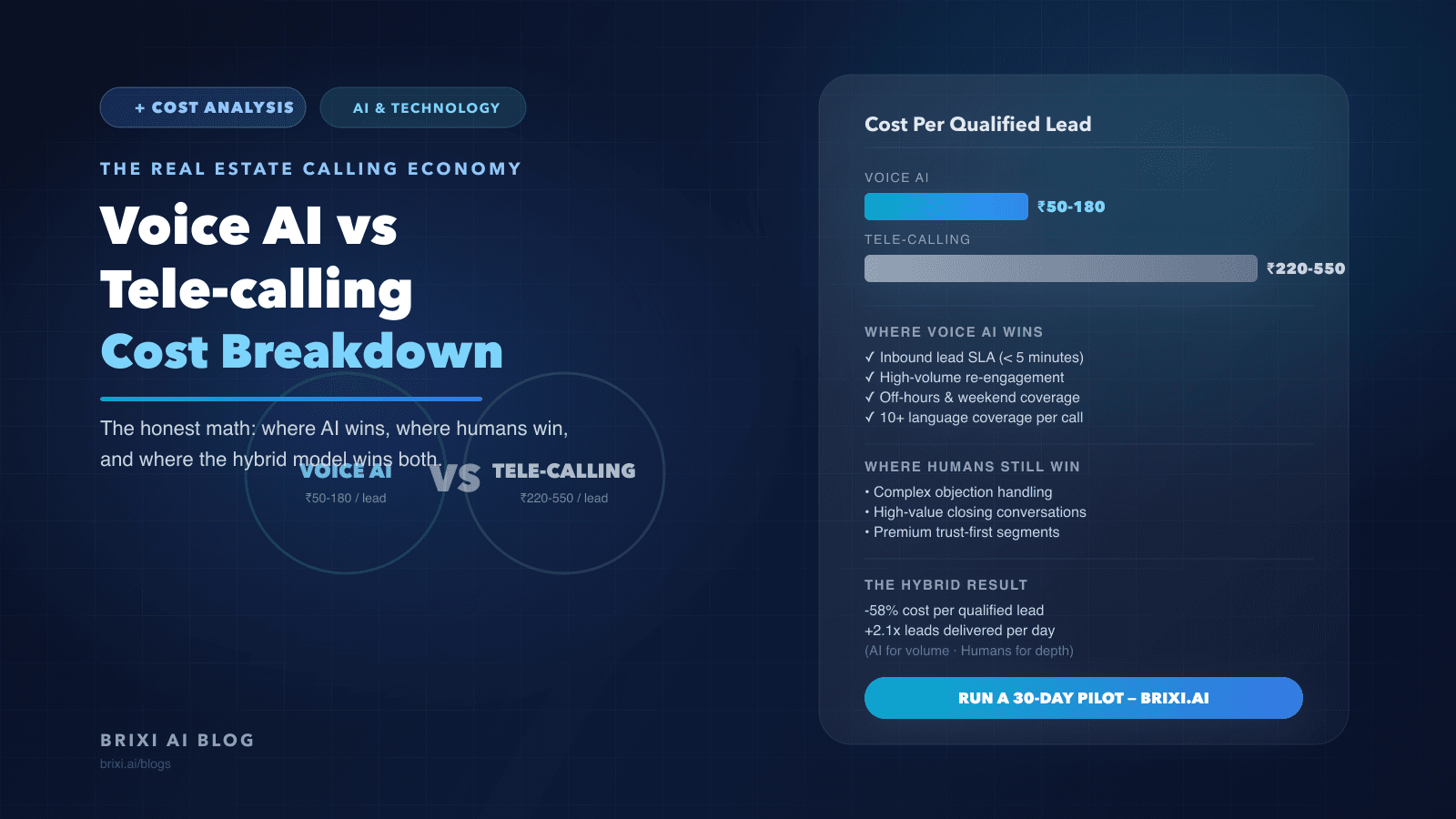
At what point does Voice AI outperform a human telecalling bench on cost per qualified lead? This is the honest math for Indian real estate and sales teams in 2026: where AI wins, where humans still win, and why the answer almost never sits fully on one side.
Gunjan runs the inside-sales floor for a mid-sized developer in Thane. In January 2026, she had 18 telecallers, a ₹9 lakh monthly payroll, and a database of 24,000 dormant leads from two previous launches. Her general manager asked a pointed question at the quarter kick-off: "We have the list, we have a new tower to announce. How many of those 24,000 people will your team actually reach in the first two weeks?" Gunjan did the honest arithmetic. At 60 connects per rep per day, five days a week, across 18 reps, the answer was roughly 10,800 connects. Not 24,000. Not in two weeks. Closer to four weeks, assuming no attrition, no holidays, and zero idle time.
That arithmetic is the real starting point for any honest Voice AI versus telecalling conversation. The debate is not about whether humans are better at relationships. They are. The debate is about whether a human-only calling bench can physically execute the volume, speed, and consistency that a modern real estate sales operation demands. In most mid-size to large teams, it cannot.
This post lays out the full cost-performance comparison between Voice AI and telecalling teams across the use cases where each genuinely wins. It introduces the concept of the Qualification Throughput Ceiling: the structural ceiling on how many qualified conversations a fixed headcount can produce in a given window, and why that ceiling is the hidden driver of most cost-per-lead problems. The goal is not to sell you on replacing your team. It is to help you see clearly where the ceiling sits and what to do about it.
What does it actually cost to run a telecalling bench in 2026?
Most sales managers undercount the true cost of a telecalling operation because they look at salary and stop there. The fully loaded cost of a telecalling agent in a tier-1 Indian metro in 2026 includes salary, variable pay, PF and ESI contributions, workstation, telephony (SIM or VoIP), CRM seat, team lead supervision time, onboarding training, and attrition cost. A rep who leaves after five months takes two weeks of onboarding cost and several weeks of ramp time with them.
- Fully loaded monthly cost per agent: ₹42,000 to ₹58,000 in tier-1 metros.
- Productive calling hours per 9-hour shift: roughly 5 to 6 hours after breaks, data prep, and CRM updates.
- Calls attempted per productive hour: 25 to 35 depending on dialer setup and list quality.
- Connect rate on a typical portal or ad lead list: 25 to 40 percent.
- Connects resulting in a qualified conversation: 15 to 25 percent of connects, depending on script discipline.
- Qualified leads produced per rep per day: 4 to 10.
- Blended cost per qualified lead: ₹220 to ₹560 across the teams we have measured.
These numbers look fine until you hit the Qualification Throughput Ceiling. The ceiling appears when your campaign needs more qualified conversations than your headcount can physically produce in the available time window. A new project launch with a 10-day pre-sales window, a WhatsApp campaign that generated 3,000 fresh leads over a weekend, or a re-engagement push on 20,000 leads before a price revision: each of these scenarios runs into the ceiling hard. Surge capacity is either expensive or unavailable, and the leads that do not get called in time cool off.
What does Voice AI actually cost at comparable volume?
Voice AI pricing is usage-based. You pay for call minutes and, in some platforms, per successful connect. There are no seat fees, no shift constraints, no attrition cost, and no productive-hour dilution because the system does not have unproductive hours. It dials when there are leads to dial.
- Typical first-pass qualification call duration: 90 to 180 seconds on a genuinely connected and responsive lead.
- Cost per connected minute on Indian volumes: ₹4 to ₹12 depending on provider, language, and concurrency tier.
- Cost per qualified lead at this rate: ₹50 to ₹190 in real-world deployments.
- Surge capacity: effectively uncapped. Parallel dials can scale to thousands of concurrent calls within minutes.
- Coverage hours: 24 hours, 7 days a week, including public holidays.
- Script consistency: identical across call one and call 50,000.
The cost gap is not incremental. It is 3x to 5x on first-pass qualification for the right use cases. That is the number that is forcing the debate open in every serious sales operations review this year.
The contrarian point worth making here: the 3x to 5x cost advantage disappears if the Voice AI is deployed on the wrong use cases. A system running complex objection conversations it is not ready for, or calling a list that has never been cleaned, or operating without a structured qualification script will produce qualified leads at a worse cost than a well-run telecalling bench. The economics are real, but they are not automatic.
Where does Voice AI win clearly?
First-pass inbound qualification inside the five-minute SLA
Meta and Google leads degrade fast. A lead contacted within five minutes of form submission converts at a meaningfully higher rate than one contacted two hours later. A human bench cannot guarantee a five-minute response at peak-volume hours. Voice AI can. Every inbound lead gets a real conversation within seconds, at any time of day, whether it is the third lead of the morning or the two-hundredth lead of the afternoon.
Large-scale re-engagement campaigns against dormant databases
This is exactly where Gunjan hit her ceiling. Calling 24,000 leads in two weeks is not a headcount problem with a headcount solution. Hiring six temporary callers to cover the gap costs money, takes days to arrange, and produces inconsistent conversations. Voice AI covers the full list in two to three days and returns structured data on each conversation: interest level, budget range, timeline, reason for no-connect, and a scoring flag for human follow-up.
Off-hours and weekend lead coverage
Real estate buyers inquire at 11pm. They browse inventory on Sunday afternoons. A rep is not at their desk. Leaving those leads to cool until Monday morning is a measurable revenue leak. Voice AI covers the overnight and weekend windows without overtime costs or shift scheduling friction, which eliminates first-contact delay for a significant segment of leads.
Multi-language campaigns across regional markets
A team selling projects in Mumbai, Bangalore, Hyderabad, and Ahmedabad cannot staff a Marathi, Kannada, Telugu, and Gujarati caller in every shift, especially not for surge campaigns. Voice AI handles all four languages and more within a single campaign, with automatic language detection at the start of the call. The qualification script adapts in real time without routing delays.
Where do human callers still win?
Complex objection handling mid-funnel
A buyer who is genuinely interested but comparing three projects, pushing back on a floor premium, or asking detailed questions about construction timelines and RERA registration needs a human in the conversation. Voice AI is improving here, but it is not the right tool for a buyer who is three objections deep and testing whether the rep actually knows the product.
High-value closing conversations
A ₹1.2 crore apartment decision does not close on an AI call in 2026. It closes when a relationship has been built across multiple conversations, the rep understands the buyer's family situation, and the buyer trusts that the person on the other side is accountable for what they are promising. That trust transfer does not happen the same way through Voice AI, at least not yet.
Referral and broker relationship management
Calling a known channel partner or a referred buyer who already has a relationship with your brand needs a human who can carry context and nuance. A Voice AI system that treats a top broker's referral the same as a cold portal lead is making a relationship mistake that costs more than the call savings.
What is the Qualification Throughput Ceiling and how do you break it?
The Qualification Throughput Ceiling is the maximum number of qualified conversations your calling operation can produce in a fixed time window given its current headcount, dialer setup, and productive-hour constraints. Every team has one. Most teams discover it during a project launch or a large-volume campaign when the lead list grows faster than the bench can handle.
The standard response to hitting the ceiling is to hire more callers. This works slowly, costs immediately, and creates an attrition problem six months later when the campaign volume normalizes and you have excess headcount. The better response is to redesign the operation so that the ceiling sits at a much higher volume than your current headcount could ever support.
The design that breaks the ceiling: Voice AI handles Layer 1, the high-volume first-pass qualification, re-engagement campaigns, inbound speed-to-lead, and off-hours coverage. A smaller, better-paid human bench handles Layer 2, the objection conversations, site visit pitches, and closing calls. Sales managers handle Layer 3, pipeline strategy, escalation triage, and campaign design informed by the structured data the AI captures.
- Layer 1, Voice AI: first-touch qualification, dormant list re-engagement, inbound SLA coverage, off-hours leads, multi-language campaigns.
- Layer 2, human closers: objection handling, site visit scheduling, pre-booking conversations, deal negotiation, referral and broker calls.
- Layer 3, sales managers: pipeline review, escalation triage, campaign design, data analysis from AI-captured conversation transcripts.
Teams that redeploy their telecallers from first-pass qualification into closing roles consistently report that overall sales productivity improves. The reps get better, higher-value conversations. The rep who was spending 60 percent of their day calling cold leads is now spending that time on leads the AI has already qualified and scored. Conversion rates from call to site visit tend to move up.
Why compliance and script consistency matter more than teams think
The cost comparison gets most of the attention. The compliance comparison deserves equal weight. Voice AI runs an identical script on every call. Every conversation is recorded and transcribed. Every regulatory disclosure is delivered exactly as written, on every call, without the rep rushing the end of the call to beat a target. Every DND check fires before the dial.
Human telecalling benches are variable by nature. Scripts drift over the course of a shift. Disclosures get compressed when a caller is behind on their daily target. Recordings exist but are reviewed on a tiny fraction of calls, usually only when a complaint is filed. For teams operating under RERA disclosure requirements, or selling in markets with active regulatory scrutiny, the consistency of AI-led qualification is a real operational asset, not just a cost line.
The anti-pattern most teams miss
Deploying Voice AI and then not reviewing the transcripts is one of the most common ways to lose the quality advantage. The AI captures structured data on every call: objection types, interest signals, language preferences, reasons for disqualification. Teams that do not analyze this data are treating Voice AI as a cheap dialer instead of as a conversation intelligence system. The cost savings are real either way, but the strategic advantage only accrues to teams that actually use the data.
When is Voice AI not the right fit?
Voice AI is not the right choice in every situation. Being honest about the failure modes is more useful than overselling the category.
- Very low call volumes, under roughly 400 to 500 dials per month: setup and integration overhead rarely pays back at this scale.
- Markets where mobile signal quality is unreliable and latency regularly exceeds two seconds: the conversation experience degrades in ways that hurt brand perception.
- Highly custom conversations that resist a structured qualification flow, for example, a bespoke villa product with entirely negotiated terms on every unit.
- Teams that have not documented a qualification script: the AI has no framework to run and cannot be configured correctly.
- Sales leadership that deploys the AI and never reviews outcomes, transcripts, or escalation patterns: the system improves only if someone is learning from it.
How do you run a 30-day pilot without disrupting the existing team?
The cleanest way to make a genuine AI-versus-human decision is a controlled pilot on a single campaign. Pick either a re-engagement list or one specific lead source, and run Voice AI in parallel with the existing bench for 30 days. Measure three numbers at the end.
- Cost per qualified lead from each channel.
- Connect rate on first attempt from each channel.
- Conversion rate from qualified lead to scheduled site visit from each channel.
Thirty days gives you enough volume to see real signal without committing the full operation. If the Voice AI channel produces qualified leads at 3x to 5x lower cost with parity or better site-visit conversion, you have a clear mandate to expand. If it does not, the data will show you exactly why: list quality, script gaps, language mismatch, or call-time distribution. You will have learned something real instead of relying on vendor case studies.
One operational note: run the pilot on a list that is genuinely comparable in quality to what the human bench receives. Giving the AI the worst-quality re-engagement list and the human bench the fresh inbound leads is a design flaw that produces meaningless results. Control for list source and lead age if you want numbers you can trust.
What changes after a quarter of running the hybrid model?
The first change most teams notice is that the cost-per-qualified-lead number falls quickly, often within the first month. The second change is less obvious: the human bench gets better, because the reps are now spending their time on conversations that actually require their skills.
After a full quarter, teams typically see three compounding effects. First, the AI has been running for long enough that its conversation data is generating patterns: which objection types correlate with eventual purchase, which lead sources produce genuine interest versus curiosity, which time windows produce the best connect rates on specific buyer segments. This data starts informing campaign design.
Second, the human closing team has been operating on pre-qualified leads for three months. Their site-visit conversion rates tend to improve because they are not spending energy on disqualified leads. Sales managers start recalibrating targets upward.
Third, the Qualification Throughput Ceiling has effectively been removed as a constraint. The team can absorb a 5,000-lead campaign surge or a weekend WhatsApp blast without scrambling for temporary callers or accepting that half the leads will cool off before being contacted.
Gunjan's quarter, three months later
Gunjan ran the pilot in February on her dormant database. She allocated 12,000 of the 24,000 leads to Voice AI and had the bench work the other 12,000 in parallel. At the end of three weeks, she had comparable connect rates, a cost per qualified lead of ₹140 on the AI channel versus ₹390 on the bench, and 11 site visits booked from the AI-qualified leads versus 14 from the bench-qualified leads on roughly equivalent volume.
The visit conversion gap was smaller than she expected. What convinced her general manager was not the cost number in isolation. It was the data the AI returned on the 8,000 leads that did not qualify: detailed tagging on reason for disqualification, budget mismatch flags, and a set of 600 leads flagged as "interest confirmed, timing not right for six months" that the bench would have closed and never re-engaged. Those 600 leads are now in an automated nurture sequence.
By April, Gunjan had moved 65 percent of her first-pass qualification to Voice AI, reduced her bench from 18 to 11 reps, and redeployed the strongest seven into a dedicated closing team focused on the mid-pipeline. Her cost per qualified lead dropped from ₹390 to ₹165. Her qualified leads per day went up because the AI was covering hours the bench never could. The Qualification Throughput Ceiling moved from roughly 600 qualified conversations per week to well over 2,000.
Ready to find your Qualification Throughput Ceiling?
Brixi Voice AI runs your qualification script alongside your existing bench on one campaign. You get full transcripts, structured lead scores, and a clear cost-per-qualified-lead comparison on your own data. No vendor case studies required.
Book a Pilot CallFrequently Asked Questions
For first-pass qualification and large-volume re-engagement campaigns, Voice AI typically produces qualified leads at 3x to 5x lower cost than a human telecalling bench. For complex objection handling and closing conversations, human callers are still stronger. Most teams end up with a hybrid model where AI handles volume qualification and humans handle depth and relationship conversations.
Modern Voice AI platforms with sub-second latency handle first-stage qualification in 30 or more languages, including Hindi, Marathi, Tamil, Telugu, Kannada, Gujarati, and Bengali. Automatic language detection at the start of the call means a single campaign can cover multiple regional markets without routing or staffing complexity.
In Indian real estate deployments, Voice AI has produced qualified leads at roughly ₹50 to ₹190 each, compared to ₹220 to ₹560 for a well-run human telecalling bench. The exact numbers depend on list quality, campaign design, language mix, and how tightly the qualification script is defined. A 30-day pilot on your own data is the most reliable way to get your specific numbers.
Run the pilot on a single campaign in parallel with your bench, using comparable list quality and lead age for both channels. Measure cost per qualified lead, first-attempt connect rate, and qualified-to-site-visit conversion over 30 days. This gives you clean comparative data without touching the rest of the operation. Avoid giving the AI the lowest-quality leads and the bench the freshest inbound leads, as that design flaw produces results that are not comparable.