The AI Admissions Desk: How Colleges Handle Peak-Season Follow-Up Without a Temporary BPO
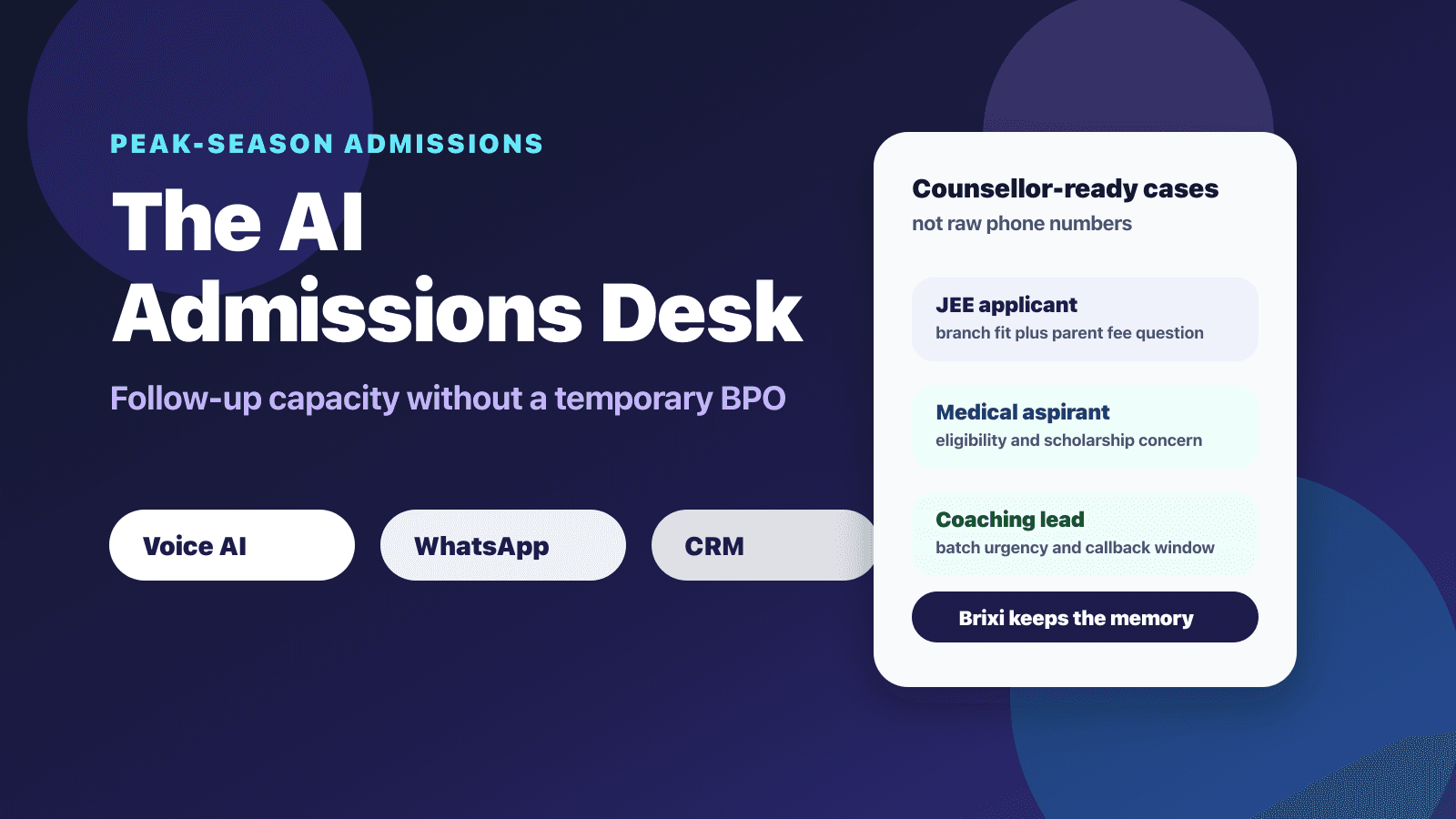
Admission season creates a 45-day capacity spike that many colleges try to solve with temporary callers. The better answer is an AI admissions desk that qualifies, reminds, routes, and keeps counsellors focused on serious student and parent decisions.
Every June, the admissions head at a large institute faces the same uncomfortable calculation. The permanent counselling team can handle the normal year. It cannot handle the 45-day rush after exam results, counselling rounds, scholarship deadlines, and seat-blocking pressure. So the institute hires a temporary calling team, shares a script, opens a few extra phone lines, and hopes the surge will pass before the damage becomes visible.
From the counselling floor, that solution never feels as clean as it looks in the budget sheet. Temporary callers can dial numbers. They cannot easily explain branch trade-offs, medical course eligibility, hostel anxiety, scholarship nuance, parent objections, or why one student with a certain rank should take a different path from another. The caller may complete the attempt. The counselling problem remains unsolved.
Call this the Short-Term BPO Trap: the belief that a seasonal counselling spike can be solved by renting extra calling capacity for a few weeks. The trap is that admission season does not only require more calls. It requires consistent first-touch qualification, accurate reminders, contextual routing, and a memory of every student and parent conversation. That is what an AI admissions desk is built to provide.
Why temporary BPOs struggle with admission counselling
A BPO model works best when the work is stable, scripted, and repeatable. Admission counselling during JEE and NEET season is none of those things. The script changes by course, score range, batch availability, fee structure, scholarship policy, location, parent concern, and deadline. A caller who has been trained for three days is expected to sound credible to a parent making a high-stakes decision about their child.
This creates four hidden costs. The first is training cost. Every temporary caller needs course context, objection handling, escalation rules, CRM discipline, and brand tone. The second is quality cost. Two callers can give different answers to the same parent. The third is context cost. When the temporary team hands a lead to a counsellor, the counsellor often starts from zero. The fourth is wind-down cost. Once the season ends, the operation disappears, and next year the institute rebuilds the same muscle again.
The result is a strange kind of coverage. More students get called, but fewer students get properly counselled. Managers see activity. Counsellors inherit confusion. Parents hear inconsistent answers. The admissions head cannot tell which leads are truly qualified and which were merely contacted.
What an AI admissions desk actually does
An AI admissions desk is not a chatbot pasted onto the website. It is a connected admissions layer across voice, WhatsApp, CRM, reminders, and human routing. Its job is to absorb the repetitive surge work while making the human counselling team more focused.
- It answers first-touch calls and WhatsApp inquiries without making the student wait for office hours.
- It qualifies the student by course interest, score or rank context, budget, timeline, parent role, and decision stage.
- It sends reminders tied to the admission state: counselling slot, document list, fee deadline, scholarship form, campus visit, or parent callback.
- It updates the CRM with structured fields instead of leaving loose notes in a call recording.
- It routes the serious conversations to the right human counsellor with context already attached.
The key difference is continuity. A temporary calling team exists for the surge. An AI admissions desk stays as the operating layer before, during, and after the surge. It learns the institute workflow, keeps the conversation history, and gives the next admission cycle a cleaner starting point.
The counsellor should receive a case, not a phone number
This is the counselling perspective that matters most. A raw phone number is not a lead. A case is a student with a context, a family decision, a course fit question, and a next step. The more raw numbers you send to counsellors, the more expert time you burn on discovery.
With Brixi, the handoff can look very different. The counsellor sees that the student appeared for JEE, is comparing two branches, has a parent worried about fees, prefers hostel, and needs a callback before Friday evening. Or the counsellor sees that a NEET aspirant is considering an allied medical course, has eligibility confusion, and asked for scholarship options in Hindi. That is a case. The human can counsel from minute one.
The AI admissions desk does the intake work that temporary callers usually do inconsistently. It asks the same essential questions every time, stores the answers in the same structure, and escalates the exceptions. Counsellors receive fewer messy calls and more prepared conversations.
The operating shift
A temporary BPO gives the institute more attempts. An AI admissions desk gives the counsellor more context. In admission season, context is what turns a callback into a decision conversation.
Peak-season follow-up is mostly reminder intelligence
When admissions leaders say they need calling capacity, much of what they actually need is reminder capacity. Remind this student about the counselling slot. Remind that parent about documents. Remind this lead after JEE Advanced counselling. Remind that medical aspirant about the scholarship form. Remind the family before the payment deadline. Remind the counsellor when a high-intent student goes silent.
A temporary caller can make some of those reminders, but only if someone builds the list, writes the script, assigns the lead, checks completion, and updates the CRM. At peak volume, that coordination work becomes its own full-time operation.
Brixi turns reminders into workflow. If a student misses a counselling slot, the system can send a WhatsApp reschedule prompt and trigger a voice follow-up. If a parent asks for the fee breakup, the system can send the correct plan and create a counsellor task. If a document is pending, the system can remind the right contact. If the student says "call after result," the system does not lose them in a generic cold list. It waits for the trigger and restarts the conversation.
Where human counsellors still matter most
The point of an AI admissions desk is not to make counselling mechanical. It is to protect the human moments that should never be rushed. A student deciding whether to take an engineering branch they did not originally want needs a counsellor. A parent trying to understand whether a medical program is financially sensible needs a counsellor. A coaching student choosing between a drop year and admission now needs a counsellor.
These are not FAQ conversations. They involve trust, comparison, judgement, and sometimes disappointment. AI should not pretend to close them. AI should identify them early, prepare the context, and route them quickly.
That is why the best AI admissions desk is selective. It handles repetitive qualification and reminders at scale, but it escalates when the conversation becomes emotionally or commercially important. The human counsellor becomes more visible at the moments that deserve a human.
How colleges can deploy this without rebuilding their team
The practical rollout does not need to start with a full transformation. A college or coaching center can begin with the seasonal surge workflow that creates the most pressure.
- Connect new inquiry sources: website forms, WhatsApp, inbound calls, campaign leads, and walk-in lead capture.
- Define the first qualification script by audience: engineering aspirants, medical aspirants, coaching leads, parents, and repeat-year candidates.
- Map the escalation rules: high rank fit, fee objection, parent callback, scholarship query, campus visit interest, or urgent deadline.
- Configure reminder journeys for counselling slots, documents, fees, scholarship forms, and visit confirmation.
- Give counsellors a daily queue sorted by readiness, not only by recency.
This sequence gives the institute usable capacity quickly. It does not require hiring a temporary BPO, training dozens of callers, and hoping they understand the brand in time. The counselling team keeps ownership. The AI desk handles the repeated work around them.
What changes after one admission season
After one season with an AI admissions desk, the institute has more than closed leads. It has a structured record of the admissions market: which courses drew serious interest, which fee objections came up most often, which sources produced parent-led inquiries, which reminders moved students forward, and which counsellor handoffs converted.
That data changes next year. The admissions head can plan counsellor staffing by real demand, not panic. Marketing can see which campaigns produced qualified cases, not only form fills. Counsellors can re-engage last year's undecided students with context instead of starting from a stale spreadsheet. Management can finally see the difference between contacted, qualified, counselled, and ready to enroll.
Temporary BPO capacity disappears at the end of the season. AI admissions capacity compounds because the records, workflows, and learning stay inside the institute.
The deeper bet: seasonal capacity should become permanent intelligence
The old response to admission season was to add temporary people around a permanent process. The better response is to build a permanent AI operating layer around a specialised counselling team. That layer can expand during the rush and stay useful during the quieter months for re-engagement, reminders, nurture, and reporting.
Engineering colleges, medical colleges, and coaching centers do not need to turn their admissions teams into call centers every summer. They need a system that handles the call-center load while preserving the counselling quality that actually wins students and parents.
That is what the AI admissions desk makes possible: short-term surge capacity without short-term memory.
Handle admission-season follow-up without building a temporary BPO
Brixi gives colleges and coaching centers an AI admissions desk for voice, WhatsApp, CRM updates, reminders, lead routing, and counsellor-ready context during peak admission season.