Lead Scoring for Admissions: Separating Serious Applicants from Window Shoppers
In peak admission season, the difference between hitting target and missing it usually comes down to one question: which inquiries actually deserve a counsellor's time today? A working lead scoring model is how the team answers that question without guesswork, and how it stops wasting human cycles on applicants who were never going to enrol.
Every admissions head has had the same conversation with the team. "Why are we not converting more?" "We are calling everyone." "But are you calling the right people first?" Silence. The truth is that most admissions teams in peak season do not actually know which of their open inquiries is worth a call right now. They work the inbox in roughly the order it came in, with adjustments for whoever shouted loudest in the last hour. This produces an effort distribution that has almost nothing to do with conversion likelihood.
Lead scoring is the discipline of fixing this. A working scoring model takes everything the institute knows about an inquiry, who they are, what they have asked for, how they have engaged, and turns it into a single number that ranks them against every other open lead. Counsellors stop guessing about who to call. The system tells them. And the team's effort lands where it is most likely to convert.
🎯 A score is a triage tool, not a verdict
A lead score does not say "this applicant will or will not enrol." It says "compared to everyone else in the queue, this is who deserves the counsellor's next hour." The scoring model is a productivity multiplier. It does not replace judgement, it focuses it.
The Three Signal Categories That Belong in Every Admission Score
Most admission lead scoring models fail because they over-index on one signal type. A score built only on form-fill data ignores how the applicant has behaved since. A score built only on engagement ignores whether the applicant is even a fit for the programme. A working model combines three signal categories.
1. Fit signals
Does the applicant match the profile of who actually enrols in this programme? Fit signals are static. They come from the form, the inquiry source, and any qualification data captured early. Examples: target entrance exam, current preparation stage, geographic eligibility, age range, prior education, expected fee range. An applicant who is a poor fit on these dimensions has a low ceiling regardless of how engaged they look.
2. Intent signals
How urgent is the decision? Intent signals come from what the applicant explicitly says or implies. Examples: stated timeline ("want to start this batch"), specific programme inquiry rather than generic browse, repeat visits to fee or hostel pages, multiple family members reaching out, asking about scholarships. High intent signals indicate the applicant is in the decision phase right now.
3. Behavioural signals
How is the applicant actually engaging with the institute's touches? Behavioural signals are dynamic and update constantly. Examples: opened the brochure, watched the campus video, replied to a WhatsApp message, attended a webinar, clicked the payment link, called back after a missed call. These signals indicate active consideration in real time.
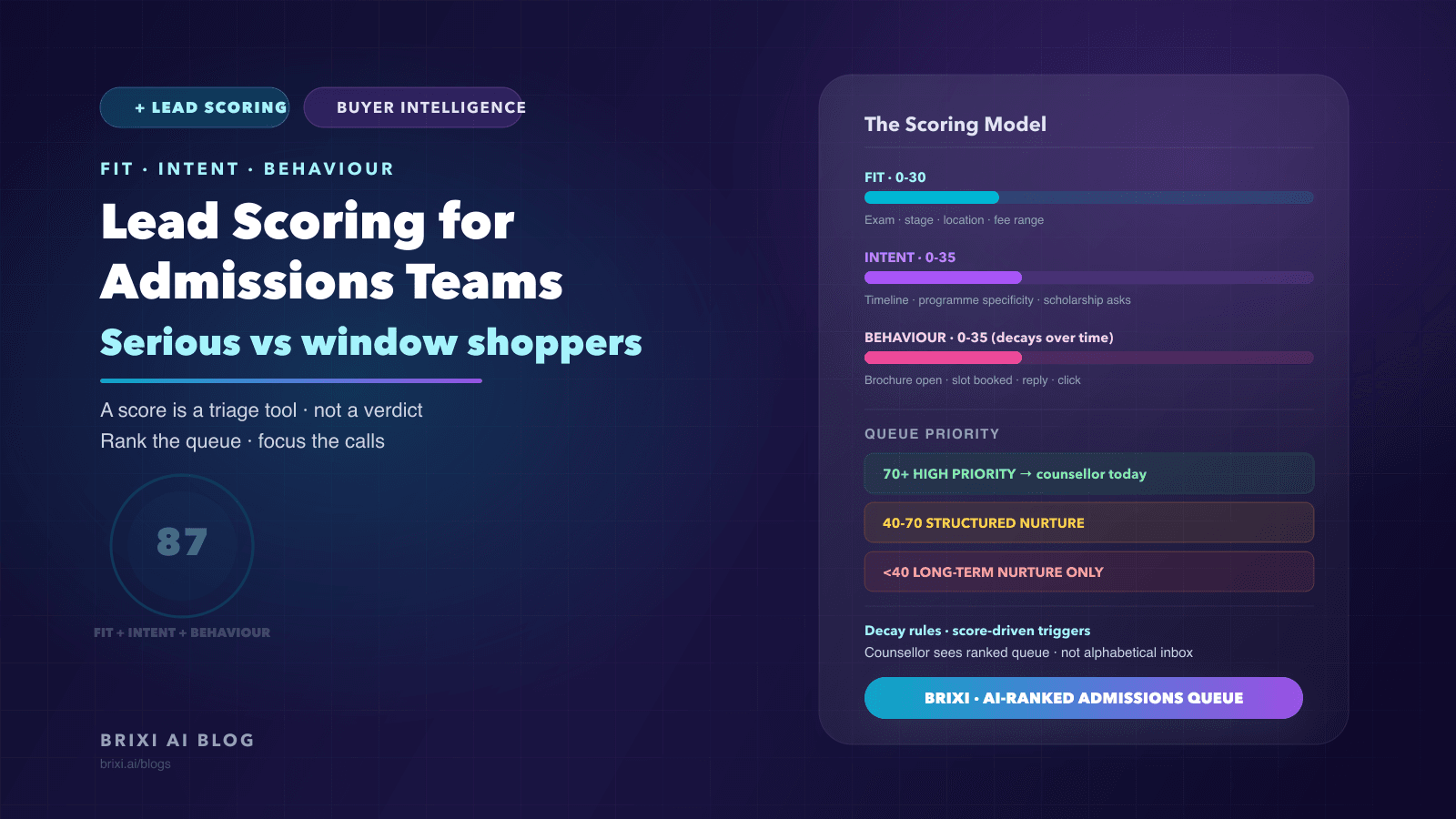
A useful score weights all three. Fit gives the ceiling. Intent gives the urgency. Behaviour confirms whether the urgency is translating into action.
A Practical Scoring Model You Can Build in a Week
Most admission teams that try to build a scoring model get stuck trying to design something elegant. The faster path is to start crude, instrument it, and refine over the season. A working starting point looks something like this.
Fit score (0 to 30)
- +10 if the applicant is preparing for the exact entrance exam this programme targets.
- +8 if the applicant is in the right preparation stage (e.g., final-year for a coaching programme that admits final-year students).
- +6 if the geographic location is within the institute's primary catchment.
- +6 if the expected fee range matches the programme's actual fee structure.
Intent score (0 to 35)
- +10 if the applicant explicitly states a "want to join this batch" timeline.
- +10 if the applicant inquired about a specific programme rather than browsing generally.
- +5 if a parent and student have both engaged on different touches.
- +5 if the applicant has asked about scholarships, payment plans, or fees in detail.
- +5 if the applicant is comparing only one or two other institutes (revealed through conversation).
Behavioural score (0 to 35, decays over time)
- +10 if the brochure was opened and time-on-document was meaningful.
- +8 if a counselling slot was booked.
- +8 if the applicant attended the counselling call.
- +5 if a payment link or document checklist was clicked.
- +4 if the applicant replied to a WhatsApp message within the last 48 hours.
The total score, on a 0 to 100 scale, becomes the basis for prioritisation. Above 70: high-priority counsellor calls. 40 to 70: structured nurture with periodic counsellor touch. Below 40: long-term nurture only. The exact thresholds will calibrate with experience. Start with a rough cut and tune over the first two weeks.
🧪 The model is wrong on day one
Every lead scoring model is wrong when it ships. The point is not to launch a perfect score. It is to launch a usable one and refine it weekly based on which scores actually translated into enrolments. The teams that benefit most are the ones that treat the model as a living thing, not a one-time project.
Decay Rules That Keep the Score Honest
A behaviour from three weeks ago is not the same signal as a behaviour from yesterday. Without decay rules, scores get stale and the queue stops reflecting real-time intent.
- Behavioural signals lose half their value every 7 days unless reinforced by new behaviour.
- Intent signals captured in conversation are valid for 14 days, then need re-confirmation.
- Fit signals do not decay. They are static facts.
- A counselling no-show does not zero out the score, but it adds a small temporary penalty that recovers when the applicant re-engages.
- A "not interested" explicit response zeroes the active score and moves the lead to long-term nurture.
How the Score Should Show Up in the Counsellor's Workflow
A score that lives in a database but does not show up in the counsellor's daily view is a score that nobody uses. Three workflow integrations are essential.
A ranked daily call queue
When the counsellor logs in, the queue should already be sorted by score. The first call of the day should be the highest-likelihood conversation, not the inquiry that came in alphabetically first.
A score-driven trigger system
When a lead crosses a score threshold (say, from 60 to 75), it should automatically trigger a counsellor task: a callback, a personalised message, a slot offer. The score is not a passive number; it drives action.
A daily scoring digest for leadership
Leadership needs a view of how the queue is shaped. How many leads are above 70, how that has changed, what the conversion rate is by score band. This is the closest thing to a real-time admissions performance dashboard.
Common Scoring Mistakes Worth Avoiding
A few patterns to watch out for in the first version of any admission scoring model.
- Over-weighting form-fill data and ignoring everything that happens after. This leads to stale scores within a week.
- Ignoring negative signals. Applicants who explicitly say they are not in the market should not stay in the queue at score 50.
- Not differentiating between parent and student behaviour. They signal different things and should be weighted differently.
- Not calibrating thresholds against actual enrolment data. The score bands are arbitrary if they do not correlate with conversion.
- Treating the score as a black box. Counsellors should be able to see why a lead has the score it has, or they will distrust it.
A Concrete Scenario: The Part-Time MBA Cohort
Consider a business school running a part-time MBA for working professionals. Their counsellors were handling over 400 open inquiries at the start of each admission window and had no principled way to decide who to call. The team was spending roughly equal time on freshers who filled out a form out of curiosity and on mid-career professionals who had already asked about EMI options and peer cohort composition.
After building a scoring model calibrated to their programme, the fit signals they weighted most heavily were current designation (manager level or above), employer type (companies that typically sponsor or support professional education), and years of work experience in the target range. Intent signals included explicit mention of a promotion goal or career pivot, and whether the applicant had asked about batch timing relative to their work schedule. Behavioural signals were weighted toward attendance at their live info sessions and time spent on the alumni outcomes page, which their highest-converting leads consistently visited.
Within three weeks, the counsellors were spending 70% of their call time on leads scoring above 65. Their connect-to-conversation rate improved because they were calling people who had already self-selected as serious. The leads below 40 were moved to a WhatsApp nurture sequence with a monthly counsellor check-in, freeing up the team to go deeper with the people who were actually close to a decision. The anti-pattern they had to break was the habit of calling everyone who opened an email, regardless of fit. Engagement without fit is noise, not signal.
The Phantom High-Intent Anti-Pattern
One failure mode that shows up in nearly every first-generation scoring model deserves its own name: the phantom high-intent lead. This is an applicant who scores heavily on behavioural signals because they are highly engaged with content, but whose fit score is low and whose intent signals, when examined closely, suggest comparison shopping across many institutes rather than proximity to a decision.
These leads absorb a disproportionate share of counsellor time because they look warm in the queue. They reply quickly, they open everything, they show up to webinars. But they are rarely the ones who enrol. The fix is to make fit a hard multiplier, not just an additive component. If an applicant's fit score is below a threshold, their behavioural score should be capped regardless of how active they are. High engagement from a poor-fit applicant is not a buying signal. It is curiosity.
What Changes After a Full Quarter
Teams that have run a scoring model for a full admission quarter develop a different kind of institutional knowledge. They can look at the score distribution of their current open pipeline and predict enrolment numbers with reasonable accuracy weeks before the batch closes. They know which score bands their counsellors are under-working and which ones they are over-serving. They can identify the specific signals that differentiated enrolees from non-enrolees in the previous cycle and adjust weights accordingly.
The model also starts to surface patterns that are invisible without it. Which inquiry sources consistently produce high-fit leads. Which nurture content drives score jumps. Which counsellors convert the most leads in a given score band and what they do differently in those conversations. This is where a scoring model stops being a prioritisation tool and starts being a learning system for the entire admissions operation.
What Changes When Scoring Actually Drives the Queue
Admissions teams that move from a "call everyone" workflow to a score-driven queue typically see two changes within the first month. Counsellor productivity goes up because the conversations they have are more often warm. And the conversion rate per call goes up because the leads they speak to are more often ready to decide. The same team, with the same headcount, produces a measurably larger admission cohort by the end of the season.
Stop calling every inquiry. Start calling the right ones first.
Brixi's admissions CRM scores every inquiry across fit, intent, and behavioural signals, with decay, calibration, and counsellor-facing transparency built in. Counsellors see a ranked queue every morning, not an alphabetical inbox.
Book a DemoFrequently Asked Questions
Three categories: fit (does the applicant match the programme profile), intent (how urgent is the decision), and behaviour (how have they engaged in the last 7 days). Assign each a 0 to 30 or 0 to 35 weight, sum to a 0 to 100 score, and use it to prioritise the counsellor queue.
Behavioural signals should update in real time. Every brochure open, every link click, every reply changes the score within minutes. Fit and intent signals update when new conversation data arrives. Decay rules apply automatically over time.
Both. The ranked queue is the primary interface, but counsellors should be able to click into any lead and see the score breakdown: what fit, intent, and behavioural signals contributed. Transparency is what makes them trust and use the system.
Fit measures whether the applicant could enrol. Does the profile match the programme. Intent measures whether the applicant wants to enrol now. Is the decision urgent. A high-fit, low-intent lead is a future opportunity. A low-fit, high-intent lead is a fast disqualification.
Look at the score distribution of leads who actually enrolled in the past season. The thresholds should split the queue so that the "high priority" band captures most of the eventual enrolments. This is a one-week analysis exercise that pays back across the entire next season.
Usually no. Each programme has different fit signals (an MBA fit profile is different from a JEE coaching fit profile), and the behavioural signals matter at different magnitudes. Most institutes run two to four scoring variants, one per programme family.