Real Estate Sales Workflow Automation Playbook
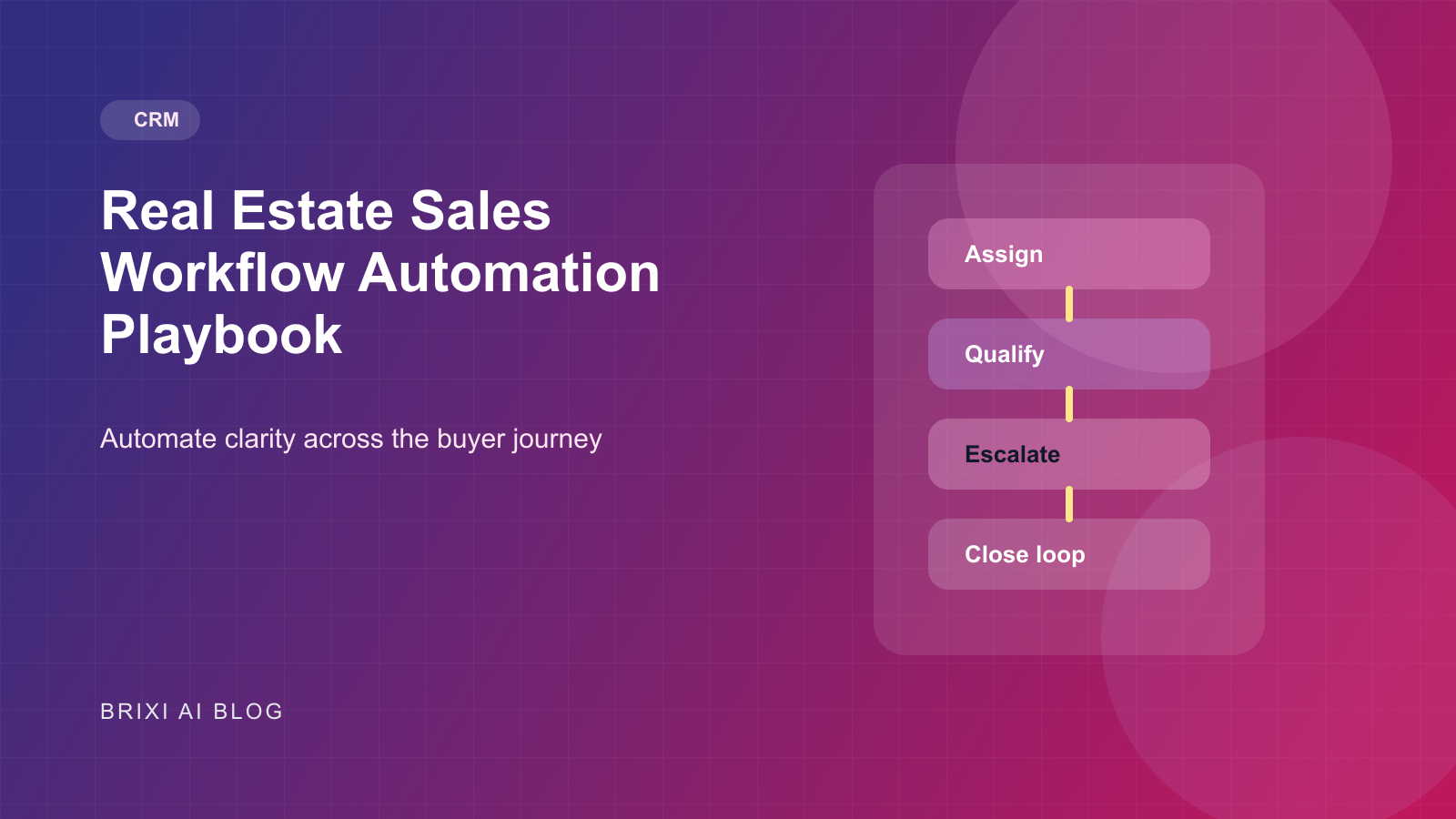
Workflow automation in real estate does not replace reps. It removes the ambiguity that costs you conversions between inquiry, qualification, follow-up, and handoff so your funnel behaves consistently under volume.
Pranav runs a mid-sized developer sales team in Kochi. Eight reps, three projects, roughly 400 to 600 inquiries per month coming in from portals, WhatsApp, and offline referrals. In the first quarter of last year his team booked 22 units. By Q3, after restructuring the sales workflow, they booked 31. The number of reps did not change. The number of leads did not meaningfully increase. What changed was how reliably each lead was moved from one stage to the next without losing momentum.
When Pranav looked at where the 22-unit quarter broke down, the answer was not effort. His team was working. The answer was handoff quality. Leads were getting qualified by one rep and passed to a closer with almost no context. Silence after a site visit was not triggering any re-engagement. Portal inquiries from Google were being treated the same as referral leads, even though referral buyers converted at nearly three times the rate. The workflow had no memory and no logic. It was just a sequence of manual tasks that depended entirely on individual rep habits.
What is Conversion Sequence Design?
The framework Pranav used to rebuild his workflow is what this post calls Conversion Sequence Design. It is the practice of mapping every buyer-facing transition in the sales funnel and pre-assigning four things to each one: who owns it, how long it should take, what gets communicated, and what buyer behavior should change the path. Conversion Sequence Design does not treat automation as a tool you add on top of your process. It treats the sequence itself as the product, and automation as the system that makes the sequence run reliably.
Most real estate teams automate tasks. They set reminders, schedule WhatsApp messages, create follow-up workflows in their CRM. Conversion Sequence Design asks a different question: are you automating the right decisions, or just the right tasks? A reminder to call a lead is a task. Automatically escalating a lead who opened your pricing page three times in one week is a decision. The distinction matters because tasks can be completed without generating any conversion progress, while decisions directly change what the buyer experiences next.
Why does real estate revenue leak between stages?
Revenue in real estate does not usually leak because a rep forgot to work. It leaks because the work is not coordinated well enough across the four moments that actually determine conversion: the first response window, the qualification call, the post-visit follow-up, and the long-hold nurture period. Each of those moments has a different owner, a different optimal timing, and a different content requirement. When the workflow does not specify all four, the team defaults to individual judgment, and individual judgment is inconsistent under volume.
- First response window: A portal lead that goes uncontacted for more than 15 minutes loses a significant share of its intent. Speed here is not customer service. It is a conversion variable.
- Qualification call: Reps who do not have a consistent qualification script produce wildly different lead quality assessments for the same buyer profile. Pipeline becomes unreliable.
- Post-visit follow-up: Most real estate sites do not trigger structured follow-up within 24 hours of a site visit. This is where the highest-intent buyers are most reachable, and most teams miss it.
- Long-hold nurture: Buyers who express interest but do not convert in the first 30 days often do convert, but only if the team maintains contact without becoming irritating. That balance requires a structured sequence, not ad hoc messages.
How should assignment rules be built for real estate?
Pranav's first structural fix was lead assignment. Before, leads were distributed in round-robin by whoever was online when the inquiry came in. After, assignment logic used three signals: lead source, project interest, and language preference. A referral lead for a premium project went to a senior closer immediately. A portal lead from a first-time-buyer inquiry on a mid-segment project went to a qualifier first. That single change eliminated the pattern where a junior rep was handling a high-value referral because the senior closer happened to be on a call.
The anti-pattern to avoid is what teams often call fair distribution. Round-robin feels equitable but it ignores the fact that rep capability varies, lead quality varies, and the match between rep and lead type has a real conversion effect. Conversion Sequence Design treats assignment not as an administrative function but as the first conversion decision the workflow makes on behalf of the buyer.
What should trigger an automated follow-up sequence?
Time-based triggers are the most common and the least powerful. Sending a follow-up message 48 hours after an inquiry regardless of what the buyer has done in the meantime is the lowest form of automation. Behavior-triggered sequences are far more effective because they respond to signals that indicate where the buyer actually is in their decision process.
- Pricing page revisit after a call: signals active comparison shopping. Trigger a value-reinforcement message or a callback offer.
- Brochure download without a follow-up call: signals intent to self-research. Trigger a soft check-in rather than a hard sales call.
- No engagement for 7 days after a site visit: signals either lost interest or a competing offer. Trigger a re-engagement sequence with a different angle.
- Third WhatsApp message opened but not replied to: signals interest without commitment. Trigger a lower-friction touchpoint like a voice note or a video walkthrough link.
- Repeated portal inquiries from the same number: signals high urgency. Escalate to a senior rep immediately rather than cycling through the standard queue.
Why do handoffs destroy conversion even when both reps are good?
This is the most underestimated problem in real estate sales operations. When a qualifier hands off a lead to a closer, the handoff typically transfers a stage label and a phone number. It does not transfer the reason the buyer is interested, the objection they raised on the qualification call, the project they were originally considering before shifting interest, or the timeline constraint they mentioned offhand. The closer starts cold. The buyer has to repeat themselves. The sales process loses the continuity that builds trust.
Conversion Sequence Design solves this by making context a required field in every handoff trigger. Before the CRM can move a lead to the next stage, the current owner must complete a structured summary: buyer motivation, stated objections, timeline, budget range, and the last meaningful commitment the buyer made. This is not extra bureaucracy. It is the difference between a closer who walks into a conversation with confidence and one who has to reconstruct the relationship from scratch.
What are the most common automation anti-patterns in real estate CRMs?
Teams who have run CRM automation for a year or more tend to accumulate several anti-patterns that quietly reduce effectiveness without being obvious in reporting.
- Stage-only branching: Using CRM stage as the only decision variable means two leads in the same stage but with completely different engagement histories follow identical paths.
- Completion metrics over conversion metrics: Measuring whether tasks were completed rather than whether those tasks moved buyers forward creates the illusion of a working workflow.
- Infinite nurture without a sunset rule: Keeping every lead active indefinitely inflates pipeline, obscures true conversion rates, and wastes rep attention on buyers who left the market months ago.
- Symmetric follow-up for asymmetric leads: Sending the same WhatsApp sequence to a first-time buyer and a repeat investor who is comparing three projects is a signal that the workflow has no intelligence.
- Automation without a fallback owner: When an automated sequence ends with no conversion and no human is assigned to review the outcome, leads fall into a status that nobody manages.
The operational test for any workflow
If a high-intent behavior occurs and the system does not automatically change the lead's priority, owner, or next action, the workflow is still too passive to protect conversion.
How should the qualification stage be structured for consistent output?
Qualification is where most real estate CRMs are weakest. Stage labels like "Interested" or "Follow-up Required" carry no standardized meaning across a team. One rep's "Interested" is another rep's "Dead lead." Conversion Sequence Design replaces stage labels with qualification gates: specific answers that must be captured before a lead advances. Budget range confirmed. Timeline stated. Project shortlisted. Decision-maker identified. These gates do not have to be completed in a single call, but they must be completed before the lead moves to a closer.
This approach has a side effect that teams often underestimate: it makes forecasting more reliable. When a closer knows that every lead in their pipeline has passed the same qualification gates, pipeline-to-booking conversion rates become meaningfully consistent quarter over quarter. That consistency is what allows sales managers to make accurate staffing and inventory decisions rather than guessing.
What changes after a quarter of running Conversion Sequence Design?
Teams that implement Conversion Sequence Design fully, meaning assignment logic, behavior triggers, qualification gates, and handoff context requirements, typically see three operational changes within 90 days.
First, lead decay slows. The proportion of leads that go cold in the first 14 days drops because behavior-triggered sequences catch re-engagement windows that manual follow-up misses. Second, pipeline quality improves. Because qualification gates are enforced before handoff, closers spend less time on leads that were never genuinely convertible. Third, manager oversight becomes more targeted. Instead of reviewing all activity to find problems, managers can monitor a small set of handoff quality signals and intervention triggers.
There is also a cultural change that matters more than any metric: reps stop experiencing their work as a series of disconnected tasks and start understanding it as a sequence with logic. When a rep knows that their job at the qualification stage is to capture four specific data points and then trigger a clean handoff, the role becomes clearer and performance becomes more coachable.
How do you roll out this workflow without breaking what already works?
The implementation risk that kills most workflow projects is trying to automate everything at once. Teams replace their existing process with a fully designed system and then struggle when real buyer behavior does not match the design. The sequencing that works in practice is narrower.
- Start with the first-response window only. Automate the acknowledgment message and the assignment rule. Measure contact rate improvement before adding complexity.
- Add qualification gates in the second week. Define the four fields that must be captured before a lead advances. Train the team on why those fields matter for the closer.
- Add behavior triggers in week three. Identify the two or three buyer behaviors that most reliably precede conversion and build alerts or automations around those alone.
- Add handoff context requirements in week four. Make the summary form part of the stage transition, not an optional note.
- Review the first 30 days of conversion data before adding any additional automation layers.
Voice AI and WhatsApp automation in the workflow
A question Pranav asked early in implementation was where voice AI agents and WhatsApp automation fit into Conversion Sequence Design. The answer is that they are execution channels for specific nodes in the sequence, not replacements for the sequence itself. A voice AI agent can handle the first-response call at 11pm when no rep is available. WhatsApp automation can deliver the post-site-visit follow-up message within two hours of the visit ending, with personalized project details included. Both of these channels work because the sequence defines exactly what should happen at that node and the automation executes it reliably.
The failure mode is deploying voice AI or WhatsApp automation without a sequence behind them. A voice AI agent that calls a lead but has no logic for what to do with the outcome is not workflow automation. It is a more expensive version of the same disconnected task problem. Channel and sequence must be designed together.
How Pranav's team operates now
By Q3, Pranav's eight reps were handling roughly the same inquiry volume as before, but the funnel had stopped leaking at the same points. The post-visit silence that used to last four to seven days was now covered by an automated sequence that triggered within two hours. The closers were receiving leads with completed qualification summaries rather than stage labels. Senior reps were being matched to high-value referral leads by assignment logic rather than by whoever happened to be free.
The 31 bookings in Q3 were not a surprise to Pranav. They were the predictable result of a workflow that had been redesigned to protect conversion at every stage rather than just track activity. That is the deeper bet of Conversion Sequence Design: that a funnel with clear logic at every transition will consistently outperform a funnel managed by capable people without structural support.
Ready to build a funnel that runs on sequence, not habit?
Brixi gives real estate sales teams the tools to automate assignment, trigger behavior-based follow-up, enforce qualification gates, and move leads through clean handoffs at every stage.
Frequently asked questions
What is the best CRM workflow for real estate sales teams in India?
The most effective real estate CRM workflow in the Indian market combines source-based assignment rules, behavior-triggered follow-up sequences, and structured qualification gates before handoff. Teams that add these three layers to their existing CRM, regardless of the platform, consistently see better lead-to-visit and visit-to-booking conversion than teams that rely on manual follow-up alone.
How do you automate follow-up for real estate leads without being intrusive?
The key is behavior-triggered timing rather than fixed-interval messaging. A message sent because a buyer revisited your pricing page feels relevant. A message sent because 48 hours have elapsed feels mechanical. When follow-up automation is tied to buyer behavior signals like page revisits, brochure downloads, or WhatsApp opens, the frequency feels appropriate because it is actually responding to something the buyer did.
How long should a real estate lead be kept active in the pipeline?
Most Indian real estate teams do not have a sunset rule and this inflates their pipeline with leads that exited the market months ago. A practical rule is to move a lead to a long-hold nurture bucket after 60 days without meaningful engagement, and then to formally close or archive it after 120 days without response to a re-engagement attempt. This keeps the active pipeline representing buyers who are actually deciding right now.
What data should travel with a lead handoff in real estate sales?
At minimum: the buyer's stated budget range, their timeline to purchase, the project or configuration they shortlisted, any objection raised on the qualification call, and the last commitment the buyer made (for example, agreeing to a site visit or asking for a specific floor plan). Without these five data points, the receiving rep is starting a cold conversation with a buyer who has already invested time in the sales process, which is one of the most preventable causes of late-stage lead decay.
Frequently Asked Questions
The most effective real estate CRM workflow in the Indian market combines source-based assignment rules, behavior-triggered follow-up sequences, and structured qualification gates before handoff. Teams that add these three layers to their existing CRM, regardless of the platform, consistently see better lead-to-visit and visit-to-booking conversion than teams that rely on manual follow-up alone.
The key is behavior-triggered timing rather than fixed-interval messaging. A message sent because a buyer revisited your pricing page feels relevant, while a message sent because 48 hours have elapsed feels mechanical. When follow-up automation is tied to buyer behavior signals like page revisits, brochure downloads, or WhatsApp opens, the frequency feels appropriate because it is actually responding to something the buyer did.
Most Indian real estate teams do not have a sunset rule and this inflates their pipeline with leads that exited the market months ago. A practical rule is to move a lead to a long-hold nurture bucket after 60 days without meaningful engagement, and then to formally close or archive it after 120 days without response to a re-engagement attempt. This keeps the active pipeline representing buyers who are actually deciding right now.
At minimum, the handoff should include the buyer’s stated budget range, their timeline to purchase, the project or configuration they shortlisted, any objection raised on the qualification call, and the last commitment the buyer made. Without these five data points, the receiving rep is starting a cold conversation with a buyer who has already invested time in the sales process, which is one of the most preventable causes of late-stage lead decay.