Re-Engaging Last Year's Unconverted Applicants Before the New Batch Starts
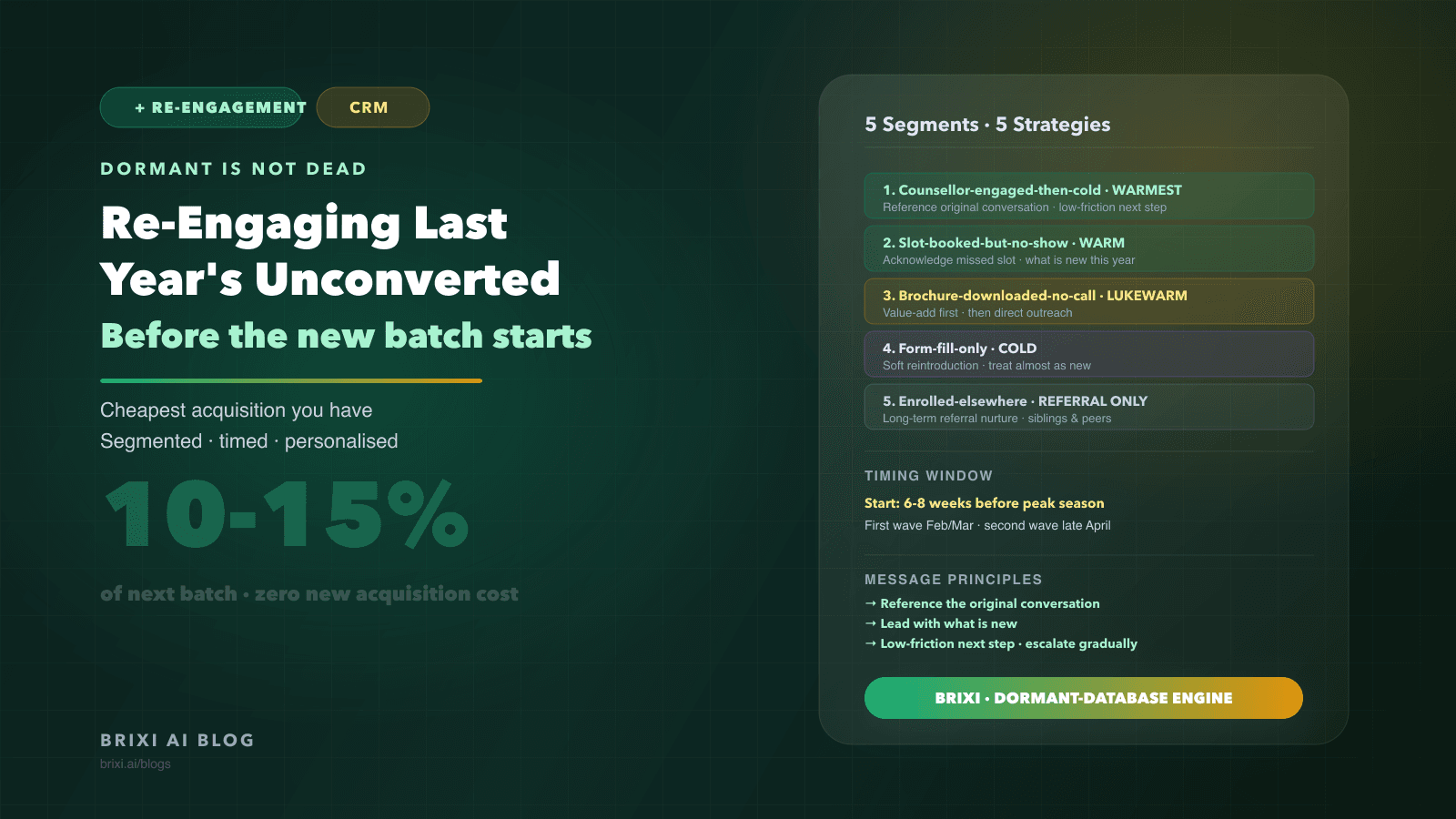
Every admissions team is sitting on a database of applicants who showed real interest last cycle and never enrolled. Most teams treat that database as dead. It is one of the highest-ROI sources of admissions in the new season, but only if the re-engagement is timed, segmented, and personal enough to feel like a continuation of the previous conversation rather than a cold outreach.
Open the admissions CRM at the start of any new season and look at the size of the database from last cycle. There are usually thousands, sometimes tens of thousands, of applicants who inquired, took a counselling call, downloaded a brochure, and never enrolled. Most of these applicants are still in the same life stage they were in last year. They are still preparing for the same exam. They are still considering similar institutes. And almost none of them have heard from your team in eight months.
The reflexive response in most teams is to treat last year's unconverted leads as dead. The marketing team spends the new season chasing fresh inquiries while sitting on a goldmine of warm prospects who already know the institute. The teams that get re-engagement right routinely add 10% to 15% of their new-batch enrolment from this source, at almost zero acquisition cost. The challenge is doing it without feeling like a generic blast that the applicant has seen from every other competitor.
🌱 Dormant is not dead
A serious applicant who did not enrol last year did not vanish. They postponed, picked a competitor, picked a gap year, or picked a different exam. A meaningful share of them are back in the market this year, and the institute that remembers their last conversation has a real advantage over the institute starting the conversation from scratch.
Why Last Year's Database Is the Cheapest Acquisition Channel You Have
A new lead from a paid campaign costs money to acquire and time to warm up. A re-engaged lead from last year costs almost nothing to acquire and arrives with most of the warming already done. The institute already knows their programme interest, their language, their exam preparation stage, their family decision-making pattern, and often their original objection. That context, used correctly, makes the second-cycle conversation faster and more likely to convert.
There are three structural reasons re-engagement works.
- Familiarity reduces friction: the applicant already recognises the institute name, faculty, and programme structure.
- Lifecycle continuity: many applicants are at the same decision point one year later, simply with more clarity on what they want.
- Competitive differentiation: most institutes do not re-engage at all, so the team that does feels uniquely attentive.
Segmenting Last Year's Database Before the First Touch
A blanket re-engagement message to every dormant lead is almost always a mistake. The database has very different sub-populations, and they need very different messages. Five segments are worth pulling out before any outreach.
1. Counsellor-engaged-then-went-cold
Applicants who completed at least one counselling call and then disengaged. These are the warmest segment. The re-engagement message should reference the original conversation specifically, the programme, batch, and the question they had, and offer a clear, low-friction next step.
2. Slot-booked-but-no-show
Applicants who booked a counselling slot last cycle but never attended. They had real intent at one point. The re-engagement should acknowledge the missed slot lightly and offer an updated context: "the new batch starts soon, here is what is different this year."
3. Brochure-downloaded-no-call
Applicants who showed initial interest but never reached the counsellor stage. These need more nurture before any direct conversation. Start with a value-add message, such as a placement update, alumni story, or exam strategy content, before any direct outreach.
4. Form-fill-only
Applicants who only filled the form and never engaged further. The lowest-warmth segment. Treat these almost as a fresh inquiry, with a soft reintroduction rather than a "remember us?" framing.
5. Enrolled-elsewhere
Applicants who explicitly told the team they had picked another institute. These should be excluded from active re-engagement, but kept in a long-term referral nurture. They often have younger siblings, friends, or peer networks who become future inquiries.
The Timing Window That Matters
Re-engagement timing is unforgiving. Too early in the new cycle and the applicant has not started thinking about admissions yet. Too late and they have already committed elsewhere. The right window opens about 6 to 8 weeks before peak admission season and closes when the applicant signals they are actively shopping again.
For Indian admissions, this typically means starting the re-engagement sequence in late February or early March, with a second wave in late April for applicants who did not respond to the first. By the time the peak inquiry surge hits in May and June, re-engaged warm leads are mixing into the regular funnel, but with the advantage of being further along in their decision than fresh inquiries.
📅 Wave the campaign, do not blast it
A single re-engagement broadcast tends to underperform a sequenced campaign. Most institutes get the best results from a 4- to 6-week wave: first message, value-add second message, soft prompt, direct counsellor outreach for those who responded. Each wave self-segments the database into who is ready and who is not.
Message Design That Avoids the "Why Are You Messaging Me Now" Reaction
The single biggest mistake in re-engagement is the message that reads as a generic broadcast. A few principles consistently produce better response rates.
Reference the original conversation
Mention the programme they originally inquired about, the city or campus, the question they had, the counsellor they spoke with. Specificity is what distinguishes a thoughtful follow-up from a database blast.
Lead with what is new
A new batch start date. A new fee structure with scholarship windows. A new placement record. A new programme variant. A new campus or hostel. The applicant should feel that there is a reason to reconsider, not just that the institute is reaching out because of the calendar.
Acknowledge time has passed
A short acknowledgement that some time has passed, without making it awkward. "It has been a while since we last spoke, and we wanted to share what has changed since then." This sets the right context for the conversation that follows.
Offer a low-friction next step
Not "book a counselling slot" as the first ask. Something smaller: a five-minute call, a video tour, an updated brochure, an open-day RSVP. Re-engagement asks should escalate gradually, not jump to the biggest commitment in the first message.
A Concrete Scenario: The Engineering College With 4,200 Dormant Leads
Consider a mid-tier engineering college that collected 4,200 inquiries in the previous admissions cycle and converted roughly 380 into enrolments. The remaining 3,820 contacts sat untouched in the CRM from August through January. When the admissions coordinator finally ran a segmentation pass in early February, three clear groups emerged: 610 had completed at least one counselling call, 940 had booked but not attended a slot, and the rest had only filled the form or downloaded the brochure.
The team sent the counsellor-engaged group a WhatsApp message that named their original programme of interest, mentioned that the new batch had a revised fee structure with an early-bird scholarship window closing in three weeks, and asked if a quick five-minute call made sense. Of the 610 contacts, 87 replied within 48 hours. Fourteen enrolled before April. That is 14 enrolments from a list the team had written off, at a cost of two days of coordinator time and a single WhatsApp template.
The slot-booked-but-no-show group required a softer touch. The opening message acknowledged the missed conversation from last year without dwelling on it, led with a short video of a current student from the same city, and offered an open-day RSVP as the next step. Conversion was lower, but the campaign surfaced 22 additional applicants who attended the open day and six who enrolled. The form-fill-only group received a nurture sequence rather than a direct outreach, and a small number filtered through to counsellor conversations by March.
💡 The anti-pattern to avoid: the undifferentiated blast
The most common re-engagement failure is sending the same "new batch open" broadcast to all 3,820 contacts at once. It reads like spam because it is. Applicants who once had a personal conversation with a counsellor receive the same message as someone who only filled a form two years ago. The result is low open rates, a spike in opt-outs, and a counsellor team fielding angry replies from people asking to be removed. Segmentation before outreach is not optional; it is what separates a campaign from a blast.
Channels That Work for Re-Engagement
Different segments respond to different channels. A few patterns worth following.
- WhatsApp works best for warm segments: counsellor-engaged and slot-booked applicants tend to recognise the institute and reply.
- Voice AI calls work well for the warmest segments and can re-qualify the lead in a single call, especially if last year's qualification data is preloaded.
- Email works for high-value, low-volume segments: alumni newsletters, scholarship announcements, programme updates that warrant longer-form content.
- SMS works as a backup channel for applicants whose WhatsApp is non-responsive.
- Paid retargeting on social can warm the audience before the direct outreach lands.
Measuring Whether Re-Engagement Is Working
The metric that matters is straightforward: what percentage of re-engaged applicants converted into a counselling slot, a campus visit, or an enrolment in the new cycle? A reasonable benchmark for a well-segmented re-engagement campaign is 8% to 15% slot booking on the warmest segments and 2% to 5% across the broader database. Below that suggests the segmentation, the timing, or the message is off and needs iteration.
What Changes After a Full Quarter of Re-Engagement
Teams that run a structured re-engagement programme consistently for a full admission quarter tend to notice a shift in how the CRM is treated. The dormant database stops being an afterthought and becomes a planned asset. Counsellors begin logging calls with more discipline because they know the notes will surface again next cycle. The marketing team stops calculating cost-per-lead purely from paid channels because they can see re-engagement conversions as a distinct, low-cost source. And the data quality of the overall database improves, since applicants who re-engage and convert bring updated contact details, exam scores, and location preferences that refresh the record.
The compounding effect is real. A team that re-engages 3,000 dormant leads this cycle, converts 5% of them, and logs the conversations correctly now has a warmer, better-documented database of 2,850 contacts to re-approach if any of them do not enrol this season. The re-engagement programme feeds itself.
What to Do When the Re-Engagement Lands
Once a re-engaged applicant responds, the next conversation should not feel like starting from scratch. The counsellor should have last year's call summary, the original objection, the programme of interest, the family decision context, and any pricing sensitivity from the previous cycle preloaded into the conversation. This is where most re-engagement campaigns fail in execution: the applicant responds, the counsellor treats them like a new inquiry, and the trust built up by the personalised message evaporates.
Turn last season's missed admissions into next batch's enrolments
Brixi automatically segments your dormant admissions database, runs sequenced re-engagement across WhatsApp, Voice AI, and email, and preloads counsellors with the original conversation context when applicants respond.
Book a DemoFrequently Asked Questions
For the warmest segments, counsellor-engaged and slot-booked applicants, 8% to 15% slot-booking rates are achievable. Across the entire dormant database, expect 2% to 5% direct conversion, with a meaningful long-tail nurture impact beyond that.
Six to eight weeks before peak admission season. For Indian admissions cycles, that typically means late February or early March, with a follow-up wave in late April for non-responders.
No. Re-engagement messages should reference the original conversation, lead with what has changed, and acknowledge time has passed. A generic-feeling message destroys the advantage of having prior context.
Exclude them from active re-engagement, but keep them in a long-term referral and alumni-network nurture. They often refer siblings, friends, or peers in subsequent cycles.
WhatsApp for warm segments, Voice AI for the warmest segments where automated re-qualification is possible, email for high-value newsletters, SMS as a backup. The mix should match the segment's prior engagement history.
When possible, yes. Continuity matters. When the original counsellor is no longer with the team, the new counsellor should still be briefed on the previous conversation so the applicant does not feel they are starting over.