AI SDR vs Human SDR: A RevOps Decision Framework
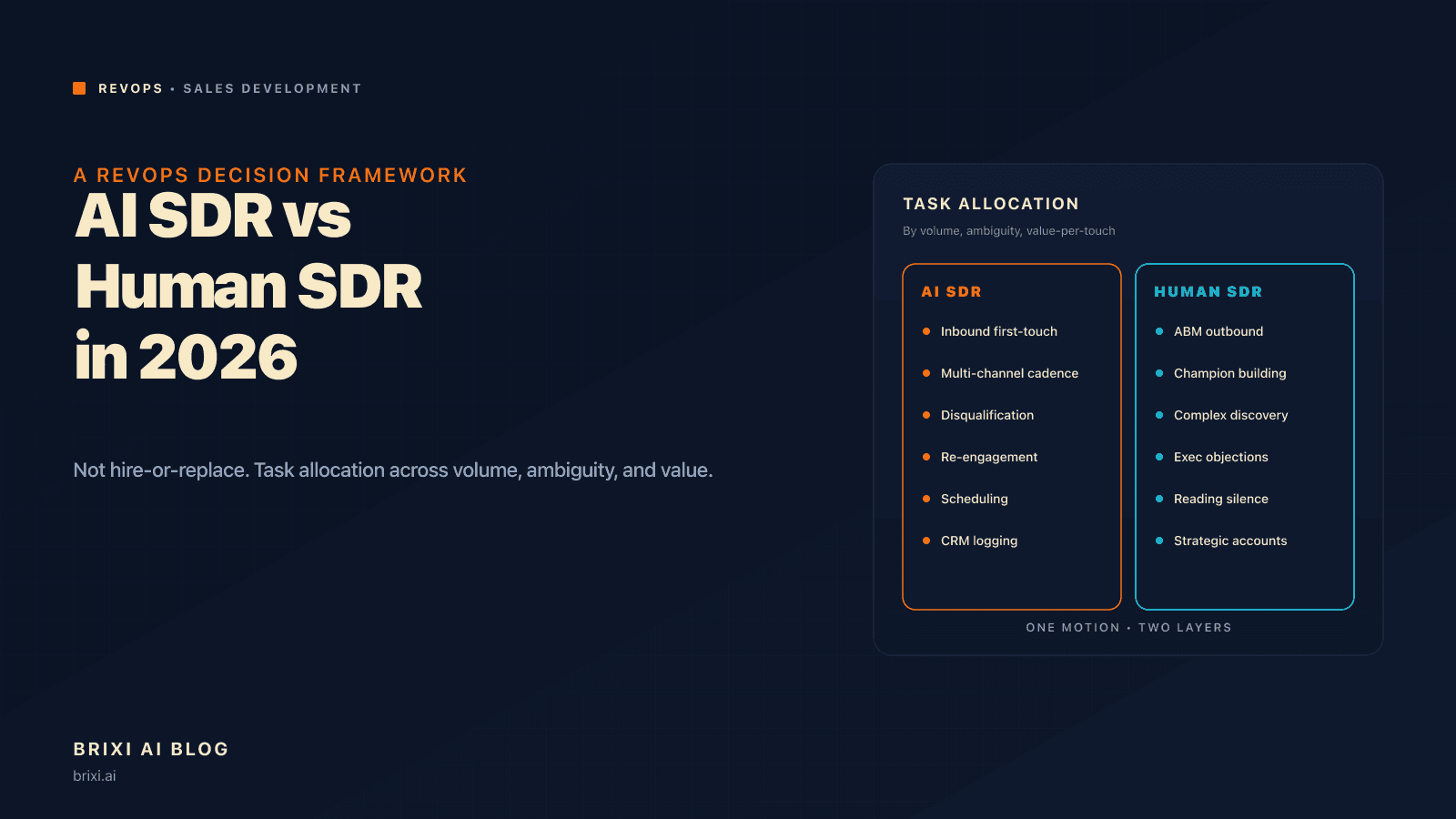
AI SDRs do not replace human SDRs. They replace specific tasks. This framework shows RevOps leaders exactly which outbound motions go to AI, which stay with humans, and how to measure the handoff so pipeline quality holds.
Bhavya runs RevOps for a mid-market SaaS company in Kochi. In January 2026, her team deployed an AI SDR to handle inbound demo requests. Six weeks later, pipeline looked fine on the dashboard. Qualified meeting rate had dropped by roughly a third. The AI was booking meetings. The buyers in those meetings had no real intent.
The problem was not the AI SDR. It was that nobody had drawn the boundary. The AI was doing work it was never suited for, and the human SDRs had drifted into doing the volume work the AI should have owned. Both were operating in the wrong lane.
This is the central challenge in every AI SDR vs human SDR conversation: not whether to deploy AI, but where the boundary sits, and what it costs when the boundary is wrong. Call that cost Handoff Debt. Every hour an AI runs a motion better owned by a human, and every hour a human runs a motion better owned by AI, that is Handoff Debt accumulating in your pipeline. It shows up late, as meetings that go nowhere and reps who feel like their job has no leverage.
What is Handoff Debt, and how does it compound?
Handoff Debt is not a single error. It is a structural misalignment that compounds across every lead that passes through the SDR layer. When an AI SDR handles a conversation that needed human judgement, the buyer gets a generic response at the exact moment they needed something tailored. Most do not complain. They just stop replying. The AI logs the outcome as "no response" and moves on. The revenue signal never surfaces.
The inverse is just as damaging. When a senior SDR spends two hours manually following up with 80 leads who requested a brochure at a trade show, that is two hours of Handoff Debt. Those leads needed a structured, fast, multi-touch sequence, not a personal call. The rep built no relationships and generated no new intelligence. The pipeline number looks fine until you measure the cost per qualified meeting.
Handoff Debt is hard to see because it rarely announces itself. RevOps leaders who catch it early do so by auditing not what the SDR layer produced, but what each motion in the SDR layer cost relative to its downstream conversion. That is the starting point for the decision framework.
Which three axes should RevOps use to score every SDR motion?
Score every outbound and inbound SDR motion across three axes. The score tells you where the motion belongs: AI, human, or a clean handoff point between them.
Axis 1: Volume
How many leads or accounts pass through this motion per week per rep? In most teams we see, anything above 150 per rep per week is effectively AI territory. The marginal human touch in a high-volume motion adds almost nothing a buyer notices, and it costs the rep attention they could direct toward the motions that do require judgement. Inbound lead response, dormant re-engagement, and post-event follow-up are nearly always above this threshold.
Axis 2: Ambiguity
How often does the right next step require context the rep has to infer from a live conversation? Low-ambiguity motions have clear, defined responses. A lead fills out a demo form, the correct next step is to qualify budget and set a meeting. An AI can run that with high consistency. High-ambiguity motions require reading a buyer who is not telling you what they mean, navigating a champion who has gone quiet, or sensing that an objection is a mask for a different concern entirely. No AI SDR currently on the market handles that reliably.
Axis 3: Value per touch
If a single interaction could materially change a deal worth six figures or more, a human runs it. If 200 touches together produce one qualified meeting at a deal value of 50,000 rupees, AI runs it. The mistake most RevOps teams make is letting value-per-touch be implicit. When you make it explicit, the allocation almost always becomes obvious.
The Handoff Debt test
For any SDR motion, ask: if a rep ran this 60 times today, would any single instance change a forecast? If the answer is no, the motion belongs to AI. If yes, the motion belongs to a human with full context.
What are AI SDRs genuinely good at in 2026?
AI SDRs in 2026 are strongest where the work is high-volume, follows a clear decision tree, and where speed of response matters more than depth of understanding. The sub-3-minute response to an inbound demo request is a genuine advantage. Most human SDR teams reply to inbound leads in hours, and by that time, buyer attention has moved. An AI SDR with a voice channel and WhatsApp sequence running in parallel changes that equation entirely.
- First-touch response to inbound demo and trial requests, within minutes, across voice, WhatsApp, and email.
- Structured disqualification calls that filter wrong-fit leads before they reach a human calendar.
- Multi-touch cadence execution across 200 or more leads per day without missed steps or inconsistent messaging.
- Re-engagement of leads marked dormant after 30, 60, or 90 days where the cost per touch needs to be near zero.
- Meeting scheduling, rescheduling, and pre-meeting confirmation without rep involvement.
- Logging every interaction to CRM with structured fields, call summaries, and sentiment tags.
The honest constraint: AI SDRs in 2026 are not creative. They do not pick up the signal that a buyer's tone shifted mid-call. They do not know that the CFO just left the company and the champion's authority has changed. When those signals matter, the AI’s consistency becomes a liability.
Where do human SDRs still outperform AI by a wide margin?
The counterintuitive claim worth making explicit: as AI SDRs get better at volume tasks, the value of a skilled human SDR goes up, not down. Human SDRs who are freed from dialing 100 leads a day and instead spend their time on account-based outbound, champion-building, and complex discovery become significantly more productive. The baseline expectation for what a human SDR should accomplish rises.
- Account-based outbound to named enterprise accounts where one misread email burns a relationship for 12 months.
- Champion-building inside target accounts where trust is built across multiple stakeholders over weeks.
- Discovery on deals with complex buying processes, unclear pain, or multiple stakeholders with conflicting priorities.
- Handling executive-level objections that require credibility, storytelling, and the ability to meet silence with silence.
- Reading the signal when a deal stalls and deciding whether to push, wait, escalate, or reframe the problem.
- Researching a prospect's recent moves, competitive pressures, and internal politics before a first outreach.
Anti-pattern to avoid: deploying a human SDR to do account-based outbound on a list of 300 accounts with a 3-day SLA per account. That is not account-based outbound. That is volume work dressed up as strategic work, and it produces neither volume results nor strategic results. The human becomes demoralized and the pipeline reflects that.
How should teams staff the hybrid SDR model in practice?
Teams that have run hybrid SDR models for more than two quarters tend to converge on a similar shape. The AI layer handles all inbound qualification, all re-engagement, and all structured cadences. The human layer is smaller, more senior, and focused entirely on accounts where the deal size justifies judgment-intensive work. The ratio varies by industry and deal size, but in most B2B sales environments we see, one experienced SDR overseeing an AI-assisted pipeline of 300 to 400 leads per month is achievable without compromising qualified meeting rates.
- Replace entry-level high-volume dialer seats with AI for inbound and re-engagement motions first.
- Promote or retain senior SDRs as account researchers and champion-builders with smaller, deeper territories.
- Build a live escalation path so AI can hand off to a human within minutes when a conversation exceeds its confidence threshold.
- Measure AI SDRs on disqualification accuracy and meeting show rate, not call volume.
- Measure human SDRs on meeting-to-opportunity rate and champion quality, not activities completed.
- Review escalation logs weekly to find which AI handoffs became opportunities and which human touches were unnecessary.
What are the named anti-patterns RevOps teams keep repeating?
After watching several teams navigate the AI SDR transition, the failure modes cluster into a recognizable set. Each one is a specific form of Handoff Debt.
- The overnight replacement: swapping all SDR headcount to AI without a tuning period causes pipeline quality to collapse before the AI is calibrated to the team's specific buyer signals.
- The enterprise mistake: letting AI run outbound to enterprise accounts where a single poorly timed message can lock you out of a procurement cycle for a year.
- The volume metric trap: measuring AI SDRs on call volume or email send rate rewards spam and penalizes the cautious follow-up a real buyer needed.
- The escalation dead-end: deploying AI without a live handoff path so conversations dead-end when a buyer asks a question outside the script.
- The comp plan lag: failing to update human SDR compensation when their motion shifts, so reps feel threatened and stop feeding the AI the signals it needs to improve.
- The clean-data assumption: running AI SDRs on a CRM with poor data hygiene, which causes the AI to contact wrong numbers, lapsed customers, and do-not-call leads at scale.
What changes after a quarter of running the hybrid model correctly?
Teams that apply the three-axis framework and run the hybrid model for 90 days report consistent shifts in how pipeline feels. Volume metrics go up because AI never drops a lead. Meeting quality improves because humans are spending time only on deals that need them. Ramp time for new human SDRs compresses because they inherit structured context from AI conversation logs rather than starting cold.
The operational shift that surprises most teams is that human SDR output becomes more predictable, not less. When humans are not distracted by volume work, their conversion rates stabilize. You can forecast their contribution more accurately, which makes the whole pipeline model more reliable.
There is also a cultural shift worth naming. Human SDRs who have been freed from dialing lists tend to report higher job satisfaction and stay longer. That is a retention variable most RevOps models do not price in. In markets where experienced SDR talent is genuinely scarce, keeping a senior rep for an extra 12 months has measurable pipeline value.
One honest caution: the quarter is not the inflection point for the AI layer. AI SDR performance tends to improve meaningfully between month 3 and month 6 as the model learns from escalation feedback, call recordings, and disqualification patterns. If you measure only at 90 days and the AI is still underperforming on a specific motion, the answer is usually to tune the threshold or adjust the escalation logic, not to pull the motion back to humans.
What is the deeper bet RevOps leaders are actually making here?
Return to Bhavya for a moment. After her team diagnosed the Handoff Debt problem, she made two changes. She pulled the AI SDR back to the first two touches on inbound leads, with a hard escalation trigger if the lead mentioned a specific use case or a timeline inside 30 days. She redefined her senior SDR's territory to the 50 accounts that had engaged with content but never booked a call. Within six weeks, qualified meeting rate recovered. Within two quarters, it exceeded the pre-AI baseline.
The deeper bet is not "AI beats humans at outbound." The deeper bet is that the SDR motion itself is being unbundled. The volume layer, the qualification layer, and the relationship layer are separating into distinct functions with distinct tooling, metrics, and talent profiles. RevOps leaders who recognize this early can build a machine where AI and humans each operate at their ceiling rather than each dragging on the other.
The teams that struggle are the ones who treat the AI SDR deployment as a cost reduction exercise. They hire less, run AI, watch qualified meeting rates decline, and conclude that AI SDRs do not work. They are right about the result and wrong about the cause. The cause was Handoff Debt: AI running motions that needed human judgment, and humans running motions that needed AI speed. Fix the boundary, and the model works.
Which SDR motions should your AI own first?
Brixi’s Voice AI handles inbound qualification, multi-channel re-engagement, and structured cadences, then hands off to your human reps with full conversation context and intent signals.
See Brixi Voice AIFrequently asked questions
Can an AI SDR fully replace a human SDR for B2B outbound?
Not across all motions. AI SDRs can fully replace human SDRs on high-volume, low-ambiguity work: inbound response, dormant re-engagement, disqualification calls, and meeting scheduling. They cannot reliably replace humans on account-based outbound, complex discovery, or executive-level conversations where a single misread signal can close a door for months. The practical answer for most B2B teams is a hybrid model where AI owns the volume layer and humans own the judgment layer.
How do I measure whether my AI SDR is performing well?
Measure AI SDRs on disqualification accuracy, meeting show rate, and escalation precision, not call volume or email sends. A useful leading indicator is the ratio of AI-booked meetings that convert to opportunities versus human-booked meetings. If the AI's ratio is significantly lower, the AI is booking meetings from leads that lack intent, which points to either a qualification script problem or a boundary problem where the AI is running motions that needed more judgment.
What does a RevOps decision framework for AI vs human SDR look like in practice?
Score every SDR motion on three axes: volume per rep per week, ambiguity of the right next step, and value of a single touch if it goes well. High volume plus low ambiguity plus low value per touch points to AI. Low volume plus high ambiguity plus high value per touch points to humans. The middle band, which is where most teams accumulate Handoff Debt, is the set of motions worth the most attention. Audit those first, draw the boundary explicitly, and build an escalation path so neither side gets stuck handling work it should not own.
How long does it take to see results from a hybrid AI and human SDR model?
Most teams see the pipeline stabilize within 30 days of drawing a clean boundary and building the escalation path. Qualified meeting rate typically recovers to baseline within 60 days. AI SDR performance tends to improve meaningfully between month 3 and month 6 as the system learns from escalation feedback and call recordings. The mistake is measuring at 30 days and concluding the model does not work. The inflection point for AI performance is usually later than teams expect, and earlier than they fear once the boundary is correctly drawn.
Frequently Asked Questions
Not across all motions. AI SDRs can fully replace human SDRs on high-volume, low-ambiguity work: inbound response, dormant re-engagement, disqualification calls, and meeting scheduling. They cannot reliably replace humans on account-based outbound, complex discovery, or executive-level conversations where a single misread signal can close a door for months. The practical answer for most B2B teams is a hybrid model where AI owns the volume layer and humans own the judgment layer.
Measure AI SDRs on disqualification accuracy, meeting show rate, and escalation precision, not call volume or email sends. A useful leading indicator is the ratio of AI-booked meetings that convert to opportunities versus human-booked meetings. If the AI’s ratio is significantly lower, the AI is booking meetings from leads that lack intent, which points to either a qualification script problem or a boundary problem where the AI is running motions that needed more judgment.
Score every SDR motion on three axes: volume per rep per week, ambiguity of the right next step, and value of a single touch if it goes well. High volume plus low ambiguity plus low value per touch points to AI. Low volume plus high ambiguity plus high value per touch points to humans. The middle band is where most teams accumulate Handoff Debt, so audit those motions first, draw the boundary explicitly, and build an escalation path so neither side gets stuck handling work it should not own.
Most teams see the pipeline stabilize within 30 days of drawing a clean boundary and building the escalation path. Qualified meeting rate typically recovers to baseline within 60 days. AI SDR performance tends to improve meaningfully between month 3 and month 6 as the system learns from escalation feedback and call recordings. The inflection point for AI performance is usually later than teams expect, and earlier than they fear once the boundary is correctly drawn.