Voice AI Qualification Questions for Real Estate Teams
The strength of a voice AI qualification workflow depends on the questions it asks, the order it asks them, and whether those answers produce routing decisions rather than noisy data capture. Most real estate teams get the first call wrong before it even starts.
Chirag runs channel sales for a mid-size residential developer in Bhopal. In early 2026 he deployed a voice AI agent to handle inbound inquiry calls across three projects. Within ten days he had 600 call transcripts. The problem was that almost none of the answers were useful. Budget fields read "under 50 lakhs" even for buyers inquiring about 90-lakh flats. Timeline answers clustered around "within a year" because that felt like the safe thing to say. His telecalling team was re-calling every single lead to ask the same questions over again.
The voice AI was not broken. The script was. Chirag had handed the vendor a list of CRM fields to collect and they built questions around each field in that order. Budget first, timeline second, unit size third. No context was established before the interrogation began. The buyer had no reason to trust the call was relevant to their actual inquiry. The answers reflected that distrust.
What is the real job of a qualification call?
A qualification call does not exist to fill a CRM row. Its job is to reduce uncertainty enough to make one confident routing decision: is this buyer worth an immediate senior callback, a scheduled callback, a nurture sequence, or no further action for now? Every question in the script should serve that decision. Questions that produce data nobody acts on should not be in the first call.
This is the core of what we call the Routing Signal Architecture. Instead of designing scripts around data completeness, you design them around decision completeness. The question is not "what do we want to know about the buyer?" It is "what is the minimum we need to know to route this buyer correctly?" Those are very different design briefs.
Why does question order matter more than question content?
Buyers answer honestly when the conversation earns the right to go deeper. If a voice AI agent opens with "what is your budget?" before it has acknowledged why the buyer is calling, the exchange feels transactional and adversarial. Buyers give round numbers or deflect. If the same question comes after the call has established context and relevance, the answer is almost always more precise.
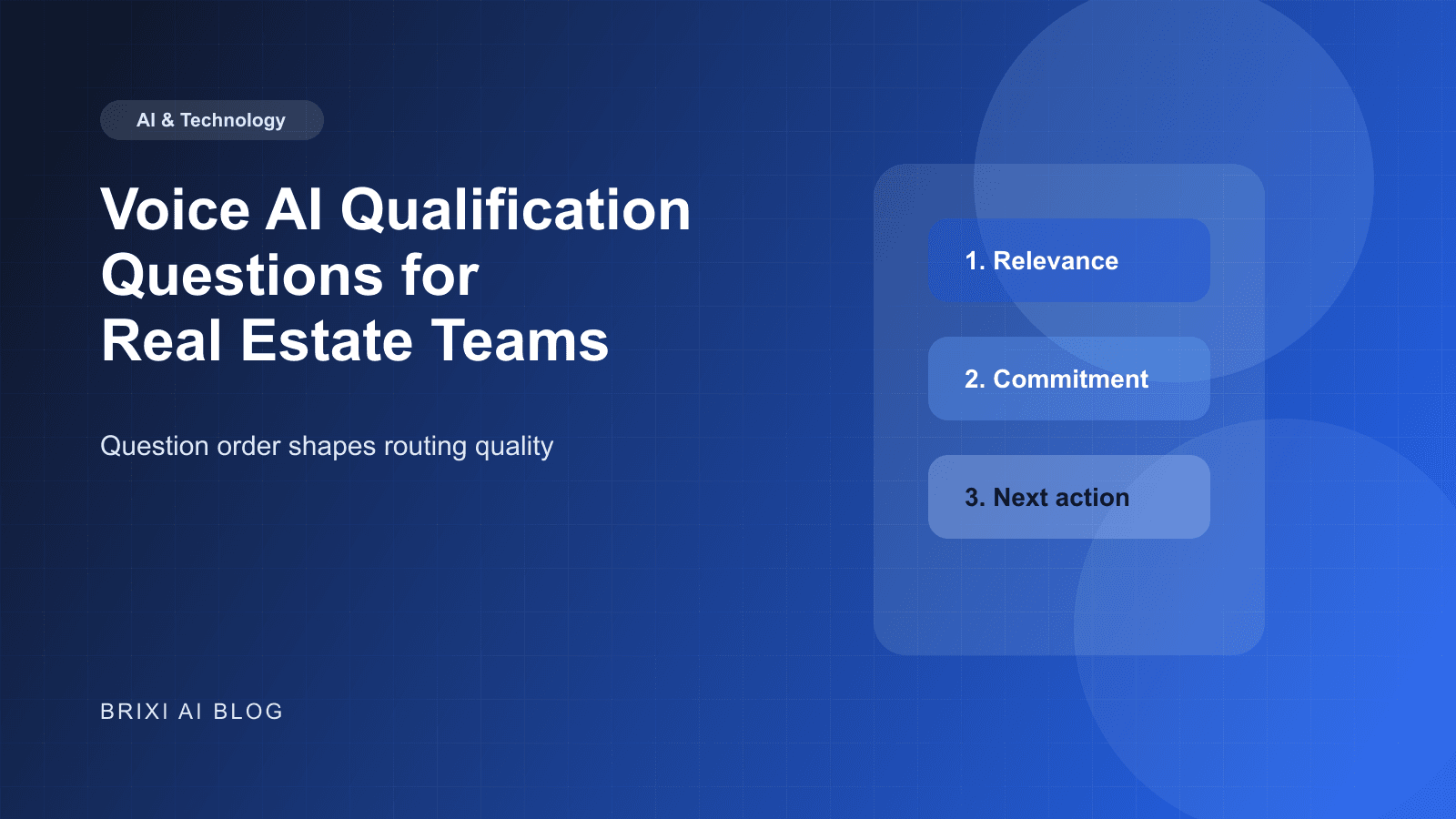
The sequence that consistently produces better answers follows a three-tier logic. Open with context. Move into commitment signals. End with a next-step question that tells the system what to do rather than leaving the lead in an undifferentiated pile.
Tier one: establish context before anything else
The first two or three exchanges should anchor the call to the buyer's actual inquiry. Confirm the project name or location they asked about. If the lead came from a portal like 99acres or MagicBricks, acknowledge the source so the call feels personalized. Ask an open-framing question such as: "Are you looking for something for your own use or as an investment?" This question feels low-stakes to the buyer but it is high-signal for routing. Own-use buyers respond to site visits and emotional features. Investor buyers want yield data, floor plans, and possession timelines.
Tier two: qualification through commitment signals
Once context is set, the Routing Signal Architecture asks for commitment signals rather than form-field answers. Commitment signals are answers that reveal how far along the buyer is in their actual decision process, not just what they claim to want.
- Timeline framing: "Have you visited any projects in the past month?" reveals active search behavior more reliably than "when are you planning to buy?"
- Budget anchoring: "Have you spoken to your bank or an NBFC about a home loan?" sorts serious buyers from early researchers without asking for a direct number.
- Decision structure: "Is anyone else involved in this decision, like a spouse or a business partner?" identifies whether a single callback will move things forward.
- Site visit readiness: "Would you be open to visiting the site this weekend if we can arrange a slot?" is the cleanest urgency signal available in a qualification call.
- Unit specificity: asking "are you thinking of a 2 BHK or 3 BHK?" rather than "what configuration do you want?" reduces ambiguity and maps directly to inventory.
Tier three: the next-step question
Every qualification call should end with a question that produces an actionable instruction. "Should I have our project advisor call you back today, or would a time tomorrow morning work better?" This is not a pleasantry. The answer tells the workflow whether to trigger an immediate callback task, schedule a future one, or hold the lead for nurture. If the script ends without this question, the routing decision defaults to human judgment and the voice AI has only done half the job.
Which questions consistently produce unreliable answers?
This is the contrarian claim most vendors will not make: several of the most common real estate qualification questions are structurally unreliable and should be redesigned or removed from first calls entirely.
- "What is your budget?" asked cold produces social desirability bias. Buyers anchor low to avoid being upsold. Replace it with the loan pre-approval question above.
- "When are you planning to buy?" produces aspirational answers, not behavioral ones. Replace it with questions about actions already taken.
- "How did you hear about us?" sounds like a marketing form. It signals to the buyer that the call is administrative rather than consultative.
- "Are you interested in our project?" is almost always answered yes, producing no routing signal at all.
- Any compound question that asks two things at once. Voice AI cannot parse a split answer reliably, and buyers often answer only one part.
How should real estate teams handle leads who resist qualification?
A segment of real estate leads will deflect, go vague, or push back on any direct question. The Routing Signal Architecture handles this through graceful exits rather than repeated prompting. If a buyer declines to answer a commitment question, the correct move is to offer them a path: "That is completely fine. Would it be helpful if I had our project advisor share some details over WhatsApp first?" This converts a failed qualification attempt into a nurture entry point. It also stops the voice AI from sounding pushy, which is one of the leading causes of mid-call drop-offs on residential property inquiries.
Design principle
A failed qualification attempt is not a wasted call. It is a routing decision: place this buyer in a low-pressure nurture path and revisit in 30 days.
What does the script look like when it is working?
A well-designed voice AI qualification call for Indian residential real estate runs between 90 seconds and 3 minutes. It produces four to six structured data points that map directly to routing rules. The sales manager can look at the call summary and know within ten seconds which tier the lead belongs to. Senior callbacks happen within minutes on hot leads. Warm leads enter a scheduled follow-up. Cold leads get a WhatsApp content flow and a 30-day re-engagement trigger.
The test is whether your calling team trusts the output. If reps are re-qualifying every lead from scratch, the script is not doing its job. If they are using the call summary to customize their opening line on the callback, the Routing Signal Architecture is working.
How do you evaluate and improve script performance over time?
Script quality is a product question, not a content question. Treat it like a conversion funnel. Measure where buyers drop off mid-call. Track which questions produce high "I don't know" or "maybe" rates. Audit whether qualified leads that the voice AI tagged as hot actually progress to site visits at a higher rate than leads it tagged as warm. If they do not, the routing logic is miscalibrated.
- Drop-off rate by question position reveals which questions feel intrusive or confusing.
- Answer completion rate per field shows where buyers go vague, signaling a question design problem.
- Routing accuracy, measured by comparing AI tier to actual conversion outcome, tells you whether the signal questions are predictive.
- Callback acceptance rate on the next-step question is the simplest proxy for whether the call felt consultative rather than robotic.
- Rep override rate shows how often the human team disagrees with the AI routing, which surfaces systematic bias in the script.
What changes after a quarter of running the Routing Signal Architecture?
Teams that rebuild their qualification scripts around routing decisions rather than data collection typically see three changes within 90 days. First, the number of leads the calling team needs to manually review drops, because the AI output is trustworthy enough to act on directly. Second, re-qualification calls, the kind Chirag's team was running on every single lead, largely disappear. Third, the tone of the sales floor changes. Reps who know what they are walking into on a callback are more confident and better prepared, and that shows up in site visit rates.
There is also a less obvious shift. When buyers feel that the first automated call actually listened, their posture on the human callback is warmer. The AI call has already done the relational work of acknowledging the inquiry and asking relevant questions. The rep inherits a lead who feels attended to rather than harvested.
What to ask if you are auditing your current script today
Go through each question in your current voice AI script and ask: if a buyer gives a vague or non-answer here, does the routing still work? If the answer is yes, the question is probably load-bearing. If the answer is no and the vague response just produces a blank field in the CRM, the question either needs to be redesigned as a forced-choice prompt or removed from the first call entirely.
- Count how many of your current questions map to a routing rule. Anything that does not map to a routing rule is data collection, not qualification.
- Check whether your script has a next-step question. If it does not, add one before anything else.
- Look at whether budget is asked before context. If it is, move it to tier two behind at least two context questions.
- Verify that compound questions have been split. One idea per prompt.
- Confirm that graceful exit language exists for buyers who deflect. It should redirect to WhatsApp or a scheduled callback, not repeat the question.
Back to Chirag: what changed in Bhopal
Chirag spent three hours rebuilding his script around the Routing Signal Architecture. He removed the cold budget question, replaced timeline with the "visited any projects recently?" framing, added the loan pre-approval check in tier two, and built a hard next-step question into every call end. He also added the graceful exit path for deflectors: a WhatsApp redirect offer instead of a second attempt at the same question.
Two weeks later, his calling team stopped re-qualifying every lead. They were using the AI call summary to prepare for callbacks. Site visit bookings in that two-week window were higher than the previous month. He did not change the voice model, the CRM, or the calling schedule. He changed the questions and their order. That is all the Routing Signal Architecture is: a principled bet that the quality of the conversation upstream determines the quality of the outcome downstream.
Is your voice AI script designed for routing or just data collection?
Brixi helps real estate teams build qualification scripts that produce trustworthy routing decisions and give calling teams the context they need to convert.
Frequently asked questions
What questions should a voice AI ask a real estate lead on the first call?
The first call should confirm the project or location the buyer inquired about, establish whether the purchase is for own use or investment, ask one commitment signal question such as whether they have spoken to a bank about a home loan, and end with a next-step question about callback timing or WhatsApp follow-up. Budget, unit specifics, and documentation questions belong in later interactions unless the lead volunteers them first.
How do you design voice AI call scripts that do not sound robotic?
Scripts sound robotic when they read like form fields. Use conversational framing: "Have you visited any projects in the area recently?" instead of "What is your timeline?" Use buyer language for configurations, locations, and budget ranges. Ask one question at a time. Acknowledge the buyer's inquiry at the start so the call feels specific rather than templated.
How do you measure whether a voice AI qualification script is working?
Track drop-off rate by question position, answer completion rate per field, routing accuracy compared to actual sales outcomes, and rep override rate. The most direct signal is whether your calling team is trusting the AI output to prepare for callbacks or re-qualifying every lead from scratch. If they are re-qualifying, the script is producing noise rather than signal.
Can voice AI handle leads who refuse to answer qualification questions?
Yes, but only if the script has a designed exit path. When a buyer deflects or goes vague, the voice AI should offer an alternative: "That is completely fine. Would you like me to have our advisor share some details on WhatsApp?" This converts a failed qualification into a nurture entry point. Scripts that repeat the same question after deflection produce drop-offs and damage brand perception.
Frequently Asked Questions
The first call should confirm the project or location the buyer inquired about, establish whether the purchase is for own use or investment, and ask one commitment signal question such as whether they have spoken to a bank about a home loan. Every call should end with a next-step question about callback timing or WhatsApp follow-up, since budget and unit specifics belong in later interactions unless the lead volunteers them first.
Scripts sound robotic when they read like form fields rather than conversations. Use conversational framing such as "Have you visited any projects in the area recently?" instead of "What is your timeline?", ask one question at a time, and acknowledge the buyer's inquiry at the start so the call feels specific rather than templated. Buyers answer honestly when the conversation earns the right to go deeper before asking for commitment.
Track drop-off rate by question position, answer completion rate per field, routing accuracy compared to actual sales outcomes, and rep override rate. The most direct signal is whether your calling team trusts the AI output to prepare for callbacks or re-qualifies every lead from scratch. If reps are re-qualifying, the script is producing noise rather than actionable routing decisions.
Yes, but only if the script has a designed graceful exit path for buyers who deflect or go vague. The voice AI should offer an alternative such as sending details over WhatsApp, which converts a failed qualification attempt into a nurture entry point. Scripts that repeat the same question after deflection produce mid-call drop-offs and damage brand perception.