Counselling No-Shows: The Edtech Recovery Playbook
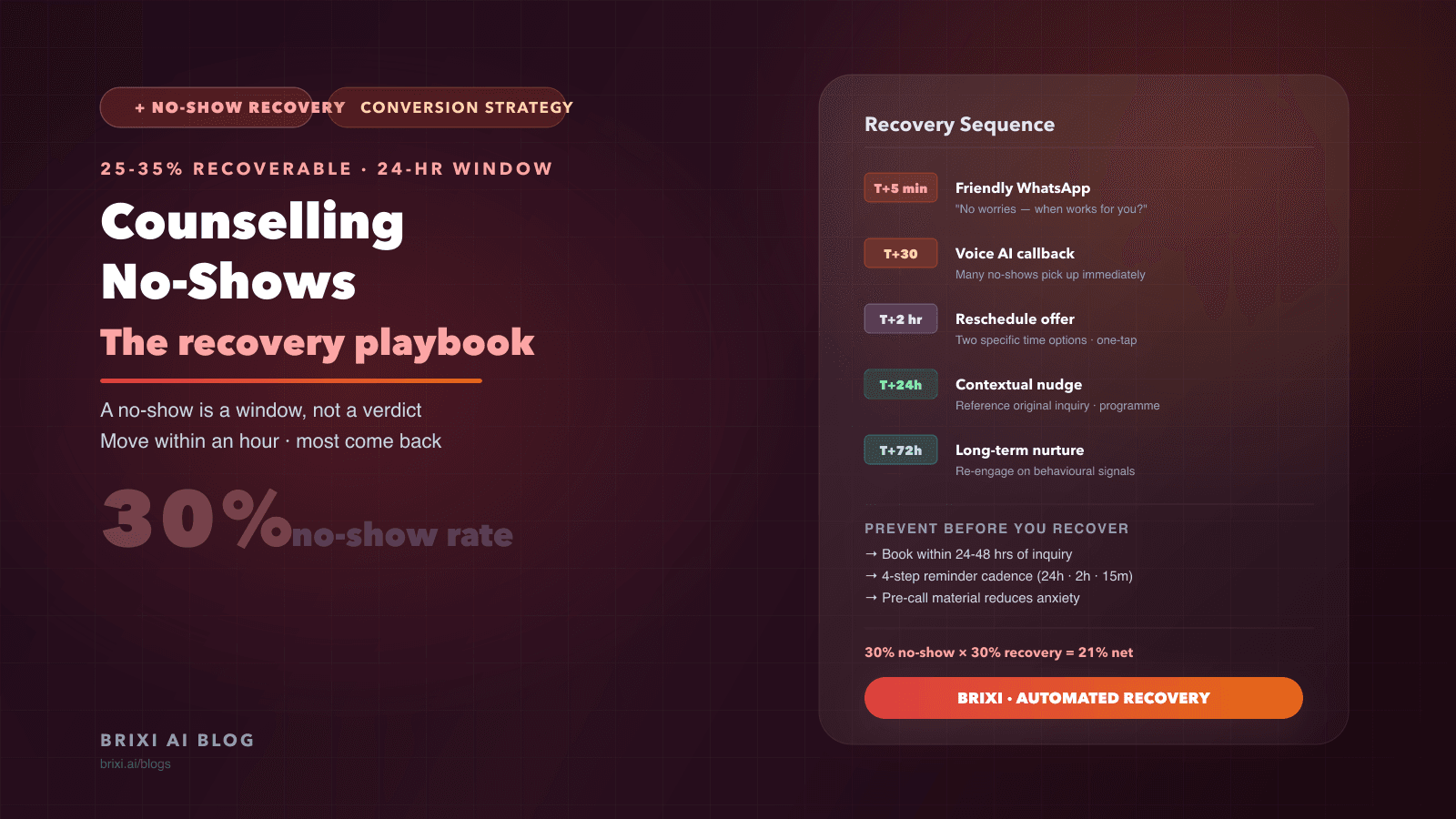
Booked counselling calls that nobody attends are the most expensive pipeline leak in admissions. Each one is a serious applicant drifting toward a competitor. A disciplined no-show recovery sequence, run automatically, brings 25 to 35 percent of missed slots back into a real conversation without any new acquisition spend.
Omkar runs admissions operations for a Pune-based test-prep company. On a Tuesday morning in March, he opened his counsellor dashboard and saw it: twelve calls booked for the day, seven attended, five blank. Not five drops. Five no-shows from applicants who had filled out a form, answered a qualifying question, and picked a time slot themselves. Every one of them had done the work to show intent.
His team sent no immediate follow-up. By the time a counsellor tried calling back the next morning, three of the five had already spoken to a competitor institute. The other two did not pick up at all. Four leads gone, each one representing a cost-per-lead somewhere between eight hundred and two thousand rupees, plus the acquisition effort that had generated the original inquiry.
Omkar is not unusual. Most edtech and admissions teams have a no-show rate between 25 and 40 percent during peak season, and most treat it as an unavoidable loss. That assumption is wrong. A no-show is not a rejection. It is an interruption. The majority of missed counselling slots are recoverable if the recovery sequence starts fast, runs automatically, and applies what Omkar eventually built: the Re-Entry Protocol.
What is the Re-Entry Protocol and why does timing determine everything?
The Re-Entry Protocol is the structured set of automated touches that starts the moment a counselling slot is marked missed. It is not a follow-up drip. It is a timed, channel-specific recovery sequence designed to bring the applicant back into a real conversation before they complete an enrollment action with anyone else.
The protocol operates on a simple truth about admissions behavior: applicant intent is highest within the first 24 hours after a missed slot. They still have the program in mind. They have not yet told themselves the story that they chose a different path. A recovery touch that lands within 30 minutes of the miss catches them in that state. A follow-up that arrives the next afternoon arrives after the narrative has already shifted.
Teams that have deployed the Re-Entry Protocol consistently find that 25 to 35 percent of no-shows reschedule and attend a second slot within 72 hours. That number is not a guarantee, and it varies by program type, lead source, and how tightly the sequence is executed. But for any team spending money on lead generation, recovering one in four missed slots without any additional acquisition cost changes the math on the entire season.
Why do applicants no-show even after booking a slot themselves?
The reasons are worth cataloguing because each one points to a specific fix, either in prevention or in recovery messaging.
- The slot was booked three or more days out and life moved on between the booking and the call.
- The reminder arrived the night before, was seen, and was forgotten by morning.
- A competing institute called at the same time and pulled the conversation away first.
- The parent needed to be present but the student booked it alone, or the reverse.
- Anxiety about not knowing what questions to ask made it easier to simply not pick up.
- The pre-call material never arrived, so the applicant did not feel prepared for the conversation.
- The slot was booked from a form or ad, not from a direct conversation, so commitment was lower.
Notice that almost none of these reasons mean the applicant has decided to enroll elsewhere. They mean the applicant hit a friction point. The Re-Entry Protocol is designed to reduce that friction fast enough to recover the conversation before it is gone.
How do you reduce no-show rates before they happen?
Recovery is the second-best option. Prevention is the first. Three upstream changes consistently reduce baseline no-show rates, and they are worth running in parallel with recovery automation.
Book within 24 to 48 hours of inquiry
Slots booked more than 48 hours out have meaningfully higher no-show rates than same-day or next-day slots. Applicant intent peaks shortly after the inquiry and decays from there. Counsellor calendars should be structured to offer immediate availability. The answer to "when can we talk?" should rarely be "next week."
Send a layered reminder sequence, not a single message
A confirmation message immediately after booking. A reminder 24 hours before. A reminder two hours before with the counsellor’s name and direct number. A final reminder 15 minutes before with a one-tap callback link. This four-touch sequence reduces no-show rates compared to a single reminder, and the investment is near-zero when it runs automatically on WhatsApp.
Send pre-call material that makes the applicant feel ready
A short message with three specific topics the call will cover, the counsellor’s background, and what to keep ready (entrance scores, fee questions, document checklist) reduces anxiety. Anxious applicants no-show at higher rates than disengaged ones. Giving the applicant a sense of what the conversation will feel like is one of the lowest-cost no-show prevention moves available.
What does the Re-Entry Protocol look like step by step?
When a slot is missed, the Re-Entry Protocol starts within 15 minutes. Not the next day. Not when the counsellor has a free moment. Within 15 minutes, while the applicant still has the tab open or the calendar notification on screen.
T+5 minutes: a soft WhatsApp message
The first touch should be warm and low-pressure. Something like: “We missed you on the call just now. No problem at all. Would you like me to call you in a few minutes, or would another time work better today?” This message lands while the applicant still remembers the slot. Accusatory language or urgency language at this stage causes more harm than it prevents.
T+30 minutes: an outbound callback attempt
A Voice AI agent or counsellor should attempt a callback within 30 minutes of the missed slot. A large share of no-shows pick up immediately when called. They were in a meeting, on another call, or simply did not recognize the incoming number in time. The callback attempt is the single highest-converting touch in the entire Re-Entry Protocol.
T+2 hours: a reschedule offer with two specific time options
If the callback did not connect, the next message should offer two concrete time options for later today or tomorrow. "Would 4pm or 7pm today work for a quick call?" outperforms "let me know when you’re free" by a significant margin. Open-ended reschedule requests place the cognitive load on the applicant. Anchored options remove it.
T+24 hours: a contextual reference message
A day later, send a message that references the specific program the applicant inquired about, the question they raised in the original form, or the entrance exam they mentioned. This shows the applicant that the institute remembers them as an individual, not as a missed slot in a queue. That specificity is what separates an edtech CRM follow-up from generic marketing noise.
T+72 hours: route to long-term nurture
If the applicant has not responded after three days, move them into a lower-frequency nurture sequence: exam strategy content, scholarship deadlines, placement statistics, fee deadline reminders. The Re-Entry Protocol is suspended. The nurture sequence re-activates the Re-Entry Protocol automatically when the applicant shows a behavioral signal, such as opening a brochure, clicking a link, or replying to a message.
The anti-pattern that kills recovery rates
The most common failure is the recovery sequence that does not stop when the applicant replies. If an applicant responds to the T+5 message and books a new slot, the T+2-hour reschedule offer and the T+24-hour nudge should not fire. Teams that do not build pause logic into their WhatsApp automation annoy re-engaged applicants and push them back out of the funnel. Automation without conditional logic is not a recovery tool. It is a churn accelerator.
What are the friction points that quietly kill re-entry conversion?
A Re-Entry Protocol that looks clean on paper often underperforms because of small friction points in the actual applicant experience. These are the named anti-patterns to audit before going live.
- Reschedule links that require login or form-fill before showing available slots. The applicant abandons before booking.
- Reschedule offers where the next available slot is three or more days out. Kills urgency and confirms the institute is hard to reach.
- Recovery messages sent from a different number or sender name than the original counsellor. Breaks continuity and trust.
- No mechanism to mark a no-show as an intentional drop-off. Wastes recovery cycles on applicants who have already enrolled elsewhere.
- Recovery sequence firing on public holidays or at 10pm. Even automated outreach has a human etiquette floor.
How do you measure whether the Re-Entry Protocol is producing results?
Three numbers tell you whether the protocol is working. If you are only tracking one of them, you are missing most of the picture.
Baseline no-show rate, tracked weekly
This should trend down over the season as prevention improves. Better reminders, faster slot booking, and better pre-call material all compress the baseline. A falling baseline no-show rate is proof that the upstream fixes are working, not just that recovery is compensating.
Re-entry conversion rate within 72 hours
Of all applicants who no-showed, what percentage rescheduled and attended a second slot within 72 hours? A well-run Re-Entry Protocol puts this number at 25 percent or higher. Teams below 15 percent usually have a friction point in the reschedule flow, a timing problem in the sequence, or a callback attempt that is arriving too late.
Recovered-applicant enrollment rate
Of applicants who came back from a no-show, what percentage eventually enrolled? This number should be comparable to the enrollment rate of applicants who attended their first slot. If it is significantly lower, the recovery sequence is bringing back low-quality reschedules, likely because the callback attempt was not personalized or the reschedule conversation started cold.
What changes after a full admission quarter with the protocol running?
In admissions teams that have automated this entire flow, the compounding effect becomes visible within one full cycle. A 30 percent no-show rate, with 30 percent re-entry recovery, becomes effectively a 21 percent net no-show rate. That nine-point improvement across a full season of, say, five hundred booked slots translates to roughly 45 additional counselling conversations recovered, each one representing a lead that was already acquired and qualified.
The more significant change is operational. Counsellors stop spending time chasing cold no-shows manually. The automation handles the first three to four recovery touches. The counsellor steps in only once the applicant has confirmed a new slot, meaning every conversation the counsellor starts is with someone who has already demonstrated re-engagement. Counsellor morale improves. Conversion quality improves. Burnout from repetitive follow-up decreases.
There is a contrarian point worth acknowledging: automating recovery does not replace the need for good counsellors. Some teams believe that if the automation is strong enough, counsellor skill matters less. The data from high-performing admissions operations runs the other direction. Automation recovers the conversation. The counsellor closes it. Recovery automation only creates value if what comes after it is a competent, prepared human who treats the re-engaged applicant as if the missed call never happened.
What is the deeper bet Omkar was actually making?
When Omkar built the Re-Entry Protocol for his team six months after that Tuesday morning in March, he was not primarily trying to recover leads. He was trying to change the assumption inside his counsellor team that no-shows were an inevitable loss. That assumption was costing him more than the leads themselves. It was making his team passive at the exact moment when speed and warmth were the only things standing between his institute and a competitor.
The Re-Entry Protocol gave the team a concrete action to take within five minutes of a missed slot. It removed the decision fatigue around whether to follow up and when. And it sent a signal to applicants that the institute was responsive, organized, and worth talking to again. That signal, delivered at the right moment through the right channel, is what turns a missed call into an enrolled student.
The deeper bet in any no-show recovery investment is not about the 25 to 35 percent re-entry rate. It is about what kind of admissions operation you are building: one that treats every inquiry as a finite asset to be converted immediately, or one that treats it as an ongoing relationship that can survive friction and still close. The Re-Entry Protocol is the infrastructure for the second kind.
Are your no-shows being recovered within 30 minutes, automatically?
Brixi runs the Re-Entry Protocol end to end: Voice AI callbacks within minutes of a missed slot, WhatsApp reschedule sequences with conditional pause logic, and behavior-driven nurture for applicants who need more time. Counsellors only see applicants who are ready to talk.
See Voice AI for AdmissionsFrequently Asked Questions
Most admissions teams see peak-season no-show rates between 25 and 40 percent. Teams with a single reminder, slots booked more than 48 hours out, or no pre-call material tend to be at the higher end. Teams with layered reminder sequences and fast slot booking run closer to 15 to 20 percent before any recovery intervention.
The first recovery touch should land within 5 to 15 minutes of the missed slot. Recovery effectiveness drops sharply as time passes. Within an hour, the applicant’s memory of the booking starts to fade. Within 24 hours, competing institutes have often already had the conversation. The Re-Entry Protocol is designed to move before either of those things happens.
A well-executed Re-Entry Protocol brings back 25 to 35 percent of no-shows into a rescheduled, attended call within 72 hours. The remaining applicants should receive lower-frequency nurture content, with the recovery sequence re-activating when they show a behavioral signal such as opening a brochure or clicking a fee structure link.
The first three to four recovery touches, the WhatsApp message, the Voice AI callback, the reschedule offer, and the contextual nudge, should run on automation. The counsellor steps in once the applicant has confirmed a new slot. This structure means counsellors spend their time on prepared, re-engaged applicants rather than chasing cold no-shows manually, which is both more effective and significantly better for counsellor retention.