Why Colleges Need AI Triage During the JEE and NEET Admissions Rush
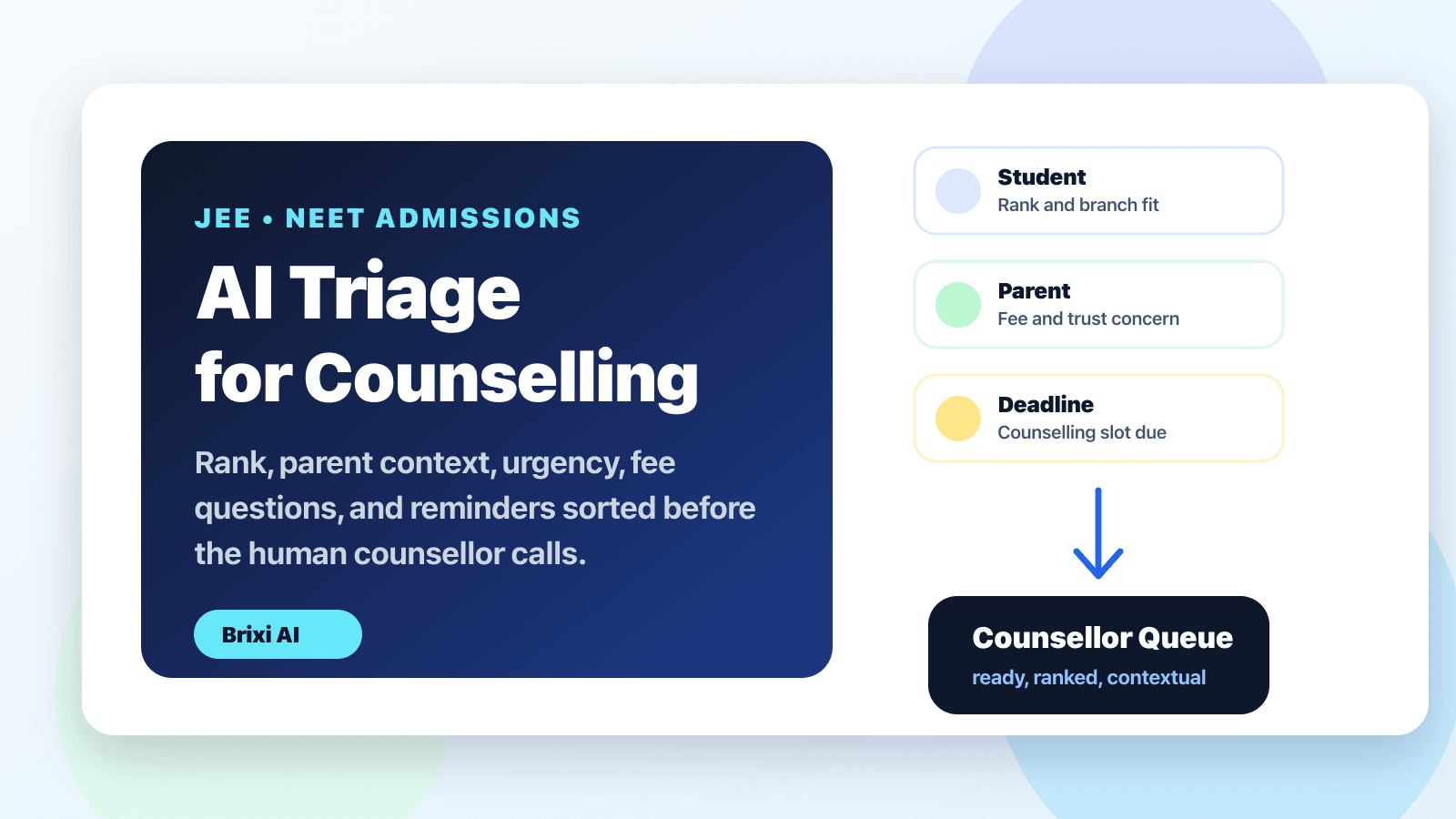
After JEE and NEET, admission counsellors do not need a bigger raw call list. They need AI triage that identifies which students are ready, confused, parent-led, fee-sensitive, or at risk of drifting before a human counsellor spends the next hour calling.
At 9:18 in the morning, Nisha opens the admissions dashboard for a private engineering college. There are 1,247 new inquiries, 312 missed calls, and a WhatsApp queue full of students asking the same question in different words: "With my rank, what can I get?" Two desks away, a counsellor for the allied medical programs is answering a parent who has already spoken to three institutes before breakfast. The parent is not asking for a brochure. He is asking whether his daughter should wait, pay a seat-blocking amount, or keep searching.
This is the JEE and NEET admissions rush from the counselling desk. It does not feel like a lead list. It feels like a moving crowd of anxious students and parents, each carrying a different score, rank, budget, course preference, language, deadline, and fear. The counsellor has to decide who needs a call now, who needs a reminder, who needs fee counselling, who needs parent handling, and who is only browsing.
Call this the Counselling Triage Window: the short period after competitive exams when the quality of the first sorting decision shapes the entire admission outcome. The institutes that win are not simply the ones that call more students. They are the ones that know which student needs which counselling path before the human call begins.
The admissions rush is a counselling problem before it is a calling problem
Most colleges and coaching centers treat admission season as a temporary calling crisis. More form fills arrive, so they add callers. More parents ask questions, so they extend shifts. More students request callbacks, so they push counsellors to clear the queue. The surface problem looks like volume.
The deeper problem is classification. A student asking about CSE after JEE is not the same as a student asking whether they should repeat. A medical aspirant asking about hostel rules is not the same as a parent asking whether the fee can be paid in two parts. A coaching lead who says "call after result" is not cold. They are waiting for a trigger. If all of them sit in the same flat queue, the counsellor spends the day guessing.
AI triage changes the first job of the system. Instead of handing every inquiry to a counsellor as an unstructured name and number, it captures the state of the decision. What exam did the student appear for? What rank or score range are they working with? Which course or batch are they considering? Is the caller the student or parent? What is the real blocker: eligibility, fee, location, hostel, scholarship, documents, or confidence?
What the counsellor needs before the first human call
A good counselling call does not start with "Which course are you interested in?" during peak season. That question should already be answered. The counsellor should open the call with context: "I saw you are comparing CSE and ECE, and your parent had a fee question. Let us walk through realistic options." That opening changes the tone of the entire conversation.
The pre-call context should be simple, structured, and directly useful. A counsellor does not need a 900-word transcript summary. They need the next five signals.
- Decision role: student, parent, guardian, or mixed conversation.
- Academic fit: exam appeared, rank or score range, target course, and eligibility questions.
- Urgency: deadline pressure, seat-blocking timeline, counselling slot request, or repeat-year consideration.
- Financial context: fee concern, scholarship inquiry, installment request, or loan discussion.
- Next action: call now, send fee breakup, book campus visit, remind after result, escalate to senior counsellor, or move to nurture.
This is where Brixi fits the counselling workflow. Voice AI and WhatsApp AI handle the first qualification exchange, update the CRM, detect student versus parent context, and create a ranked queue for counsellors. The human counsellor still makes the serious decision-stage call. They just stop spending that call doing intake.
AI triage must understand parents, not only students
In Indian admissions, the buyer and the user often sit in different rooms. The student worries about branch, peers, city, coaching quality, hostel life, and whether they are making the right academic bet. The parent worries about fee, safety, credibility, placement, faculty, and whether the child will stay disciplined. The same applicant can produce two entirely different conversations in one afternoon.
A temporary calling team usually collapses this nuance into one status: interested, not interested, callback, or follow-up. That is too blunt for counselling. If the father asks about fee and the student later asks about switching branches, those signals should sit under one applicant record, but they should not be treated as the same conversation.
Brixi keeps that distinction visible. The AI assistant can identify who is speaking, ask the right next question, remember prior context across voice and WhatsApp, and hand the counsellor a single view of the student and family decision. The counsellor walks in prepared for the real objection instead of discovering it ten minutes into the call.
The counselling rule
Admission AI should not replace the counsellor. It should remove the blind first five minutes of every counselling conversation, so the human starts where judgement actually matters.
The highest-risk students are often not the loudest students
Peak season creates a dangerous bias. The students who keep messaging get attention. The parents who call twice get callbacks. The quiet student who filled a form, read the fee page, and is deciding between two colleges can disappear without creating noise. By the time the counsellor reaches them, they have already paid a token amount somewhere else.
AI triage should surface silent high-intent leads. A student who opened the hostel details twice, clicked the scholarship page, replied "I will discuss with my father," and stopped responding is not a low-priority lead. They are a counselling risk. They need a different touch: a parent-facing fee explanation, a scheduled callback, or a senior counsellor who can address the hesitation.
This is where plain reminder automation falls short. A generic "complete your admission" message ignores the reason the student paused. Brixi can trigger reminders from conversation state: document pending, parent callback due, counselling slot missed, scholarship deadline approaching, or campus visit not confirmed. The reminder is tied to the decision, not just the date.
What changes for counsellors after AI triage is in place?
The first change is emotional. Counsellors stop opening the day with a flat list they do not trust. They open with a ranked queue and a reason each lead is there. The top of the queue is not "newest lead." It is "parent asked for fee breakup and wants callback before evening," or "student has rank range and wants CSE options," or "campus visit scheduled but documents pending."
The second change is call quality. Counsellors spend less time asking obvious questions and more time counselling. That means explaining realistic branch options, helping a parent compare fee structures, guiding a student through a repeat-year decision, or clarifying what the next step actually involves. Those are the conversations that close admissions. They are also the conversations that protect the institute brand.
The third change is manager visibility. Admissions heads can see which stage is clogged: unqualified inquiries, parent objections, fee concerns, document reminders, missed counselling slots, or payment hesitation. Without that view, every problem sounds like "the team needs to call more." With that view, the team can fix the actual bottleneck.
What engineering and medical colleges should automate first
A college does not need to automate every admissions workflow on day one. The highest-return starting point is the first triage conversation across voice and WhatsApp. That conversation should collect the minimum viable counselling context and decide the next step.
- For engineering colleges: rank range, preferred branch, city or hostel preference, fee concern, parent involvement, and whether the student is comparing other colleges.
- For medical and allied health colleges: entrance status, target program, eligibility questions, fee and scholarship concerns, location preference, and parent callback requirement.
- For coaching centers: exam track, attempt year, repeater or fresher status, batch preference, schedule constraints, parent decision role, and urgency to start.
Once this is working, the next layer is reminders. Not generic reminders, but counselling-state reminders: attend the session, bring documents, speak with parent, confirm scholarship form, visit campus, complete payment, or re-engage after the result trigger. These reminders keep the student moving without forcing a counsellor to manually chase every micro-step.
The deeper bet: counselling teams will become decision teams
The old admissions model treated counsellors as the first line of response. They answered every question, sorted every lead, sent every brochure, chased every reminder, and then somehow still had to close admissions. During JEE and NEET season, that model breaks because the crowd moves faster than the team can classify it.
The new model treats counsellors as decision specialists. AI handles the first touch, captures context, sorts the queue, sends the right reminders, and escalates when judgement is needed. Human counsellors spend their energy on the moments where trust, nuance, and persuasion matter.
That is the real advantage during the JEE and NEET admissions rush. Not more calls. Better counselling minutes.
Give counsellors a queue that already understands the student
Brixi helps colleges and coaching centers qualify students, handle parent and student context, trigger reminders, and route high-intent admissions conversations to the right counsellor.