AI CRM for Coaching Institutes: Win JEE, NEET, UPSC Admissions
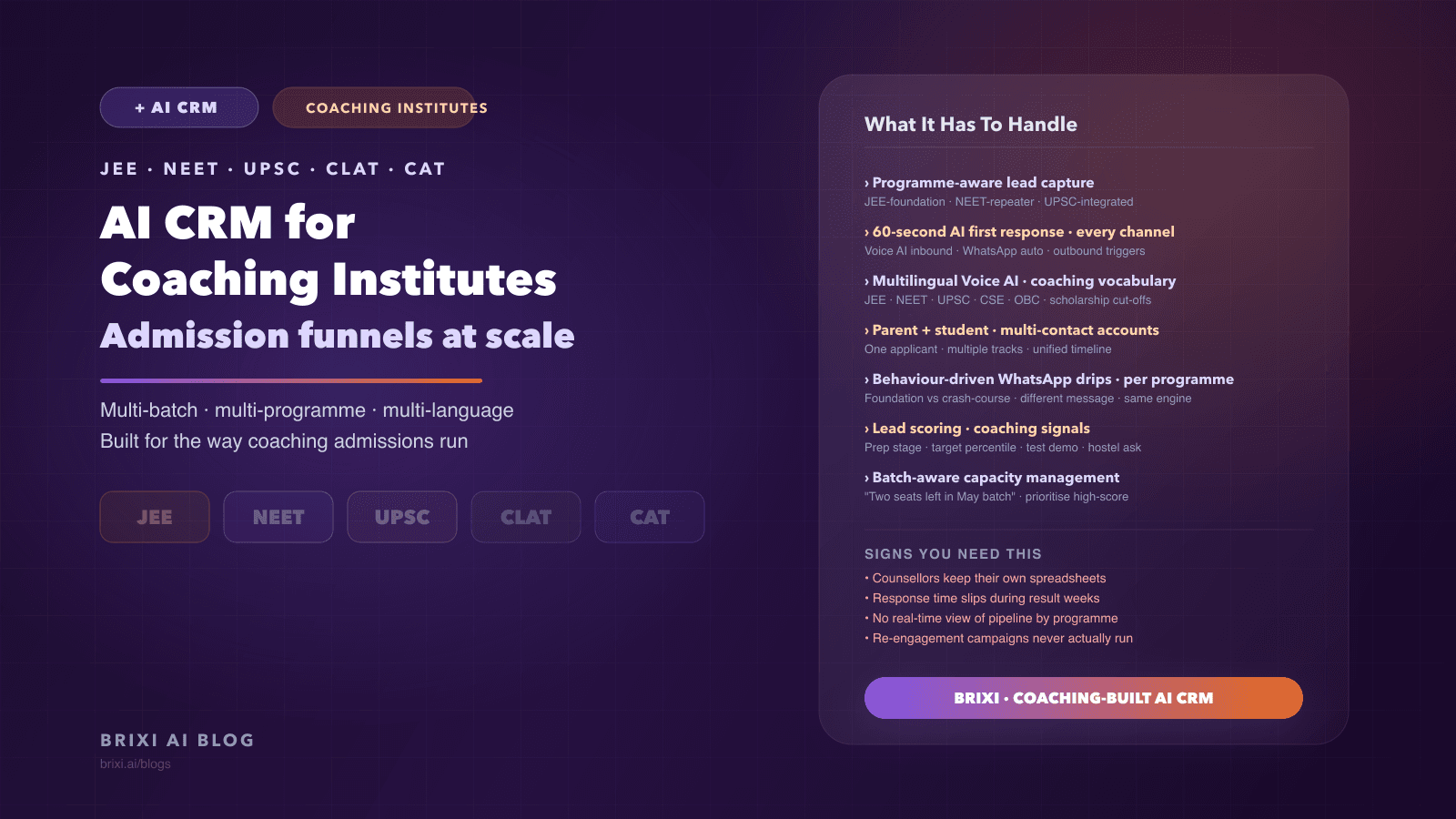
Coaching institutes running JEE, NEET, UPSC, and CAT admissions face a funnel problem that generic CRMs were never designed to solve: multiple programmes, exam-result surges, parent-as-decision-maker dynamics, and competitors calling the same lead within the hour. Here is how an AI CRM built for this reality changes the outcome.
Ankit runs admissions for a mid-size JEE and NEET coaching institute in Noida. In the third week of April, JEE Main Session 2 results dropped on a Tuesday evening. By Wednesday morning his team had 340 new form fills, 180 missed inbound calls, and a WhatsApp inbox that had not been touched since 11 PM the previous night. Three of his counsellors called in sick. The two who showed up spent the first two hours of the day figuring out which leads had already been called by a competitor.
This is not a staffing problem. It is a structural problem. The same Tuesday-evening result drop happens every April. Ankit knew it was coming. His CRM did not.
Coaching admissions have a specific pressure pattern that separates them from every other education vertical. The funnel does not flow continuously. It spikes in predictable bursts keyed to exam calendars, each spike generating inquiry volumes that overwhelm manual processes and leave high-intent applicants unanswered at the exact moment they are deciding where to enrol. Call this the Batch Pressure Stack: the compounding load of multiple programmes admitting in parallel, each subject to its own exam-result surge, all competing for the same counsellor bandwidth at the same time.
An AI CRM built for coaching institutes is not a generic sales tool with coaching-themed labels pasted on. It is a system designed around the Batch Pressure Stack, one that absorbs the spike without requiring proportional headcount growth and routes every inquiry to the right place before a competitor picks up the phone.
Why does the Batch Pressure Stack break generic CRMs?
Generic CRMs assume a roughly linear inquiry flow with one active programme and one decision timeline. Coaching institutes operate nothing like this. At any given moment, an institute like Ankit’s might be admitting students across JEE foundation, JEE crash course, NEET regular, NEET repeater, and UPSC integrated programmes, each with two or three batch start dates within the same quarter. That is fifteen to twenty parallel admission funnels running simultaneously, each with its own fee structure, counsellor specialisation, seat inventory, and messaging cadence.
When JEE Main results drop, the JEE funnels spike. When NEET cut-offs are released, the NEET funnels spike. The Batch Pressure Stack means these spikes often overlap. A generic CRM has no mechanism to route a JEE Advanced foundation inquiry to the counsellor who specialises in that programme, no awareness that the May batch has three seats left while the June batch is half-empty, and no ability to trigger an automated first-response within 60 seconds of a form fill at 11 PM on a Tuesday.
The workarounds are well-known: counsellors keep parallel spreadsheets, WhatsApp group threads serve as ad-hoc routing, and batch capacity is tracked in an Excel file that only one person fully understands. Every one of these workarounds is a conversion leak.
What does programme-aware lead routing actually look like?
The first thing a coaching-built AI CRM does differently is capture programme intent at the moment of inquiry and route immediately. When a parent fills a form saying their child dropped NEET this year and is looking for a repeater batch starting in June, that inquiry should arrive in the queue of the counsellor who handles NEET repeaters, tagged with the programme, the relevant batch start date, the available seats, and the fee range, before that counsellor picks up the phone.
This sounds straightforward. In practice, most coaching institutes see a 20 to 30 minute delay between form fill and first counsellor contact because the lead lands in a shared inbox, gets assigned manually, and the counsellor then has to research the right programme context before calling. In a competitive market where three other institutes are calling the same parent, 20 minutes is the difference between opening the conversation and getting told "we already enrolled elsewhere."
Programme-aware routing also means the CRM respects counsellor specialisation. An AI CRM for coaching should let the admissions head configure routing rules by exam, by programme type, and by batch tier, so that subject experts handle the counselling conversations they are actually equipped for. Generalist routing is an anti-pattern that coaching institutes outgrow quickly.
Why is Voice AI the most important feature for coaching admissions?
On the night of an exam result, Ankit’s team cannot answer 180 calls. A Voice AI agent can. More importantly, a coaching-tuned Voice AI can answer those calls in Hindi, Tamil, Telugu, or Marathi, pronounce "JEE Advanced," "NEET PG," "OBC reservation," and "prelims" correctly, confirm which batches are available, and either book a counsellor slot or qualify the inquiry for callback by programme and urgency.
The contrarian claim worth making here: Voice AI for coaching is not about replacing counsellors. It is about ensuring that every high-intent inquiry receives a substantive first response within 60 seconds, regardless of the hour, the day, or how many other results just dropped. Counsellors are expensive, specialised, and finite. Voice AI absorbs the spike so counsellors spend their hours on conversations that actually require human judgement.
In deployments at coaching institutes, Voice AI handles the bulk of first-touch triage during exam-result windows, qualification conversations outside office hours, and re-engagement calls to cold leads from the previous cycle. The counsellor queue that opens each morning is pre-sorted: the leads that need human attention are at the top, the leads that need another automated touchpoint are already in a drip.
How should a coaching CRM handle parent-as-decision-maker dynamics?
Coaching admissions are more parent-driven than almost any other education category. The student fills the form; the parent makes the fee decision. In many UPSC and JEE foundation cases, the parent is also the one asking the detailed questions about faculty, batch size, hostel availability, and scholarship percentile cut-offs. A CRM that models the applicant as a single contact with a single phone number loses half the relevant conversation history.
A coaching-built AI CRM treats each applicant as an account with multiple contacts: student, mother, father, and sometimes a sponsor or extended family member. Each contact has their own language preference, their own conversation history, and their own engagement track. When the father calls to ask about the fee instalment schedule, the counsellor should see that the mother already attended a brochure walkthrough last week. When the student attends a test-series demo, the system should update the parent’s engagement score, not just the student’s.
The Batch Pressure Stack is predictable. The response should be too.
JEE Main results in January and April. NEET UG in June. UPSC prelims in May. CAT in November. Every major exam result is a known date on the coaching institute’s calendar, and every one of them triggers a spike in the Batch Pressure Stack. The institutes that convert at those spikes are not the ones with more counsellors. They are the ones whose CRM was already set up to absorb the volume automatically before the results were announced.
What does lead scoring look like for coaching admissions specifically?
Generic lead scoring uses recency, frequency, and monetary signals. Coaching admissions scoring needs a different set of dimensions.
- Fit signals: current preparation stage, previous attempt scores or percentile, target exam year, and declared family fee budget.
- Intent signals: whether the inquiry is for a specific batch start date, whether scholarship eligibility was asked about, whether hostel availability was a question.
- Behavioural signals: attendance at a test-series demo or open house, depth of brochure engagement, response rate to WhatsApp messages.
- Competitive signals: time elapsed since form fill, whether the lead has gone quiet after an initial conversation (often a sign a competitor has moved in).
- Parent engagement signals: whether the parent contact has engaged independently from the student, which is a strong predictor of conversion in high-fee programmes.
These signals combine into a score that ranks the counsellor queue, triggers automated next steps when a threshold is crossed, and flags leads that are at risk of going cold. In practice, coaching institutes that deploy this model spend counsellor time on the leads most likely to convert rather than on whoever submitted a form most recently.
What changes after a quarter with a coaching-built AI CRM?
After one admission cycle on a coaching-built AI CRM, the operational picture looks different in concrete ways.
- First-response time drops from 20 to 60 minutes to under 90 seconds on most channels, including at exam-result hours.
- Counsellors start each day with a ranked call queue rather than a flat list, cutting wasted calls on low-intent inquiries.
- Programme-specific WhatsApp drips run without manual intervention, keeping leads warm between counsellor touchpoints.
- Leadership has a real-time dashboard by programme, by batch, by counsellor, and by source, so capacity decisions are made on actual pipeline data.
- Re-engagement campaigns from the previous cycle actually run, because the segmentation is automated rather than a manual project nobody has time for.
- Counsellor onboarding drops from a week to a day or two, because the system surfaces context rather than requiring the counsellor to carry it all in memory.
The most counterintuitive change is what happens to the counsellors who were previously the highest performers. In most coaching institutes, the top counsellors succeed by keeping personal spreadsheets, managing their own WhatsApp follow-ups, and remembering details that the CRM never captured. When the CRM starts doing that work automatically, those counsellors do not become redundant. They become even more effective, because the administrative load they were carrying disappears and their conversations are better prepared.
The deeper bet: owning the Batch Pressure Stack as a competitive advantage
Ankit’s institute called the same result-night leads that three competitors called. The difference in conversion came down to who called first, who called in the right language, and who had the right programme detail ready. That is not a question of counsellor quality. It is a question of infrastructure.
The institutes that will consistently outperform on coaching admissions over the next several years are the ones that treat the Batch Pressure Stack as a known constraint to engineer around, not a recurring crisis to manage manually. A coaching-built AI CRM is the engineering solution. It absorbs the surge, routes with precision, keeps every parent and student in the right conversation, and frees counsellors for the high-value work that actually requires their expertise.
The institutes that keep using generic CRMs will keep experiencing Ankit’s Tuesday night. The ones that switch will run a better admission cycle every time an exam result drops, which is to say, every single quarter.
Ready to stop losing coaching admissions to the first caller?
Brixi handles JEE, NEET, UPSC, CLAT, and CAT admission funnels with programme-aware Voice AI, multilingual WhatsApp drips, parent-and-student multi-contact accounts, and lead scoring built for coaching admissions reality.
Book a DemoFrequently Asked Questions
Voice AI for first-touch response is the single highest-impact feature, because coaching conversion depends on responding to high-intent inquiries within 60 seconds, especially during exam-result windows. Close behind it is programme-aware lead routing, which ensures that JEE, NEET, and UPSC inquiries reach the right specialised counsellor immediately rather than sitting in a shared inbox. Multilingual WhatsApp drips and coaching-specific lead scoring complete the core stack.
A coaching-built AI CRM is configured before result day to handle the surge automatically. Voice AI picks up inbound calls and qualifies leads in Hindi, Tamil, Telugu, and other regional languages. WhatsApp automation responds to form fills within seconds. Outbound Voice AI calls go out within minutes of high-intent signals. By the time counsellors arrive the next morning, the queue is pre-sorted by programme and urgency, and the leads that need human attention are at the top.
A coaching-built AI CRM treats each programme as a parallel funnel with its own routing rules, drip sequences, batch calendar, fee structure, and scoring model. The admissions head sees a unified dashboard across all programmes, while each counsellor works in their programme-specific queue. This is the core design requirement that generic CRMs fail to meet, because they were not built to run fifteen or twenty parallel admission funnels at the same time.
The correct model is one applicant account with multiple contacts: student, mother, father, and any other decision-maker. Each contact has their own language preference, conversation history, and engagement track. When a parent calls independently, the counsellor should see the full account context including any conversations the student has already had. WhatsApp drips can be configured to address parents and students differently within the same applicant journey, which is especially important for high-fee programmes where the parent is the primary decision-maker.