When the Wrong Person Answers: Voice AI and Customer Identity

Voice AI needs an Identity Before Context Rule. The fact that a call reaches a known number does not establish who answered or what they are authorized to hear.
Imagine an assistant calling about a property financing inquiry. A family member answers the shared phone. The assistant opens with the customer’s budget and loan concern before establishing who is speaking. It has personalized the call using correct information and disclosed that information to the wrong person.

The Identity Before Context Rule keeps the customer’s meaning connected to the next action.
Voice AI needs an Identity Before Context Rule. The fact that a call reaches a known number does not establish who answered or what they are authorized to hear. A connected customer record should support a restrained opening, an appropriate identity check, and a safe path when the intended person is unavailable.
A familiar number can belong to an unfamiliar speaker
Separate destination number, actual speaker, intended contact, and permission for the current discussion. Apply a verification approach appropriate to the business and information involved. A routine request for the person is different from formal account authentication. Do not invent a universal script that claims to satisfy every privacy or regulatory requirement.
Identity and permission are related but different. Establishing a person’s name may be sufficient to deliver a generic requested brochure, while discussing account-specific information may require a stronger approved verification step. Define the boundary for the particular workflow. An assistant that applies the same intrusive check to every call creates unnecessary friction. An assistant that skips verification because the topic feels ordinary may expose information the customer expected to remain private.
Identity mistakes also corrupt customer memory
Wrong-person disclosures can harm customer trust even when the information seems ordinary to the sales team. The assistant may also treat the family member’s responses as the customer’s preferences, creating incorrect opt-outs, callbacks, or qualification notes. The problem therefore affects both disclosure and the integrity of future memory.
The practical failure is specific: known number is treated as verified identity. The desired behavior is equally specific: sensitive context waits for the correct recipient. Use those two statements as the review boundary. A response should be judged by the state it leaves behind, not only by whether its wording sounds helpful.
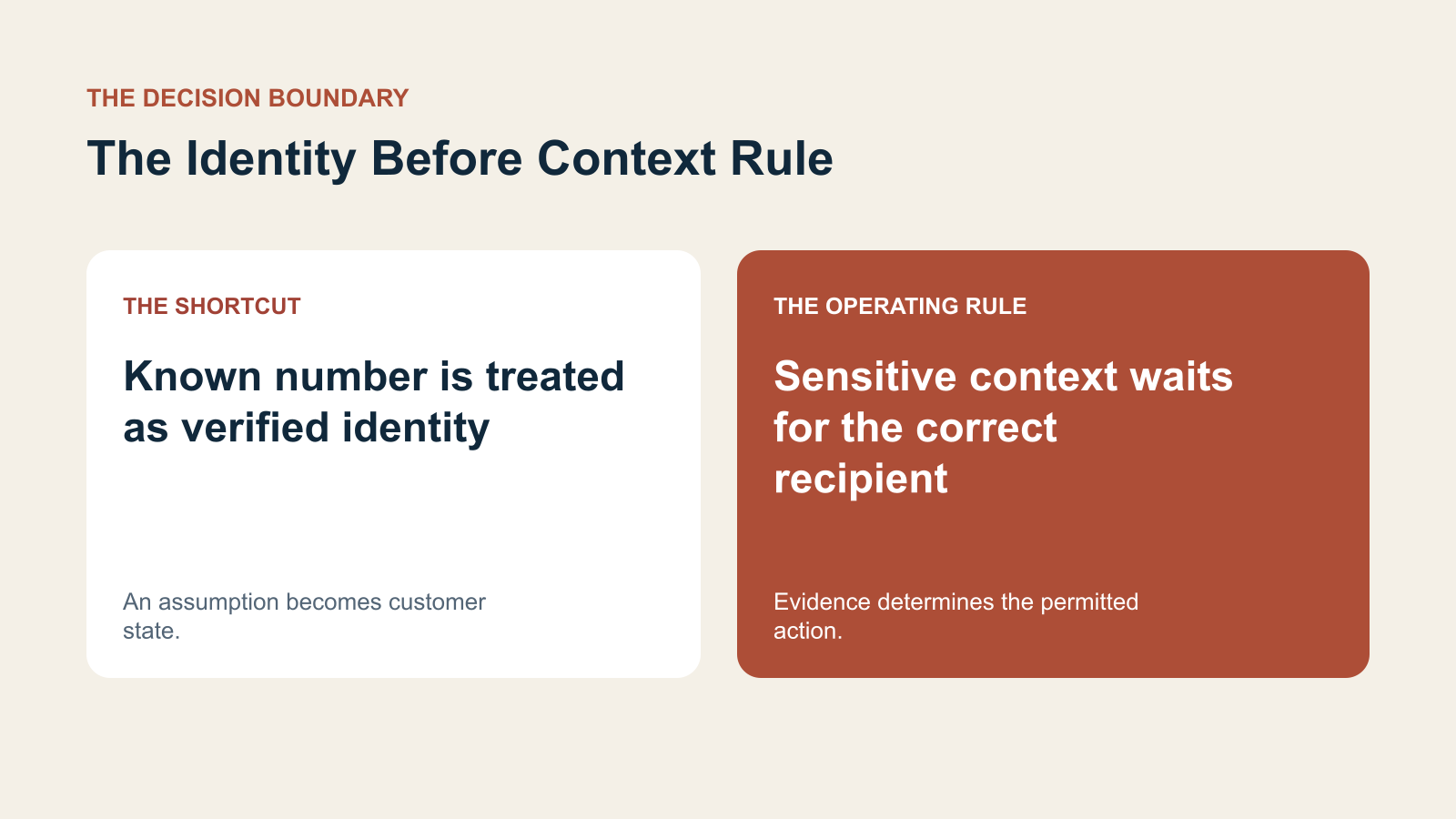
The Identity Before Context Rule: the wrong shortcut and the evidence-based decision.
The working record behind The Identity Before Context Rule
The record needs enough structure for another owner to verify the interpretation. For this journey, preserve four parts together rather than scattering them across a transcript, a note, and an action queue. Each part below has a different operating purpose. A populated field is useful only if the next owner can tell what it refers to and whether it is current.
Destination number and intended contact
Treat the destination as a routing input, not proof of speaker identity. Shared devices and transferred calls can reach someone other than the intended customer.
Actual speaker and confirmed relationship
Record the actual speaker and verified relationship where relevant. A family member's availability report is relayed information, not the customer's own commitment.
Verification state and permitted discussion scope
Match verification to the sensitivity of the discussion. A neutral introduction and an account-specific action can require different approved identity boundaries.
Attributed response and approved callback path
Preserve attribution in callback and preference updates. Do not convert another person's casual answer into the customer's budget, intent, or product rejection.
Use a restrained opening before personalized detail
Open with an approved neutral introduction and ask for the intended person without stating private details. If they are unavailable, offer a permitted generic callback path. Record what the actual speaker said with attribution. Do not update the buyer’s budget, intent, or permission from a relative’s casual response unless the authorized relationship and applicable policy support it.
A suitable clarification or acknowledgment in this illustrative scenario is: “May I speak with the person who requested the information?” The wording is an example to adapt to the approved customer process, not a universal script. Its purpose is to make the next decision clear without claiming that an unverified action has already completed.
Attribution should remain correct even when the conversation ends early. If a family member says the customer is unavailable until evening, record that as a relayed availability statement. Do not treat it as a direct commitment from the customer. If the speaker asks not to receive calls on their own number, route that request through the relevant contact-preference process without assuming the intended customer has rejected the product. These distinctions make later recovery both more respectful and more accurate.
The Identity Before Context Rule
Known number is treated as verified identity. Sensitive context waits for the correct recipient.
The boundary cases that change the correct action
The customer may ask a representative to handle the call, or a receptionist may transfer it. Verify the relevant authority before continuing into restricted topics. A caller claiming to be the customer does not automatically satisfy a sensitive workflow’s requirements. Escalate when the assistant cannot complete the business’s approved identity process.
Map information sensitivity for the specific call journey. Define the neutral opening, allowed identity questions, wrong-person disposition, and contact-preference handling. Review shared-device and representative scenarios alongside ordinary successful calls. Preserve access to the underlying evidence for authorized reviewers without exposing unnecessary information in broad campaign reports.
Introduce the change in review mode first. The assistant prepares an interpretation and proposed next step while the existing authorized process remains in control. Collect disagreements with a reason, including cases where the reviewer lacks enough evidence to decide. Once the team can distinguish an interpretation mistake from a policy exception, expand only the narrowly defined actions that consistently produce reviewable results.
How to test The Identity Before Context Rule before expanding it
Begin the evaluation with the business decision, not the quality of the wording. Have a reviewer inspect the original exchange and identify the action it actually permits. Then compare the assistant’s interpretation, saved record, and customer-facing message. These three outputs can disagree even when each appears reasonable in isolation.
- A relative answers; the assistant does not disclose the customer’s financial concern.
- A receptionist transfers the call; identity is reassessed after transfer.
- A third party declines on the customer’s behalf; customer intent is not overwritten automatically.
Test the opening with a shared household phone, a corporate receptionist, a delegated representative, and an unknown speaker who requests details. Review the earliest point at which personal context is revealed. Then inspect the resulting CRM changes. A call can avoid disclosure yet still incorrectly update the customer’s preferences from the wrong person’s statements. The identity boundary must protect both what leaves the system and what becomes durable memory.
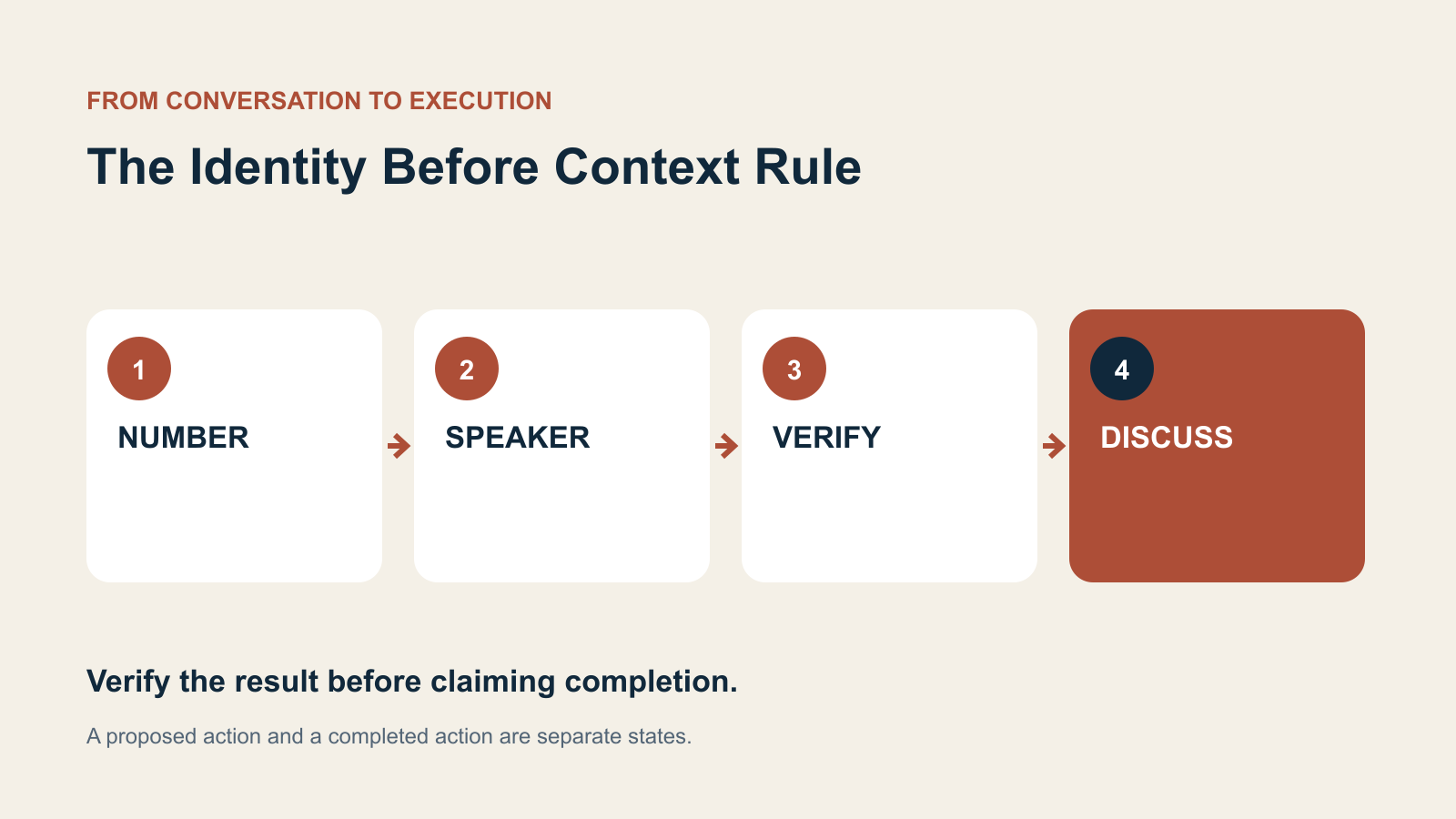
NUMBER → SPEAKER → VERIFY → DISCUSS: review the state transition, not just the response.
Measure decision accuracy alongside customer effort
Audit personal details spoken before the identity boundary, customer fields changed from another person’s answers, and legitimate contacts blocked by excessive verification. Report wrong-person and unreachable outcomes separately. A safe wrong-person disposition should not be hidden as a generic failed call.
Use an explicitly illustrative audit to make the denominator clear. Suppose reviewers inspect 40 cases that genuinely require The Identity Before Context Rule, and find 6 unsupported actions. That is 6 divided by 40, or 15% in that sample. It is not a market benchmark or an expected result. Counting 200 unrelated greetings alongside those cases would hide the failure without fixing it. Keep the relevant case count, error count, review rules, and uncertainty visible when reporting the result.
Also inspect the opposite failure: an unnecessary hold when the evidence was already sufficient. Reviewers should distinguish a justified clarification from an avoidable repeat question. An appropriate human review is different from a case abandoned without an owner. Pair the action error rate with customer effort and completion evidence so the team cannot improve one dashboard by moving the cost to the customer or another department.
Connect The Identity Before Context Rule with the rest of customer operations
Brixi treats Voice AI as part of a complete AI-native customer platform. Calls connect with CRM memory, WhatsApp, workflow execution, qualification, routing, and the human team. The operating benefit is that a phone event can be reviewed beside the customer state and the next action, instead of requiring an operator to reconcile a dialer, a transcript archive, and a separate task queue.
For this use case, make the implementation review concrete: ask the Brixi team to walk through the original evidence, the current CRM state, the permitted action, and recovery when that action cannot complete. Validate any required source system, permission rule, and approval path during configuration. The recommended operating design in this article should be demonstrated against the actual deployment rather than assumed from a generic AI feature label.
For the wider operating model, read the anatomy of a Voice AI agent. The important connection is between interpretation and accountable execution: the same evidence should prepare the assistant, the responsible human, and the next workflow.
What to inspect after the first quarter
After a quarter, the useful evidence is a change in operating behavior: fewer unsupported actions, fewer repeated clarifications, and clearer ownership of unresolved cases. Treat these as questions to investigate, not promised gains. Compare similar journey types and inspect the difficult cases as well as the average. Improvements should survive a new owner, a changed source record, and an ordinary customer correction.
The deeper bet behind The Identity Before Context Rule
Personalization needs a recipient boundary. The stronger customer platform will know a great deal about a relationship while revealing only what the present interaction permits. That makes shared context more trustworthy and prevents automation from confusing a familiar phone number with a verified person.
Put The Identity Before Context Rule into a connected customer workflow
Explore how Brixi connects Voice AI, CRM, AI assistants, conversations, workflows, and human teams around a reliable next action.