A Voicemail Answered the Call. Your AI Should Not Mark the Customer Reached.
Voice AI needs a Human Contact Boundary separating telephony connection from customer participation. Answered, human reached, identity established, purpose discussed, and action confirmed are different states.
Consider an outbound campaign where a phone connection is counted as a reached lead. An answering message plays, the assistant asks its qualification questions, and the call ends. The dashboard records contact, but no customer participated. A rep later skips that lead because the system says the first conversation already happened.
The Human Contact Boundary keeps the customer’s meaning connected to the next action.
Voice AI needs a Human Contact Boundary separating telephony connection from customer participation. Answered, human reached, identity established, purpose discussed, and action confirmed are different states. A campaign becomes misleading when the earliest technical event substitutes for all the later business outcomes.
Telephony success is only the first boundary
Use the available call events and conversation evidence to classify the interaction, retaining uncertainty when an answering system cannot be distinguished confidently. Do not claim perfect voicemail detection. A recorded greeting, a receptionist, and the intended customer can all produce connected audio while supporting very different next actions.
The disposition model should express what is known. A connected line establishes a technical event. A short exchange establishes participation. Identity and purpose require further evidence. Keep these stages separate even if a vendor exposes only a broad call-status field. The customer platform can retain a richer operating disposition beside that field. This prevents a technical limitation in one component from becoming a misleading definition of customer contact across the entire organization.
A false reached label suppresses useful recovery
False reached labels reduce recovery and distort qualification rates. Managers believe the team spoke with customers who have never heard the offer. Reps inherit empty or fabricated qualification fields. Cost per contacted lead looks attractive because the denominator includes machines, while genuine customer availability remains unknown.
The practical failure is specific: a connection becomes a completed customer conversation. The desired behavior is equally specific: participation is established before qualification. Use those two statements as the review boundary. A response should be judged by the state it leaves behind, not only by whether its wording sounds helpful.
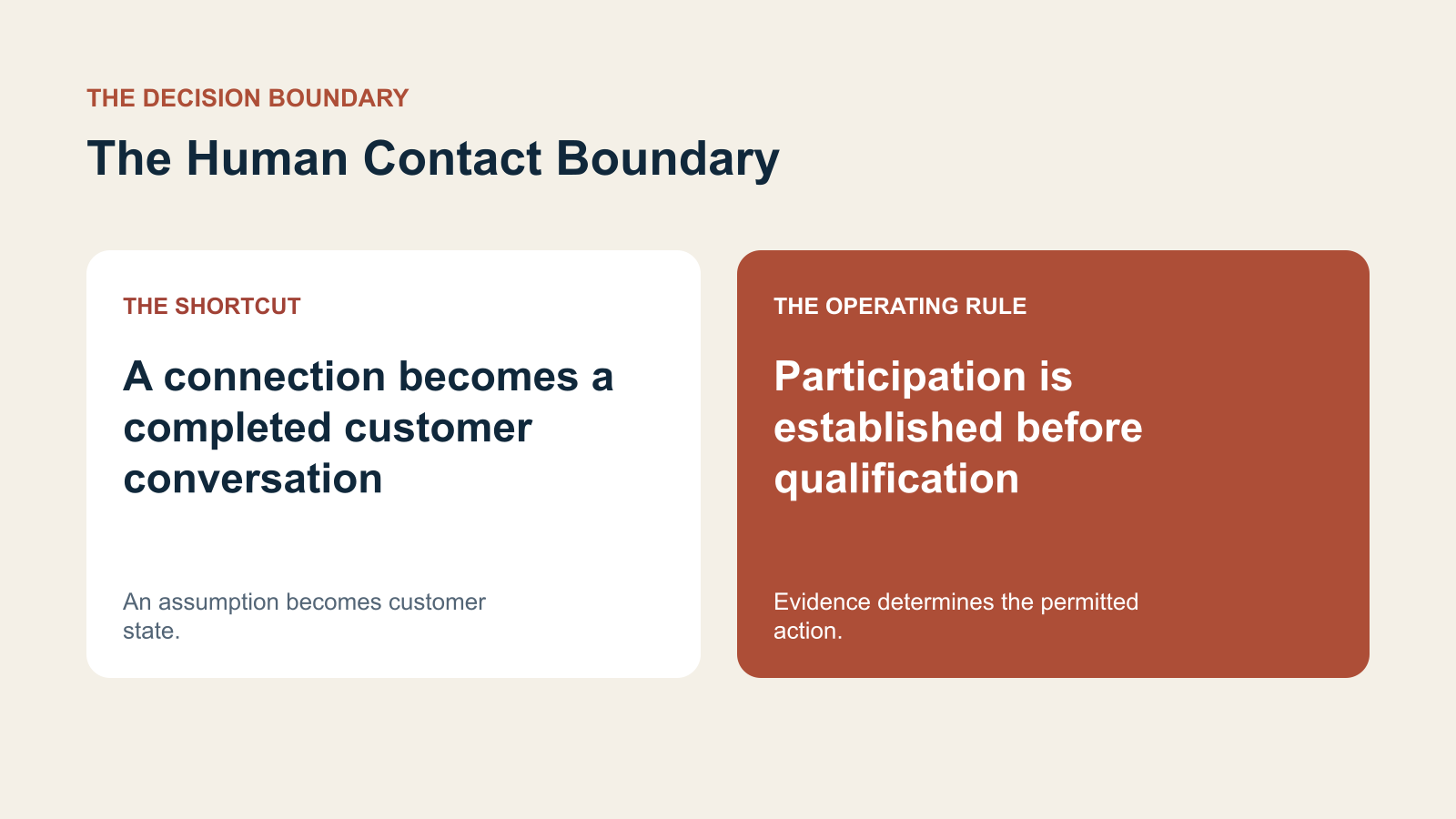
The Human Contact Boundary: the wrong shortcut and the evidence-based decision.
The working record behind The Human Contact Boundary
The record needs enough structure for another owner to verify the interpretation. For this journey, preserve four parts together rather than scattering them across a transcript, a note, and an action queue. Each part below has a different operating purpose. A populated field is useful only if the next owner can tell what it refers to and whether it is current.
Technical connection and answering-state evidence
Keep connection separate from participation. An answered line establishes a phone event without proving that a person heard or discussed the purpose.
Human participation and intended-person status
Distinguish a receptionist from the intended recipient. A live voice can still leave identity and customer contact unresolved for the business outcome.
Approved message or no-message decision
Follow the approved message policy. Rich CRM context should not become a personalized voicemail disclosure merely because the call has connected.
Retry eligibility and unresolved qualification
Leave qualification unanswered when no customer participated. The correct retry path should use the actual disposition rather than a manufactured conversation success.
Keep uncertainty visible in call disposition
If the evidence indicates voicemail, record the attempt as voicemail or uncertain answering state. Leave only an approved generic message when the contact policy permits it. Keep qualification unanswered and apply the appropriate retry or customer-requested alternative channel. A later genuine callback should start from the attempt history without pretending a prior conversation occurred.
A suitable clarification or acknowledgment in this illustrative scenario is: “May I speak with the person who requested this information?” The wording is an example to adapt to the approved customer process, not a universal script. Its purpose is to make the next decision clear without claiming that an unverified action has already completed.
Voicemail handling also needs a content boundary. An approved generic message may invite a callback without describing private account details. Some workflows may permit no message at all. Follow the business’s contact policy and the applicable process for the intended recipient. Do not let a model improvise a personalized message simply because it has rich CRM context. The presence of that information increases the importance of establishing who or what is listening.
The Human Contact Boundary
A connection becomes a completed customer conversation. Participation is established before qualification.
The boundary cases that change the correct action
A human can use a scripted greeting, and a business number can be answered by a receptionist. Silence is not proof of voicemail. Do not disclose sensitive account details until the appropriate identity boundary is satisfied. The assistant should ask a suitable opening question and retain an uncertain classification when the evidence is weak.
Review a labeled sample of campaign audio spanning voicemail, reception, silence, intended recipients, and uncertain cases. Define the business meaning of reached before choosing a metric. Make the disposition visible beside the recording and ensure downstream workflows use the right state rather than a broad connected flag.
Introduce the change in review mode first. The assistant prepares an interpretation and proposed next step while the existing authorized process remains in control. Collect disagreements with a reason, including cases where the reviewer lacks enough evidence to decide. Once the team can distinguish an interpretation mistake from a policy exception, expand only the narrowly defined actions that consistently produce reviewable results.
How to test The Human Contact Boundary before expanding it
Begin the evaluation with the business decision, not the quality of the wording. Have a reviewer inspect the original exchange and identify the action it actually permits. Then compare the assistant’s interpretation, saved record, and customer-facing message. These three outputs can disagree even when each appears reasonable in isolation.
- An answering greeting plays; qualification fields remain unanswered.
- A receptionist answers; intended-customer contact is not claimed.
- A genuine customer returns the call; the assistant sees the actual attempt history.
Listen to uncertain examples during review rather than discarding them. A system may achieve attractive accuracy by excluding the hardest calls, while production still has to decide what to do with them. Give uncertainty a valid disposition and a safe next action. Review whether uncertain cases are retried appropriately, assigned to people when justified, and kept out of human-contact conversion metrics until sufficient evidence exists.
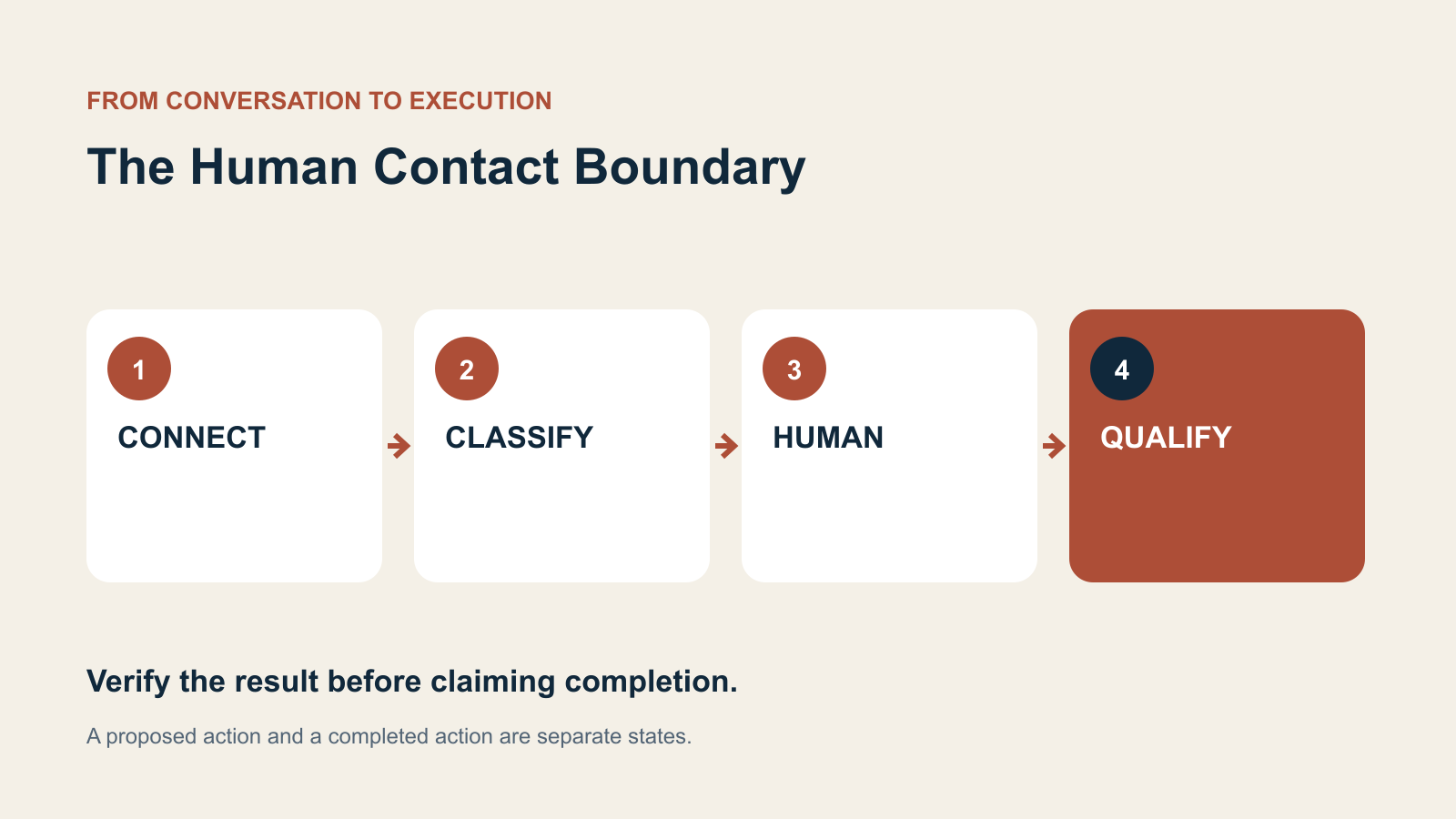
CONNECT → CLASSIFY → HUMAN → QUALIFY: review the state transition, not just the response.
Measure decision accuracy alongside customer effort
Track voicemail mislabeled as human contact, genuine humans mislabeled as machines, and qualification records created without participation. Report connection rate and intended-human contact rate separately. Evaluate the uncertain category rather than forcing every attempt into a confident success or failure.
Use an explicitly illustrative audit to make the denominator clear. Suppose reviewers inspect 40 cases that genuinely require The Human Contact Boundary, and find 6 unsupported actions. That is 6 divided by 40, or 15% in that sample. It is not a market benchmark or an expected result. Counting 200 unrelated greetings alongside those cases would hide the failure without fixing it. Keep the relevant case count, error count, review rules, and uncertainty visible when reporting the result.
Also inspect the opposite failure: an unnecessary hold when the evidence was already sufficient. Reviewers should distinguish a justified clarification from an avoidable repeat question. An appropriate human review is different from a case abandoned without an owner. Pair the action error rate with customer effort and completion evidence so the team cannot improve one dashboard by moving the cost to the customer or another department.
Connect The Human Contact Boundary with the rest of customer operations
Brixi treats Voice AI as part of a complete AI-native customer platform. Calls connect with CRM memory, WhatsApp, workflow execution, qualification, routing, and the human team. The operating benefit is that a phone event can be reviewed beside the customer state and the next action, instead of requiring an operator to reconcile a dialer, a transcript archive, and a separate task queue.
For this use case, make the implementation review concrete: ask the Brixi team to walk through the original evidence, the current CRM state, the permitted action, and recovery when that action cannot complete. Validate any required source system, permission rule, and approval path during configuration. The recommended operating design in this article should be demonstrated against the actual deployment rather than assumed from a generic AI feature label.
For the wider operating model, read the anatomy of a Voice AI agent. The important connection is between interpretation and accountable execution: the same evidence should prepare the assistant, the responsible human, and the next workflow.
What to inspect after the first quarter
After a quarter, the useful evidence is a change in operating behavior: fewer unsupported actions, fewer repeated clarifications, and clearer ownership of unresolved cases. Treat these as questions to investigate, not promised gains. Compare similar journey types and inspect the difficult cases as well as the average. Improvements should survive a new owner, a changed source record, and an ordinary customer correction.
The deeper bet behind The Human Contact Boundary
Voice AI economics will become more honest as teams measure customer events instead of phone events. A complete platform should connect call evidence, CRM disposition, retries, and the next owner. That prevents impressive dialer activity from replacing the business conversation the customer still needs.
Put The Human Contact Boundary into a connected customer workflow
Explore how Brixi connects Voice AI, CRM, AI assistants, conversations, workflows, and human teams around a reliable next action.