The Multimodal Thread: Why Voice, WhatsApp, Images, and CRM Need One Timeline
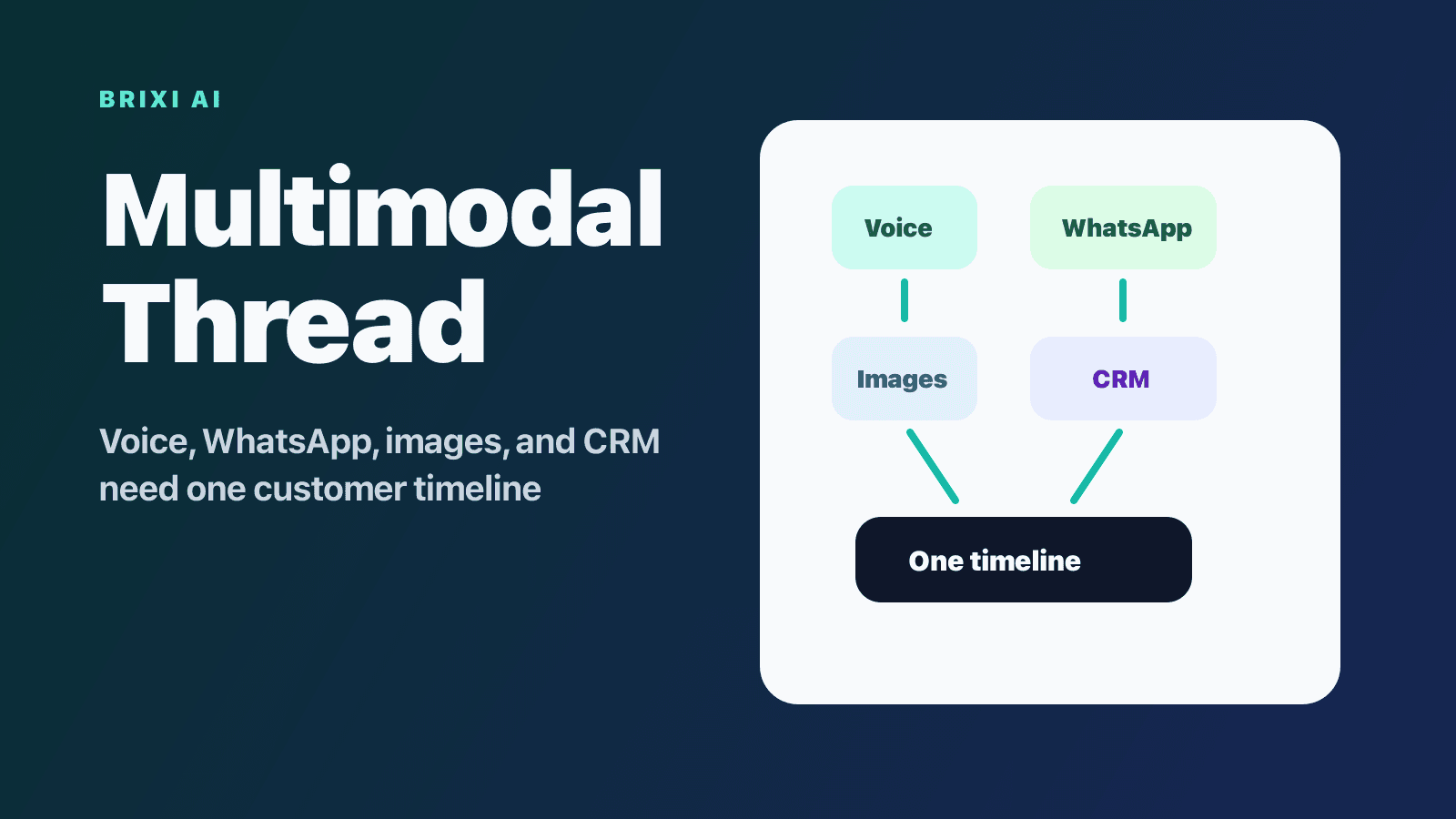
Customers do not communicate in one format anymore. They send screenshots, voice notes, WhatsApp replies, calls, and form details. The Multimodal Thread is how teams keep one customer timeline across all of it.
A customer does not describe the problem in a neat support form. She sends a WhatsApp message, then a screenshot, then a voice note explaining what happened, then calls because the issue is urgent. By the time a human agent opens the CRM, the evidence lives in four formats and two tools.
The agent sees a ticket title. The customer assumes the company has seen everything. The gap between those two realities is where modern customer experience breaks.
This is the Multimodal Thread: one customer timeline that can hold text, voice, images, call outcomes, CRM fields, workflow events, and human notes without forcing the customer to restart. It is becoming the real standard for omnichannel work because customers no longer communicate in one mode.
Multichannel is not the same as multimodal.
Multichannel means the business is reachable in several places. Multimodal means the customer can express themselves in several formats and the business can still understand the whole case. That distinction matters because many teams have added channels without adding a shared interpretation layer.
WhatsApp can receive an image. Voice AI can capture spoken urgency. Web chat can record a typed objection. CRM can store the owner and stage. But if those inputs do not land in one timeline, the next person sees fragments. The customer sees repetition.
A customer does not care that one system handles images and another handles calls. They care whether the business responds as if it understood the full context. The Multimodal Thread is the operating answer to that expectation.
The thread breaks at format boundaries.
Most customer systems were built around structured fields and typed notes. That made sense when customer communication was mostly form fills, phone notes, and email replies. It is weaker when the customer sends a payment screenshot, records a voice note in Hindi, then responds to a WhatsApp button.
- Images get stored as attachments but not interpreted as evidence.
- Voice notes get treated as media files instead of urgency and intent signals.
- Call transcripts live outside the CRM fields that drive routing.
- WhatsApp replies update a thread but do not update the next action.
- Human notes summarize only the part the agent personally saw.
These format boundaries create invisible work. Someone has to open the image, listen to the voice note, read the transcript, update the CRM, and decide what it means. When volume rises, that manual interpretation fails first.
The multimodal rule
A customer timeline is only complete when every format can change the next action. If an image, voice note, or call cannot influence routing, the timeline is incomplete.
One timeline changes what AI can do.
AI becomes more useful when it can reason across the full thread. A pricing objection in a call, a screenshot of a competitor quote, and a WhatsApp reply saying "can you match this" are three signals pointing to one decision moment. Separately, they are noise. Together, they are a clear action.
The timeline should not merely collect artifacts. It should interpret them. Voice becomes sentiment and intent. Images become evidence and category. Text becomes objection and preference. CRM events become stage and ownership. Workflows become next action and deadline.
That is where AI can qualify, route, summarize, and recommend with less guesswork. The model is not trying to infer the customer from one message. It is reading the customer journey as a continuous thread.
The hard part is interpretation, not storage.
Most teams can technically store the screenshot, the call recording, the chat transcript, and the CRM note. That is not the breakthrough. The breakthrough is turning each format into the kind of signal a team can act on without opening every file manually.
A screenshot may show a competitor quote, a payment proof, a damaged product, or a form error. A voice note may carry urgency that the typed words do not show. A call transcript may reveal that the buyer is not objecting to price, but to trust. The timeline has to convert each artifact into evidence, category, sentiment, risk, and next action.
Without interpretation, multimodal data becomes a heavier archive. The customer did the work of explaining the situation, but the team still has to rediscover it from raw media. With interpretation, the format disappears into the workflow. The person acting next sees what matters and why it matters.
The interpretation layer also needs confidence. Some artifacts are obvious: a payment screenshot, a signed document, a clear complaint. Others need human review: a blurry image, a sarcastic voice note, a mixed-language objection, or a screenshot that may be outdated. Good systems do not pretend every format is equally certain. They mark what is known, what is inferred, and what needs a human check.
That distinction protects trust. A support agent should not act on a weak image classification as if it were verified proof. A sales rep should not treat one unclear voice note as a buying signal. The thread becomes useful because it keeps the evidence attached to the recommendation.
Brixi treats every format as customer context.
Brixi connects voice AI, WhatsApp, CRM, workflow automation, and conversation intelligence so each interaction updates the same customer record. The goal is not just channel coverage. The goal is one operating timeline for the relationship.
When a buyer sends a WhatsApp reply, takes a voice call, uploads proof, or asks a question in chat, the system can preserve the context, extract the operational meaning, and route the next action. A human does not have to manually stitch together what the customer already showed the business.
That matters across sales, support, admissions, healthcare intake, real estate follow-up, and post-sales operations. The format changes. The operating principle does not: every customer signal belongs in one timeline.
The thread needs a clear owner.
A shared timeline creates value only when someone is accountable for the next step. Otherwise the system becomes a perfect history of work no one owns. Multimodal context should always end in an owner, a status, a recommended action, or a reason to wait.
This is especially important when formats cross teams. A support image may create a sales risk. A WhatsApp pricing question may require finance approval. A voice call may reveal that the original owner is unavailable. The timeline should not merely show that these things happened. It should route the operational consequence.
The best test is simple: if a manager opens the customer record, can they see the latest meaningful signal and the person responsible for acting on it? If the answer is no, the thread is still descriptive. It has not become operational.
Ownership should also travel when the format changes. If a customer leaves a voice note after a WhatsApp thread, the owner should not reset. If an image creates a compliance risk, the owner may need to change. The timeline should make that transfer visible so teams do not lose accountability at the exact moment the case becomes more complex.
What changes after a quarter of one-timeline operations?
The first change is fewer blind replies. A rep can see that the customer already sent a screenshot and asked for a comparison. A support agent can see the voice note and the failed self-service attempt. The reply becomes specific because the context is visible.
The second change is better escalation. Urgent cases no longer depend on a human noticing one message among many. Voice tone, text language, image evidence, and repeat contact can all contribute to escalation logic.
The third change is cleaner reporting. Leaders can inspect the full customer path, not just the CRM field. They see which formats carry the most intent, where customers get stuck, and which teams act from full context.
The fourth change is less hidden labor. Agents spend less time opening attachments, replaying calls, and asking colleagues whether anyone saw the screenshot. The thread turns scattered evidence into a usable brief before the next response is written.
That reduction matters because hidden labor is where service quality becomes inconsistent. The best agent stitches context together. The busiest agent misses a signal. A shared thread makes the good behavior normal instead of heroic.
The deeper bet: the customer record becomes a living thread.
The old CRM record was a static profile. The next customer record is a living thread. It captures what customers say, show, ask, resist, accept, and change across formats.
Teams that build this thread will have a practical advantage: every new interaction starts smarter than the last one. That is what customers now expect from AI-first service and sales. Not more channels. One remembered conversation.
Turn every customer signal into one timeline
Brixi brings voice, WhatsApp, CRM, workflows, and conversation intelligence together so teams can act from the full customer thread.
Explore omnichannel AI