The Lost-Deal Reactivation Window: Closed-Lost Is Not Forever
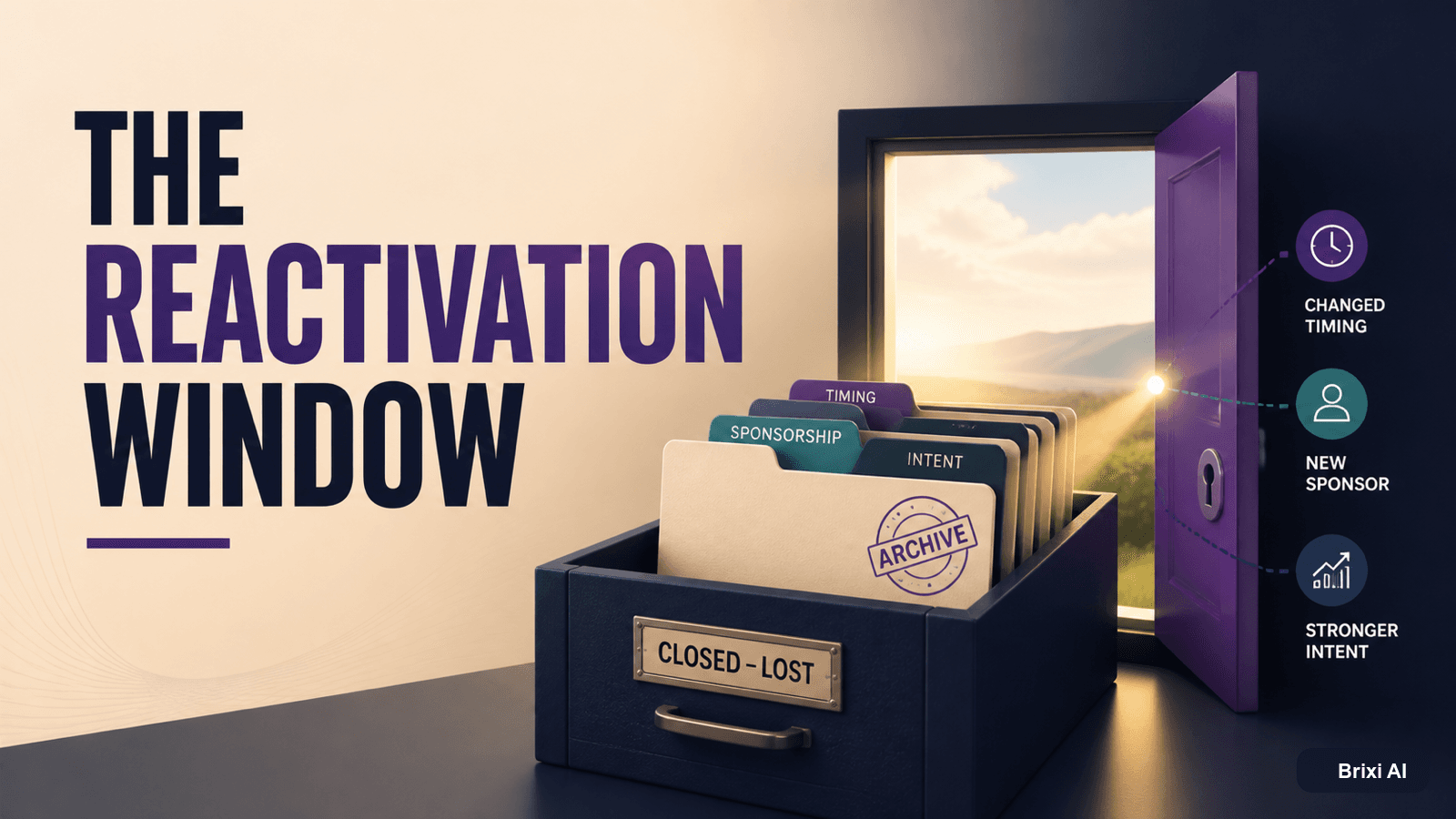
Most closed-lost deals are stored as history. Some are future pipeline waiting for a condition to change. The Reactivation Window opens when timing, budget, leadership, product need, or competitive context moves.
At 9:35 on Tuesday, a former prospect returns to the pricing page six months after a deal was marked closed-lost. The original record says budget. The call transcript says the project lost its executive sponsor during a reorganization. No one notices the return visit.
The account did not reject the product forever. One condition prevented progress at one moment. The Lost-Deal Reactivation Window opens when that condition changes and the seller has enough memory to respond intelligently.
The Permanent Loss Assumption wastes future demand
Closed-lost is an administrative state, not a permanent description of buyer need. The Permanent Loss Assumption treats every outcome as final and turns useful learning into archival data.
A reactivation system preserves the real blocker, the stakeholders, the promises, and the conditions that would justify a future conversation. It then watches for evidence that those conditions moved.
Loss reasons must describe a condition, not a dropdown
Budget, timing, and competitor are too broad to guide reactivation. The useful question is what specifically prevented the next commitment and what evidence would show that constraint changed.
Conversation analysis can recover detail from calls and messages, but teams should still let reps validate the operational reason.
- Blocker and affected stakeholder
- Expected review date or trigger
- Competitive or internal alternative
- Permission and preferred recontact channel
Reactivation should follow evidence, not anniversaries
A ninety-day email sequence assumes the calendar changed the deal. Stronger triggers include new leadership, renewed site activity, product usage, a contract cycle, a reopened role, or a direct question.
The outreach should name the changed condition and add useful context. A generic checking-in message proves that the seller remembers the account but not the conversation.
Reopened deals need a new qualification pass
Conditions can improve and requirements can also change. Do not drop a returning account into its old stage with its old probability.
Reconfirm the problem, decision group, timing, constraints, and success criteria. Preserve history while treating the current buying process as new evidence.
Closed-lost is a time-stamped diagnosis
Reactivation becomes credible when the system knows what changed and why that change matters.
Brixi turns loss memory into timed opportunity
Brixi connects CRM history, conversation analysis, buyer intent, omnichannel follow-up, and workflows. Real loss conditions can become watchable signals rather than forgotten notes.
When relevant evidence appears, Brixi can prioritize the account, prepare a contextual message, assign the owner, and capture the new outcome.
- Structured loss context from conversations
- Behavior and timing reactivation signals
- Contextual AI-assisted outreach
- Fresh qualification with preserved history
A quarter can build a measurable reactivation motion
Start with recent losses where the need remained real and the blocker was conditional. Exclude poor-fit, explicit do-not-contact, and trust-damaged accounts.
Measure triggered accounts, meaningful replies, reopened opportunities, progression, and revenue. Compare signal-based outreach with calendar-only campaigns.
- More relevant reactivation messages
- Higher reply quality
- Cleaner reopened pipeline
- Better learning from repeated loss patterns
The deeper bet is that pipeline has memory
Acquisition becomes more expensive when every lost deal returns to zero. Customer memory lets the organization compound learning across buying cycles.
The future pipeline will include present opportunities and monitored future conditions. Closed-lost becomes a source of intelligence, not a graveyard.
Turn loss reasons into future pipeline
See how Brixi connects conversation memory, buyer intent, workflows, and contextual reactivation.
Book a pipeline reactivation reviewFrequently Asked Questions
Prioritize good-fit accounts lost to conditional timing, budget, sponsorship, procurement, or competitive-cycle factors, with valid permission to recontact.
Use the known condition and customer signal rather than one universal delay. Some triggers happen in weeks, others follow budget or contract cycles.
No. Preserve history but requalify the current need, stakeholders, timing, constraints, and next commitment.