The June Pipeline Review: Find Deals That Are Alive, Stuck, or Already Lost
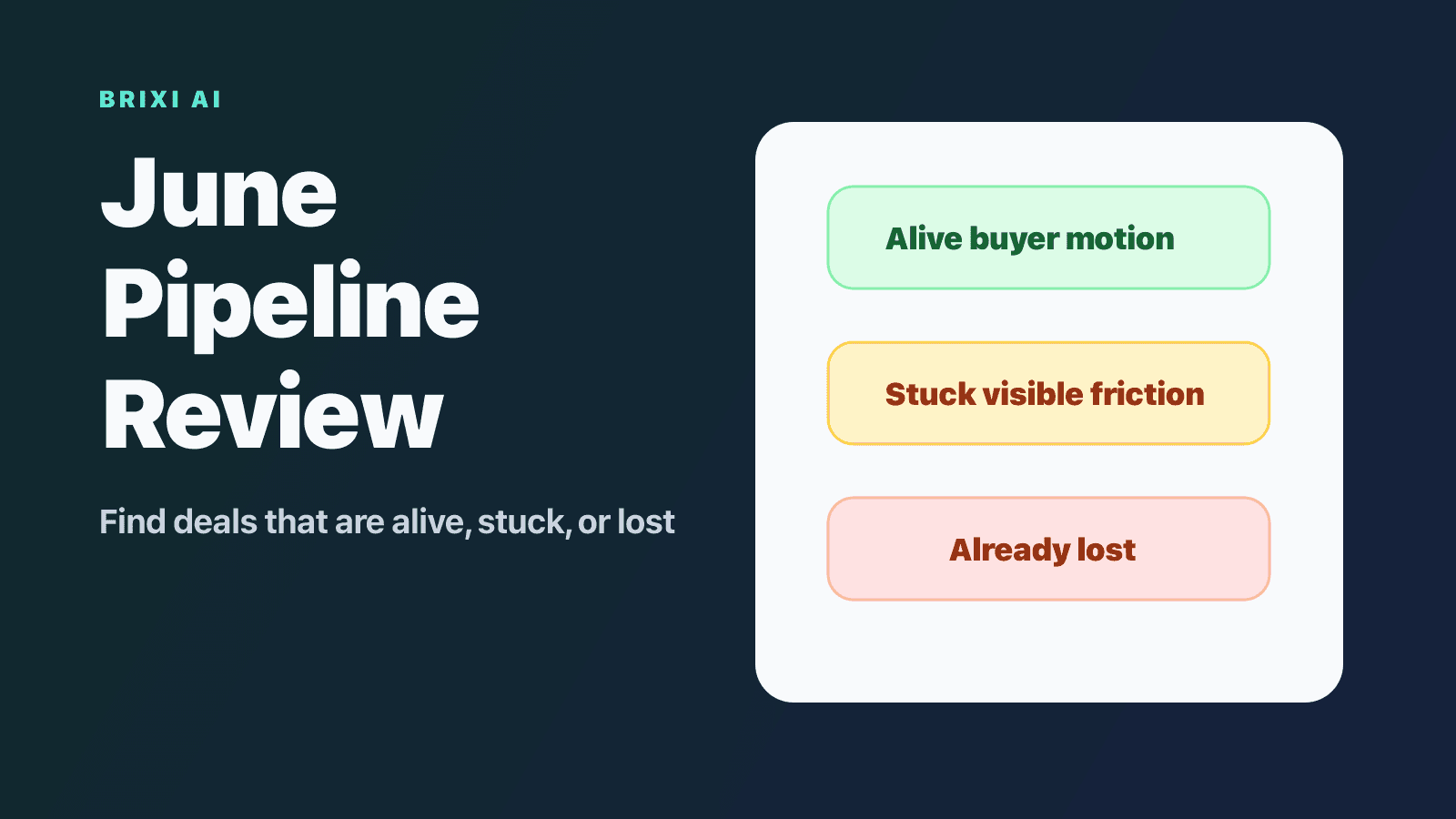
Month-end pipeline review should not be a stage cleanup ritual. It should separate deals that are alive, stuck, or already lost using conversation signals, buyer behavior, and follow-up evidence.
It is the last working day of June. The sales manager opens the CRM and sees a familiar comfort: enough pipeline to feel safe. The stages look full. The weighted number looks respectable. The reps sound cautiously optimistic. Then someone asks the only question that matters: which of these deals are actually alive?
The room gets quieter because the CRM stage cannot answer that question. Stage tells you where the team placed the deal. It does not tell you whether the buyer is still moving.
A useful June pipeline review should divide every meaningful opportunity into three states: alive, stuck, or already lost. That classification should come from buyer behavior, conversation evidence, and follow-up quality, not rep optimism.
Alive deals show recent buyer movement.
A deal is alive when the buyer is still doing something that indicates decision motion. The action may be a reply, a question, a document revisit, a stakeholder introduction, a pricing discussion, a site visit confirmation, or a clear next meeting. The signal is not that the rep followed up. The signal is that the buyer responded with intent.
This distinction matters because many pipelines confuse sales activity with buyer activity. A rep can make five calls into silence. That is effort, not deal health. A buyer can send one specific WhatsApp question after a week of quiet. That may be a stronger signal than all five rep attempts.
Alive deals deserve speed and precision. Do not bury them in normal cadence. Route them to the right owner, prepare with the latest context, and remove the next friction point quickly.
Stuck deals have friction but not final rejection.
A stuck deal is not dead. It has a visible blocker and weak forward motion. The buyer may be waiting on budget, comparing options, checking with a partner, delaying a visit, or asking the same unresolved question. The mistake is treating stuck deals like normal nurture.
- The buyer has not responded, but they opened pricing or revisited the proposal recently.
- The buyer agreed to a next step but missed the meeting or site visit.
- The buyer keeps asking for information but avoids commitment.
- The buyer raised an objection that no one has answered directly.
- The buyer is active on WhatsApp but no longer picking calls.
Stuck deals need diagnosis. What friction is holding the buyer? What evidence supports that diagnosis? What is the next action designed to remove that friction? Without those answers, follow-up becomes noise.
The month-end rule
A deal is not alive because the rep is active. It is alive because the buyer is active. Pipeline reviews should start there.
Already-lost deals are usually visible before they are marked lost.
The most uncomfortable part of a serious pipeline review is admitting that some open deals are already lost. The buyer has stopped engaging, the objection was never resolved, the decision moved elsewhere, or the last meaningful interaction is too old to defend the stage.
Keeping those deals open does not make the pipeline stronger. It makes the forecast less honest and hides the work needed to replace them. The purpose of classification is not to punish reps. It is to give the team a real operating picture before the next month begins.
Already-lost deals still have value if the team extracts the lesson. Which objection ended the motion? Which handoff failed? Which competitor appeared? Which follow-up promise was missed? Closed-lost data becomes useful only when it changes the next play.
The review needs evidence rules before the meeting.
Pipeline reviews become political when the evidence standard is unclear. One rep defends a deal with activity. Another defends it with a verbal promise. A manager pushes for a commit because the stage is late. Everyone is using a different definition of deal health.
A better review sets rules before the meeting. Alive requires recent buyer-initiated motion. Stuck requires a named blocker and a recovery action. Already lost requires evidence that motion has stopped or shifted elsewhere. The categories should be based on signals the team can inspect, not on confidence words.
This changes the meeting tone. Reps come prepared with buyer replies, call outcomes, WhatsApp signals, proposal activity, and missed follow-up evidence. Managers spend less time arguing about probability and more time deciding the next move.
Evidence rules also reduce sandbagging and wishful thinking. A rep can still explain nuance, but the baseline is shared. If the buyer has not moved, the deal cannot be defended as alive because the rep feels good about it. If the buyer is active, the deal should not be ignored because the stage looks early.
The review becomes less about who tells the strongest story and more about which signal deserves action. That is healthier for the team and cleaner for the forecast.
Brixi turns pipeline review into signal review.
Brixi connects CRM, buyer intent, WhatsApp, voice AI, workflow automation, and conversation intelligence so pipeline review is not limited to stage and activity. Managers can inspect what buyers actually did and said.
A deal can be flagged alive because the buyer revisited pricing and replied to WhatsApp. It can be flagged stuck because a payment-plan objection remains unresolved. It can be flagged at risk because the last buyer-initiated activity was too old for the stage. Those signals are more useful than a rep probability field on its own.
This gives managers a better coaching surface. They can ask for the next action tied to the blocker, not a generic update. They can route urgent deals, recover stuck ones, and clear false pipeline earlier.
Managers need a recovery play for each state.
Classification is only useful when it leads to action. Alive deals need speed, senior attention, and friction removal. Stuck deals need diagnosis and a specific recovery play. Already-lost deals need clean closure, lesson capture, and replacement planning.
The recovery play should be concrete. For an alive deal, call with the latest context and confirm the next step. For a stuck deal, answer the unresolved objection and change the channel if needed. For an already-lost deal, record the real reason and stop letting it distort the forecast.
This is where buyer intent and conversation intelligence make the review practical. The manager is not asking reps to remember every detail from the month. The system surfaces the evidence, and the team decides how to act before the month resets.
The recovery play should also have a deadline. Alive deals need action today or tomorrow, not next week. Stuck deals need a specific unblock attempt before they are downgraded. Already-lost deals should be closed cleanly before they survive another forecast cycle.
This makes the end-of-month review a management system instead of a reporting ritual. Every meaningful opportunity leaves the meeting with a state, evidence, owner, and time-bound next action.
What changes after one quarter of signal-led reviews?
The first change is cleaner forecasts. Deals with no buyer movement stop surviving review simply because they are in a late stage. Managers become less dependent on confidence and more dependent on evidence.
The second change is better rep behavior. Reps learn that activity alone will not defend a deal. They bring buyer signals, objections, and next actions into review because those are the things the system and the manager now value.
The third change is faster recovery. Stuck deals get named earlier, before they become silent losses. Teams can choose a specific recovery action while the buyer still has some motion left.
The fourth change is a cleaner start to the next month. July begins with fewer fantasy deals, clearer recovery priorities, and a sharper view of replacement pipeline. The review stops being cleanup after the fact and becomes operating preparation.
That preparation compounds. Each month, the team gets faster at spotting weak motion, cleaner at closing false pipeline, and sharper about which buyer signals deserve immediate attention. The forecast improves because the review language improves, and the team learns to separate hope from buyer motion earlier. That discipline carries into every follow-up.
The deeper bet: pipeline health is buyer motion.
The old pipeline review was a stage inspection. The next pipeline review is a motion inspection. It asks whether the buyer is moving, what direction they are moving in, and what the team should do about it.
That shift makes the review less political and more useful. Deals become alive, stuck, or already lost based on evidence. The team enters July with a cleaner number and a clearer operating plan.
Run your next pipeline review from buyer evidence
Brixi combines buyer intent, CRM, conversation intelligence, WhatsApp, voice AI, and workflows so managers can see which deals are alive, stuck, or already lost.
Explore the Buyer Intent Engine