The Human Handoff Contract: When AI Should Escalate, Route, or Stop
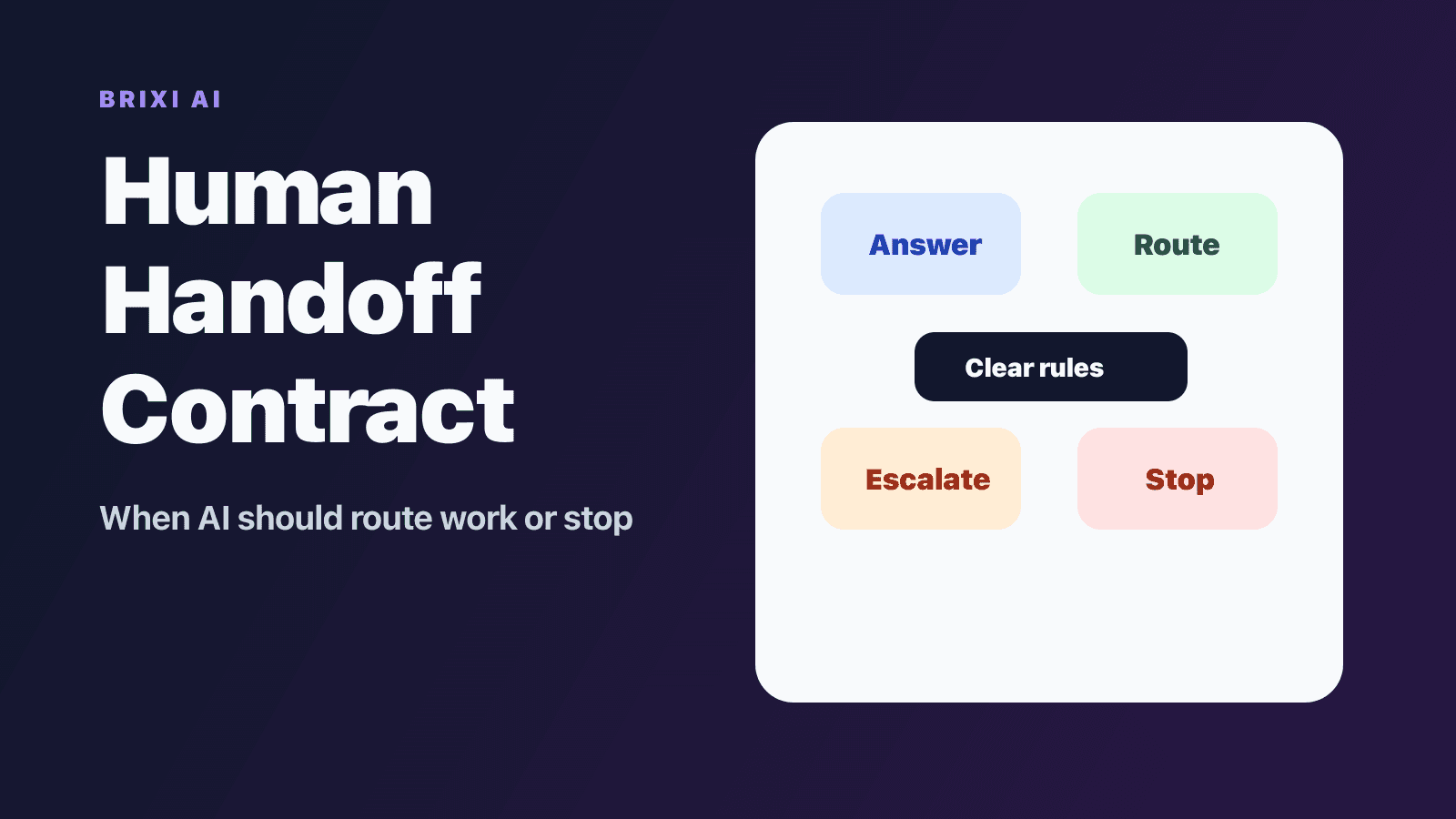
A customer-facing AI system needs more than a fallback to a human. It needs a Human Handoff Contract that defines when to escalate, route, or stop before the customer journey breaks.
At 7:36 PM, a customer tells an AI assistant that they are upset, confused, and considering cancelling. The assistant offers a generic apology, repeats policy language, and asks whether it can help with anything else. Ten minutes later, the same customer calls the sales manager directly.
The AI did not fail because it lacked empathy words. It failed because no one had defined the contract. When should it keep answering? When should it route? When should it escalate? When should it stop?
This is the Human Handoff Contract: the explicit operating agreement that governs how customer-facing AI transfers work to humans. Without it, handoffs become improvisation hidden behind automation.
Fallback is not a contract.
Most AI systems have a fallback path. If confidence is low, send to a human. If the customer asks for an agent, send to a human. If the conversation fails, create a ticket. That sounds reasonable until production exposes the edge cases.
A confidence score does not always capture risk. A customer can be angry and very clear. A pricing negotiation can be simple to understand but commercially sensitive. A medical intake question can look routine while requiring human judgment. Fallback rules based only on model uncertainty are too narrow.
A contract is broader. It defines decision boundaries before the conversation starts. It tells the AI what it can handle, what it can collect, what it can recommend, and what must move to a human owner.
The contract needs four actions.
Every customer-facing AI interaction should be governed by four possible actions. The AI can answer, route, escalate, or stop. Each action needs a clear trigger and a clear output.
- Answer when the request is low risk, well understood, and covered by approved knowledge.
- Route when the request belongs to a specific team, owner, product, location, or workflow.
- Escalate when urgency, emotion, value, compliance, or ambiguity requires human judgment.
- Stop when answering would require guessing, overpromising, or making a decision the AI is not authorized to make.
The stop action is the most underrated. Good AI should know how to say, "I should get a human to confirm this," without sounding broken. Trust often increases when the AI refuses to invent certainty.
The contract rule
A handoff is not a failure when it follows the contract. A handoff is a failure when the AI keeps talking after the conversation has crossed a human-judgment boundary.
The triggers should come from customer context, not just keywords.
Keyword escalation is brittle. A customer may never say "angry" while clearly sounding angry. A buyer may not say "urgent" while asking for a site visit before tomorrow. A patient may not say "emergency" while describing a symptom that needs faster handling.
The contract needs context triggers: sentiment, repeat contact, unresolved issue, high-value account, missed promise, pricing sensitivity, compliance category, language change, and channel preference. The AI should read the situation, not just match a word.
That requires conversation intelligence connected to CRM and workflows. The AI must know whether this is a first-time lead or a returning customer, whether there was a prior failed handoff, and whether the current request changes the next action.
The contract should define the output, not just the trigger.
Many handoff rules stop too early. They say when to send a conversation to a human, but they do not define what the human should receive. That creates a familiar failure: the AI escalates correctly, then the human still has to reconstruct the case from a messy transcript.
A good contract specifies the handoff artifact. The output should include customer identity, issue type, urgency, risk reason, evidence, prior actions, promised next step, recommended owner, and deadline. If the AI stops, the customer should also receive a clear explanation of what will happen next.
The format matters because humans act from the artifact, not the policy. A vague escalation creates a queue. A structured escalation creates motion. The contract is only real when it changes the handoff a human sees at 7:40 PM with ten other items waiting.
The artifact should also protect the customer from repetition. If the AI already asked for account number, preferred time, budget range, policy detail, or issue history, the human should see that clearly. The contract should define what must not be re-asked unless there is a compliance reason to confirm it.
That rule is more than courtesy. Repetition tells the customer the handoff was fake. The AI may have sounded helpful, but the organization behaved as if nothing was learned. A good contract prevents that reset.
Brixi makes the contract operational.
Brixi connects AI assistants, voice AI, WhatsApp, CRM, workflows, and conversation intelligence in one platform. That makes the Human Handoff Contract more than a policy document. It becomes routing, task creation, owner assignment, escalation, and CRM update logic.
A voice AI call can detect urgency and route to a senior rep. A WhatsApp reply can trigger an escalation if the customer mentions a failed promise. A support conversation can stop the AI from guessing and create a human-owned case with the right summary. The contract becomes executable.
This is where point tools struggle. A bot may know what was said. A CRM may know the owner. A workflow tool may know how to create a task. The contract needs all three at once.
The contract needs review rituals.
A handoff contract is not finished when it is written. Production creates edge cases the policy did not imagine. Customers change language. New offers create new pricing boundaries. A support issue that looked low risk last quarter may become sensitive after a product change.
Teams should review a sample of answer, route, escalate, and stop decisions every week during rollout. The question is not only whether the AI made the right call. It is whether the human received enough context, whether the customer understood the next step, and whether the workflow completed.
Those reviews turn handoff failures into design improvements. Add a new escalation trigger. Tighten a stop rule. Change the brief. Update the owner logic. The contract matures because the operating system keeps learning from real customer moments.
The review should include near misses, not only visible failures. Look at conversations where the AI answered but the customer asked for a human two messages later. Look at routes that were accepted but delayed. Look at stops where the customer did not understand what would happen next. Those moments show where the boundary is technically correct but operationally weak.
Over time, the contract becomes a shared language between AI, humans, and managers. Teams stop debating whether automation is good or bad in the abstract. They debate the specific boundary, output, and owner for each customer moment.
What changes after a quarter of contract-led AI?
The first change is fewer awkward escalations. Humans receive better briefs and customers hear clearer expectations. The AI does not dump work into a generic queue. It routes with a reason.
The second change is safer automation. Teams become more willing to expand AI coverage because the boundaries are visible. Risk is managed through explicit rules, not vague trust in the model.
The third change is better customer trust. Customers do not mind AI when it is helpful and honest. They mind AI when it blocks access to judgment. A good contract protects that boundary.
The fourth change is less internal confusion. Reps, support agents, and managers stop guessing why a handoff arrived. The brief carries the reason, the evidence, and the expected action, so human work starts from a shared contract instead of a cold transcript.
That clarity also makes coaching easier. When a handoff goes poorly, the manager can inspect the boundary, the brief, the owner, and the customer expectation. The review becomes a system improvement conversation, not a blame exercise. Teams learn which boundary failed instead of arguing about who should have guessed better in the moment. That makes improvement repeatable and gives operators a precise place to tune the next workflow before the pattern repeats. The next handoff should be better by design.
The deeper bet: AI maturity is boundary maturity.
Immature AI programs ask how much work the AI can take away from humans. Mature programs ask which work should stay with AI, which work should move to humans, and how the two should transfer context.
The Human Handoff Contract is a sign that a team has moved from experimentation to operations. It accepts the obvious truth: AI and humans will share the customer journey. The quality of that sharing determines the customer experience.
Turn AI handoff rules into real workflows
Brixi connects AI assistants, CRM, voice, WhatsApp, conversation intelligence, and workflow automation so every handoff follows clear operating rules.
Explore workflow automation