The Fragmentation Tax: What Disconnected Customer Tools Cost
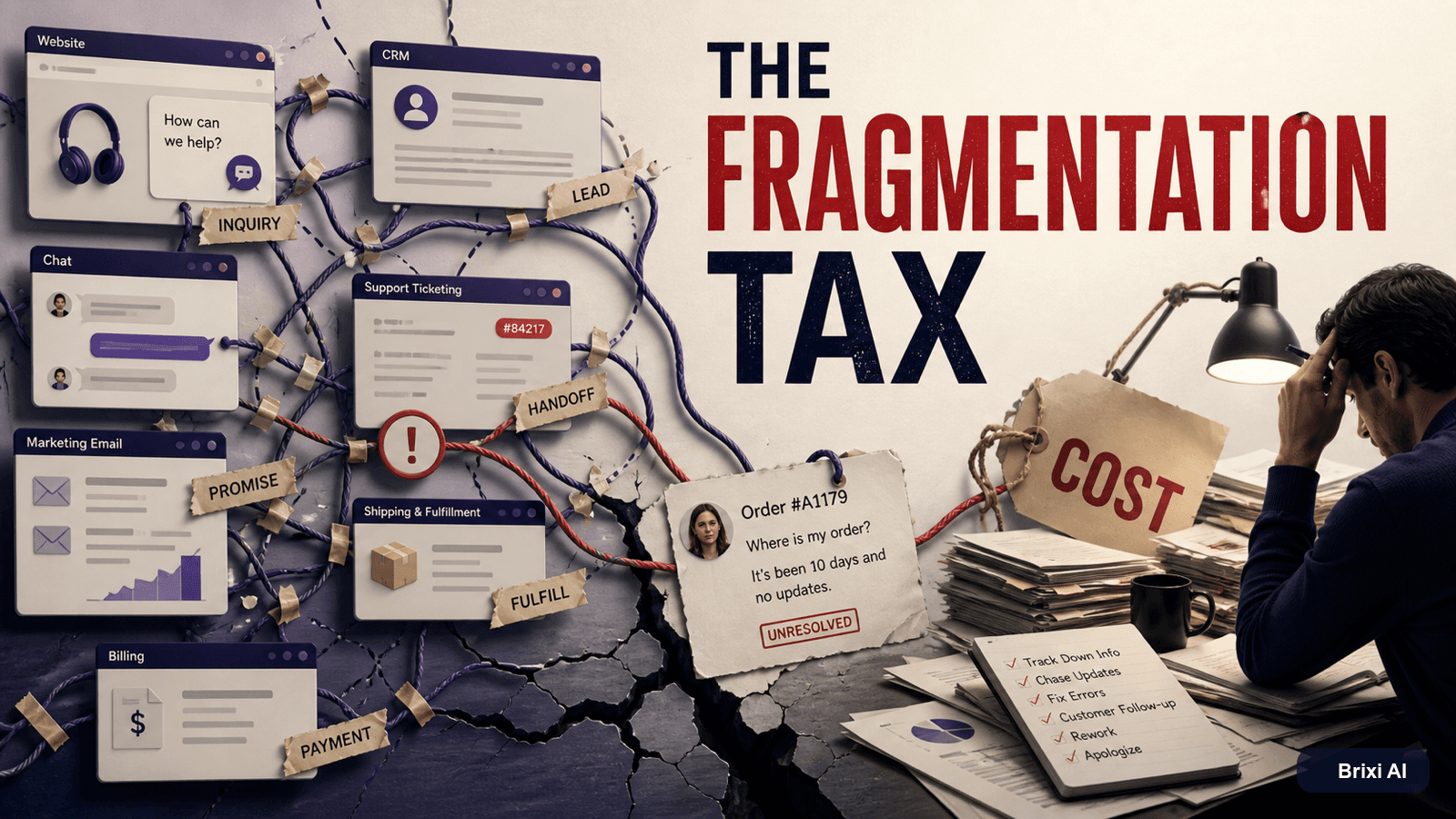
The cheapest tools can create the most expensive operating model. The Fragmentation Tax appears in duplicated work, silent failures, lost context, and customers who notice the company has forgotten them.
At 6:40 on Tuesday evening, a RevOps manager is comparing two spreadsheets. One came from the CRM. The other came from the WhatsApp team. A third export from the calling platform is still downloading. Leadership wants to know why 73 paid leads received no meaningful follow-up.
Every vendor invoice looks reasonable. The operating model does not. The company bought separate tools to save money and flexibility, then hired people to reconcile the gaps between them. That hidden burden is the Fragmentation Tax.
The Fragmentation Tax has five separate bills
Software comparisons focus on subscription price. Operators pay a wider bill: integration design, maintenance, failure recovery, manager investigation, and customer trust. These costs sit in different budgets, so no one sees the total.
A stack can be inexpensive at purchase and costly in production. Every field mapping, webhook, retry rule, duplicate record, and manual check becomes part of the real cost per customer outcome.
The build tax arrives before the first customer benefits
Someone must define identifiers, fields, ownership rules, triggers, credentials, and error paths across every tool. The work looks finite in a project plan, but each connection encodes assumptions that will change.
The first demonstration usually covers the happy path. Production exposes reschedules, duplicate inquiries, channel changes, partial qualifications, shared phone numbers, reassigned owners, and customers who reply to an older thread.
- Field and identity mapping
- Authentication and permission setup
- Retry, deduplication, and fallback logic
- Testing and documentation for every path
The maintenance and failure taxes compound quietly
Campaign names change. CRM fields are renamed. APIs introduce new limits. A team adds a stage or changes assignment rules. Each reasonable change can break a connection that no customer-facing employee knows exists.
The worst failures are silent. The workflow reports success because an event was sent, while the receiving system rejected the field, created a duplicate, or assigned the task to an inactive user.
- Broken triggers that look successful
- Duplicate contacts split across channels
- Stale ownership and invalid queues
- Manual repair after customers have already waited
The trust tax is paid by the customer
Customers experience architecture as memory. When a company asks for the same details twice, sends an irrelevant reminder, or calls after a clear opt-out, the customer concludes that the company is careless.
Trust does not fail because the customer understands the integration diagram. It fails because the company behaves as if the previous conversation never happened.
Cheap software can create expensive operations
The relevant unit is not cost per tool. It is total cost per resolved customer outcome, including the people and failures required to keep the stack coherent.
A native platform removes coordination work at the source
Brixi keeps CRM, AI assistants, conversations, routing, workflows, and intelligence inside one customer operating model. Shared identity and context are native, so teams do not rebuild them for every channel.
External tools can still extend the platform where they add specialized value. The difference is that they no longer hold the customer journey together. Core memory, decisions, execution, and handoffs remain connected.
- Shared customer identity and conversation history
- Native routing, workflow, and escalation logic
- One audit trail for AI and human action
- Fewer mappings and reconciliation queues
A quarter reveals whether the stack is getting simpler
The right migration does not begin by replacing everything. It begins with the journey carrying the highest failure cost, then moves its memory, decisions, and actions into one operating layer.
After a quarter, leaders should see fewer exception queues, faster investigation, less duplicated outreach, and fewer hours spent reconciling reports. If those measures do not improve, the architecture changed without changing the operating burden.
- Lower manual reconciliation time
- Fewer duplicate records and missed handoffs
- Shorter incident investigation
- More consistent customer context across channels
The deeper bet is consolidation around outcomes
The pendulum is moving away from buying one tool for every task. AI increases that pressure because intelligent action depends on complete context, not a collection of partial databases.
Future stacks will keep specialized tools at the edges while consolidating customer memory, policy, and execution at the center. The platform that owns the outcome becomes more valuable than the tools that merely emit events.
Calculate your Fragmentation Tax
Map one customer journey with Brixi and identify the build, maintenance, failure, manager, and trust costs hidden between tools.
Book an architecture reviewFrequently Asked Questions
Add software spend to integration labor, maintenance effort, incident recovery, manual reconciliation, missed outcomes, and customer-facing errors for a specific journey.
No. Keep tools that add distinct value. Consolidate the shared memory, decision, routing, and execution layers that otherwise require constant coordination.
Choose a high-volume journey with measurable failure cost, such as lead response, qualification, appointment recovery, or support escalation.