The Customer Operating System: What Comes After CRM
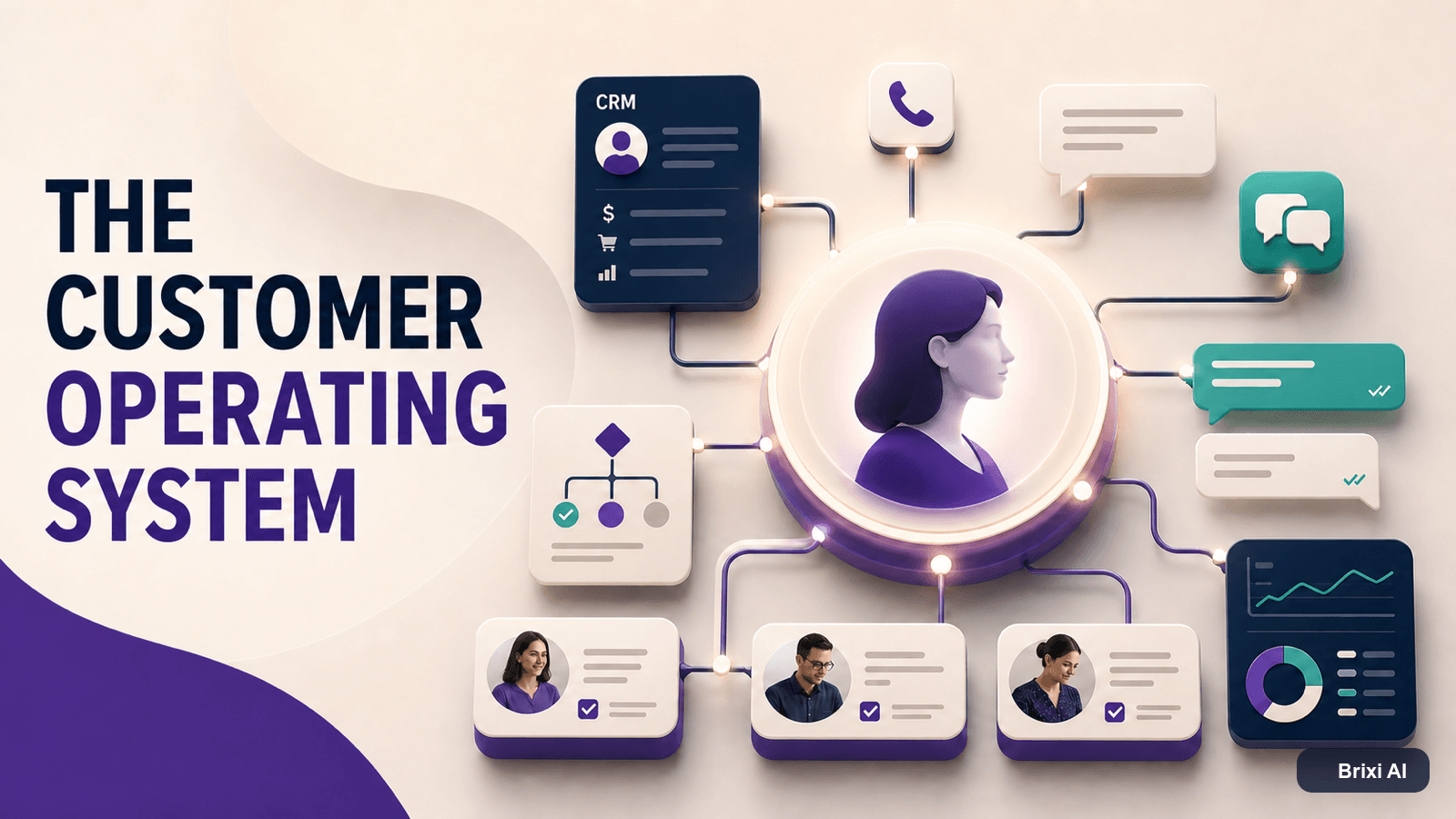
CRM gave companies a system of record. The next operating advantage comes from a system that can understand customer context, decide what happens next, and coordinate execution across AI and human teams.
At 9:12 on Monday morning, a sales manager opens the CRM and sees 186 active leads. Eleven have replied on WhatsApp, four called over the weekend, three visited the pricing page, and one asked support whether the product works with an existing system. The CRM still shows 186 rows. It does not show which customer deserves attention first.
The problem is not missing data. The company has more data than any manager can read. The problem is that the system records events without turning them into coordinated work. A database can remember the past. A customer operating system must decide what the organization should do next.
The System of Record Ceiling limits what CRM can do
Traditional CRM reached what we call the System of Record Ceiling. It can store contacts, stages, owners, notes, and tasks. It becomes less useful when the decisive signal lives inside a call, a WhatsApp thread, an email reply, or a web conversation that no one has interpreted.
The next category is not a more complicated CRM. It is a customer operating system that combines memory, interpretation, decision logic, and execution. It knows what the customer said, what they did, who owns the relationship, which promise is outstanding, and which action should happen now.
More integrations do not create one operating model
Most companies respond to fragmentation by connecting more tools. A form creates a CRM record. The CRM triggers an email tool. A call platform writes a note. A workflow engine posts an alert. Each connection moves information, but none owns the customer outcome.
This produces local automation and global confusion. Every tool completes its task while the customer journey still breaks between tasks. When a buyer reschedules, changes channel, introduces a decision maker, or raises an objection, the stack needs interpretation rather than another trigger.
- Events move, but meaning gets lost.
- Tasks are created, but ownership remains ambiguous.
- Channel history exists, but the next conversation restarts.
- Managers see activity totals, but not unresolved customer intent.
A useful customer system must close four loops
The operating test is simple: can the system sense, understand, decide, and act without forcing a person to rebuild context at every step? Missing any one loop turns automation into a queue of exceptions.
Sensing captures conversation and behavior. Understanding converts language into intent, urgency, risk, and preference. Decisioning selects the owner and next action. Execution completes the call, message, task, routing change, or escalation and writes the outcome back to shared memory.
- Sense every relevant customer signal.
- Interpret meaning rather than keywords alone.
- Choose an action using context and policy.
- Execute and preserve the result for the next touch.
AI becomes valuable when it shares accountability with the team
An AI assistant that answers questions but cannot update ownership, schedule a follow-up, or hand off with context is a conversational island. It may reduce response time while creating more reconciliation work behind the scenes.
The stronger model gives AI clear authority boundaries. It can qualify routine inquiries, complete safe actions, and escalate cases that involve risk, ambiguity, anger, or commercial judgment. Humans receive the conversation, the reason for escalation, and the recommended next move.
The operating test
A system of record tells you what happened. A customer operating system decides who should do what next, then preserves the result as shared context.
Brixi connects the customer journey as one operating layer
Brixi brings AI assistants, CRM, voice, WhatsApp, email, web conversations, workflows, buyer intent, and conversation intelligence into one customer platform. The point is not to display more modules. It is to let every module work from the same customer memory.
A pricing question can become a qualified opportunity. A missed call can trigger a contextual WhatsApp reply. A risk signal can route a manager review. A human handoff can continue from the exact point where the AI stopped. The outcome returns to the same customer record.
- One customer memory across channels
- AI and human work from the same context
- Intent-based routing and next-best actions
- Auditable workflows, outcomes, and escalations
After one quarter, the operating metrics start to change
The first visible improvement is not a dramatic dashboard. It is fewer customers repeating themselves and fewer managers searching across tools to understand what happened. Response becomes faster because context arrives before the task.
By the end of a quarter, the organization can inspect customer outcomes instead of activity volume alone. Leaders see why leads stalled, where handoffs failed, which AI actions resolved work, and where people still need better rules or capacity.
- Shorter time from customer signal to owned action
- Fewer duplicate or contradictory follow-ups
- More complete context at AI-to-human handoffs
- Clearer visibility into unresolved intent and workflow failure
The deeper bet is that customer work becomes programmable
The winning customer platform will not be the database with the most fields. It will be the operating layer that turns messy human intent into reliable execution while keeping people in control of judgment and risk.
CRM remains essential as memory. It stops being the destination. The customer operating system becomes the place where memory, intelligence, workflows, AI assistants, and teams coordinate the next move.
Move from customer records to customer execution
See how Brixi connects conversations, CRM, AI assistants, workflows, and team action in one platform.
Book a Brixi demoFrequently Asked Questions
A customer operating system connects customer memory, conversations, AI interpretation, workflows, routing, and human execution. Unlike a standalone CRM, it helps decide and complete the next action.
It includes or connects CRM capabilities, but expands the role from storing records to coordinating customer-facing work across channels, AI assistants, and teams.
Start with one expensive journey such as inbound lead response, qualification, missed-call recovery, or support escalation. Connect its signals, ownership rules, actions, and outcomes before expanding.