The CRM Integration Stack Real Estate Teams Actually Need
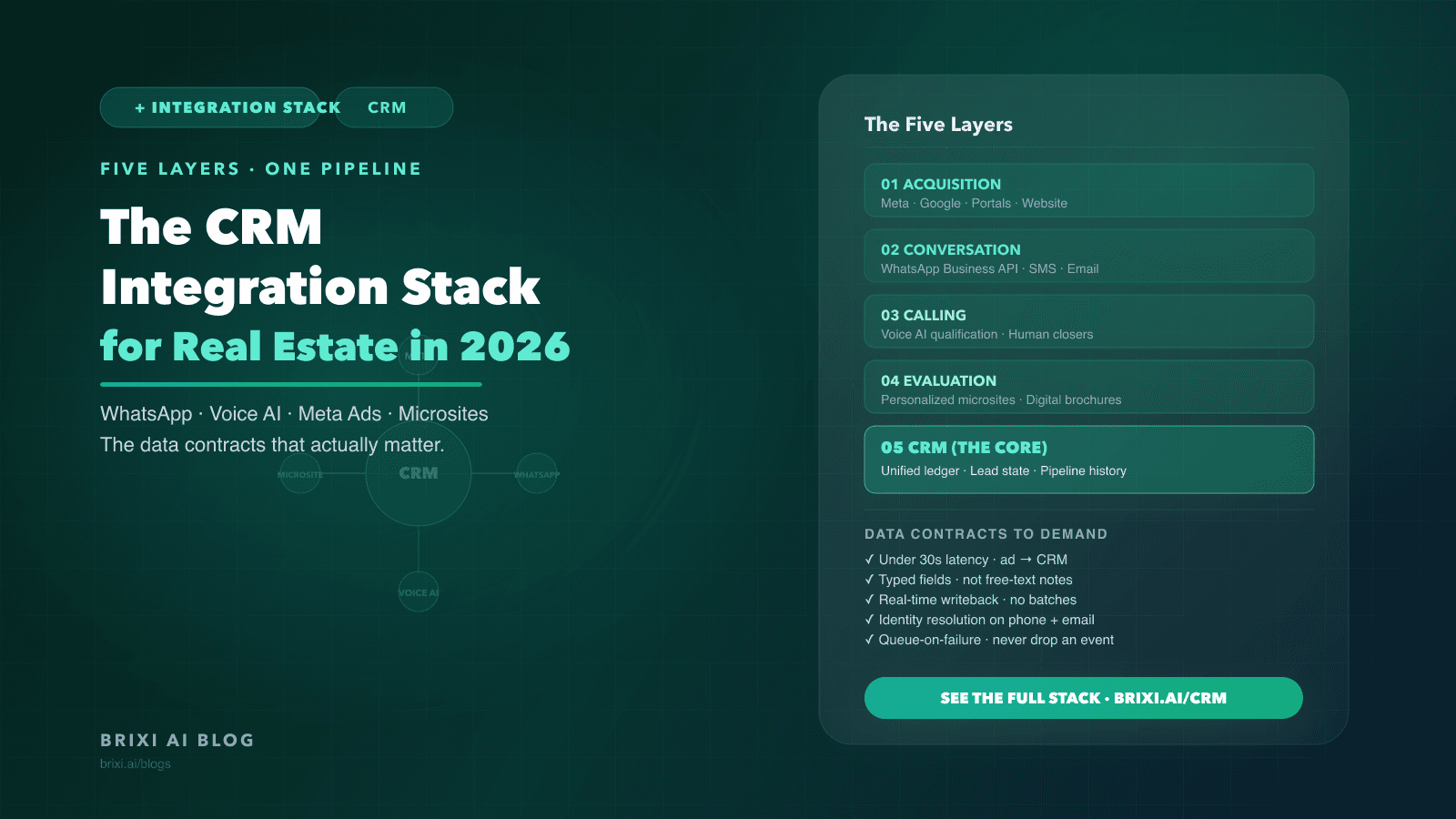
A real estate CRM on its own is a pipeline tracker. Wired into WhatsApp, Voice AI, Meta lead ads, and tracked microsites, it becomes a revenue system. Here is the integration blueprint and the data contracts that make each layer worth having.
Rekha runs pre-sales operations for a mid-sized residential developer in Noida. Her team works three projects at once, pulls roughly 4,000 leads a month from Meta and property portals, and has eleven reps on the floor. Eight months ago she moved the team to a new CRM. It has a clean interface, a Kanban pipeline, and a mobile app. Six months in, the conversion rate is identical to what it was on the old tool.
The CRM was not the problem. The integrations around it were. WhatsApp messages lived in a separate inbox. Voice AI call outcomes were logged by hand. Microsite links were static PDFs. Meta leads arrived in a CSV at 10 a.m. each morning. The CRM had perfect records of nothing that mattered.
This is Connector Rot: the slow degradation that happens when a CRM is connected to the right tools in the wrong way. Each integration looks functional on paper. The WhatsApp provider has an API. The Voice AI vendor has a webhook. The microsite is shareable. But the data contracts between them are weak: events arrive late, land as unstructured notes, or never arrive at all. The CRM becomes a ledger for old news rather than a live picture of buyer behavior. Connector Rot is not about missing features. It is about bad plumbing.
What does a real estate CRM actually need to integrate with?
Before evaluating individual integrations, it helps to name the layers. A real estate sales stack in 2026 has five of them, and the CRM sits at the center rather than the top.
- Lead acquisition: Meta Lead Ads, Google Ads, property portals (99acres, Housing, MagicBricks), and website forms.
- Conversation: WhatsApp Business API, SMS, and email for asynchronous back-and-forth.
- Calling: Voice AI agents for qualification and re-engagement, human reps for negotiation and closing.
- Evaluation: personalized microsites, digital brochures, floor plan viewers, and payment plan calculators that the buyer uses alone.
- Intelligence: the CRM itself, as the central record of lead state, pipeline stage, and behavioral history across the four layers above.
The CRM’s job is not to replace any of these layers. It is to receive structured data from each of them fast enough that the rep always has current context. Every integration judgment should start with one question: what data does this layer produce, and how does it reach the CRM record?
Why does Meta lead ad integration latency kill contact rates?
Meta Lead Ads remain the dominant lead source for residential real estate in India. The conversion from form fill to booked site visit depends almost entirely on how fast the first contact happens. Most teams know this. Most teams still have latency problems.
The anti-pattern is the morning CSV: Meta leads are pulled from the campaign manager, exported to a spreadsheet, and uploaded to the CRM once a day. By the time a rep calls, the buyer is four hours removed from the moment of intent. A competing developer whose CRM received the lead in 30 seconds has already set the site visit.
A tight Meta integration does more than reduce latency. It captures campaign, ad set, and creative ID on every lead so that cost-per-qualified-lead can be broken down by creative, not just by campaign. It deduplicates against existing records so a buyer who fills two forms across two campaigns is unified rather than split. It captures project intent from the form itself as structured fields. Latency is table stakes. Attribution depth is the part that most teams miss.
Is WhatsApp a first-class CRM channel or a side tool?
This is where Connector Rot is most common and most costly. Most real estate teams have WhatsApp as a side tool: a separate inbox, conversations saved as manual notes ("spoke on WA, interested, will call back"), and template messages sent outside the CRM. The CRM record reflects what the rep remembered to write, not what actually happened.
A CRM that treats WhatsApp as a first-class channel stores every inbound and outbound message against the lead record with timestamp and direction. The rep opens one screen and sees the full conversation. The manager can audit it. Compliance is automatic. Template sends are triggered by pipeline events: site visit scheduled, follow-up overdue, payment plan requested. The rep does not copy-paste.
The piece that breaks most DIY integrations is template approval management. Meta requires pre-approval of every outbound WhatsApp template. Teams that manage approvals outside the CRM find that a rep occasionally sends an unapproved message, the number gets flagged, and the entire outbound workflow goes down for weeks. A CRM with native WhatsApp management routes approvals through the product. A connector built on top of a third-party provider does not.
- Every message stored on the lead record: inbound, outbound, and media.
- Template approvals managed inside the CRM, not in a separate compliance workflow.
- Automated sends triggered by pipeline stage changes and follow-up timers.
- Read receipts and response times surfaced in manager reporting, not hidden in the WhatsApp inbox.
- Shared number routing or agent-specific numbers, configurable by team size and structure.
What does a Voice AI integration need to write back to the CRM?
Voice AI for real estate qualification is genuinely useful. A well-designed agent can call a fresh Meta lead within 90 seconds of form fill, establish intent, capture budget range and timeline, and route a warm lead to a human rep. The question is not whether Voice AI works. The question is whether the outputs of the call land in the CRM in a form that a rep can act on.
The named anti-pattern here is the Transcript Dump: the Voice AI call completes, and a full transcript is appended to the lead notes as unstructured text. The rep must read 200 lines to find that the buyer mentioned a budget of 85 lakhs and wants possession before end of year. The intent score is not updated. The pipeline stage is not moved. The rep still has to do all the work.
A mature Voice AI integration writes structured qualification data back to the CRM as typed fields: budget range, timeline, buyer type (investor or end user), objections flagged, and a disposition code. It updates the buyer intent score. It attaches the transcript as a searchable artifact, not as the primary record. And it handles live escalation: when a buyer meets the qualification threshold during the call, the lead is routed to an available human rep while the call is still active. That handoff, not the transcript, is the integration moment that actually closes deals.
Why do microsite signals change how reps prioritize their day?
The microsite is where the buyer forms their actual opinion. The rep is not in the room. The buyer is looking at floor plans at 11 p.m., opening the payment plan calculator twice, sharing the link with a family member. A static PDF generates none of this data. A tracked microsite generates all of it.
The integration to the CRM is what makes that data actionable. Each microsite link is personalized per lead so every session is attributable. Events flow in real time: page view, section time, pricing view, payment plan download, share event. Each event updates the buyer intent score on the lead record. High-intent events, specifically payment plan downloads and share events, trigger an immediate rep notification. The rep arrives at their desk in the morning with a ranked list of leads who showed intent overnight.
The integration most teams underestimate
Microsite engagement tracking is the highest-leverage integration in the real estate stack, and the most commonly skipped. A rep who knows which section a buyer spent seven minutes on has a different conversation than a rep who is guessing. Connector Rot in the microsite layer costs the most because it happens in silence: the signals existed, the CRM just never saw them.
Is it cheaper to build these integrations or buy a bundled platform?
The honest answer is counterintuitive: building your own integrations is almost never cheaper, even when you price in platform licensing. The cost that most teams underestimate is correctness debt, not maintenance cost.
A Zapier workflow from Meta to CRM can go live in an afternoon. But it will miss deduplication logic. It will not capture ad creative IDs. It will not handle the edge case where the same buyer submits forms on two separate campaigns. The workflow works; the data contract is shallow. The CRM has records, but those records are missing the fields the analyst needs to run campaign attribution. Six months later, the team cannot answer which creative drove qualified buyers versus unqualified volume. That is correctness debt: the integration is live, but it never captured the right data.
A purpose-built real estate platform ships with integrations where the same team owns both sides of the data contract. The CRM team built the Meta integration knowing what the CRM fields need. The WhatsApp module was designed alongside the pipeline module. The Voice AI agent writes back to the same schema that the intent score reads. The data contracts are deeper because they were designed together, not stitched together.
What does the diagnostic checklist for your current stack look like?
Before rebuilding anything, run this checklist on the current stack. Most teams find three or four answers that are uncomfortable.
- Meta lead to CRM record latency: under 30 seconds, under 5 minutes, or batch? (Target is under 30 seconds.)
- Can a rep see the full WhatsApp conversation history on the lead record without switching tools? (Yes or No.)
- Does a Voice AI call write structured fields to the lead record, or append a transcript? (Structured fields or transcript dump.)
- Does the intent score update automatically when a buyer downloads the payment plan on the microsite? (Automatic or manual.)
- When a buyer shares a microsite link with a family member who opens it, does the CRM capture that signal? (Yes or No.)
- If you change your WhatsApp provider, how many other integrations break? (The correct answer is zero.)
- Can a manager pull a campaign attribution report that breaks down cost-per-qualified-lead by creative? (Yes or No.)
If the answers include "no," "transcript dump," "manual," or "I am not sure," the stack has Connector Rot in at least one layer. The lead volume already in the pipeline can produce meaningfully more site visits and bookings with tighter integrations. No additional ad spend required.
What changes after a quarter of tighter integrations?
Teams that close Connector Rot across all four layers typically report three changes within 90 days. First, the first-contact rate on Meta leads improves because reps are calling within minutes, not hours. Second, rep prioritization improves because the intent score is driven by real behavioral data, not by the rep’s guess. Third, manager visibility improves because the CRM finally reflects what happened in the field, not what reps chose to log.
A less obvious change: the quality of the handoff between pre-sales and the site visit team improves. When the site visit team can see that a buyer spent eleven minutes on the 3BHK floor plan, downloaded the payment plan twice, and asked the Voice AI agent about possession dates, they walk into the visit with a brief rather than starting from scratch. That context, delivered through the CRM, is worth more than an extra hour of sales training.
There is also a downstream effect on campaign spending. Attribution that links ad creative to qualified leads, not just to form fills, gives the marketing team data to shift budget toward creatives that drive intent rather than volume. In deployments where this attribution was absent, teams discover they were spending a significant portion of their Meta budget on creatives that filled the pipeline with leads that never converted.
The deeper bet: Rekha’s stack is the product
Six months after Rekha fixed the integrations, the CRM record looks different. Every Meta lead arrives in under a minute. Every WhatsApp message is on the timeline. Every Voice AI call outcome is a set of typed fields, not a transcript. Every microsite share event pings the rep who owns the lead. The intent score moves on its own.
The conversion rate moved. Not because the CRM changed. The CRM was fine before. What changed is that it finally knew what was happening.
The deeper bet in real estate sales is that the team with the best data wins, not the team with the most calls or the most leads. Connector Rot is the thing that prevents the data from existing. Fixing it is not a technology project. It is an operations decision: the stack is the product, and weak integrations are unacceptable quality in the core product.
Is your CRM stack suffering from Connector Rot?
Brixi bundles CRM, WhatsApp, Voice AI, buyer intent tracking, and personalized microsites into a single platform with native data contracts between every layer.
See the Buyer Intent EngineFrequently Asked Questions
Four integrations carry most of the weight: Meta Lead Ads for acquisition with latency under 30 seconds, WhatsApp Business API as a first-class channel on the lead record, Voice AI with structured qualification writeback, and personalized microsites that push engagement events to the intent score. A CRM without tight data contracts on all four of these is operating with Connector Rot in at least one layer.
Under 30 seconds from form submission to CRM record creation is the target. Contact rates on Meta leads drop sharply after the first few minutes. A batch upload at 10 a.m. means the first call happens hours after the buyer expressed intent. The integration also needs to capture campaign, ad set, and creative ID as structured fields, not just source equals Facebook.
Inside the CRM. A separate WhatsApp inbox breaks context: reps lose the conversation thread, managers cannot audit it, and template compliance is difficult to enforce. WhatsApp should be a first-class channel on the lead record. Every message, in both directions, should be stored with a timestamp. Template approvals should be managed inside the same product.
Structured fields, not a transcript. Budget range, timeline, buyer type, objections, and a disposition code should land as typed CRM fields. The transcript belongs attached to the record as a searchable artifact. The intent score should update automatically from the call outcome. And live escalation, routing a qualified buyer to a human rep while the call is still active, is the integration moment that drives actual bookings.