Buyer Intent Score for Real Estate: Predict Site Visits
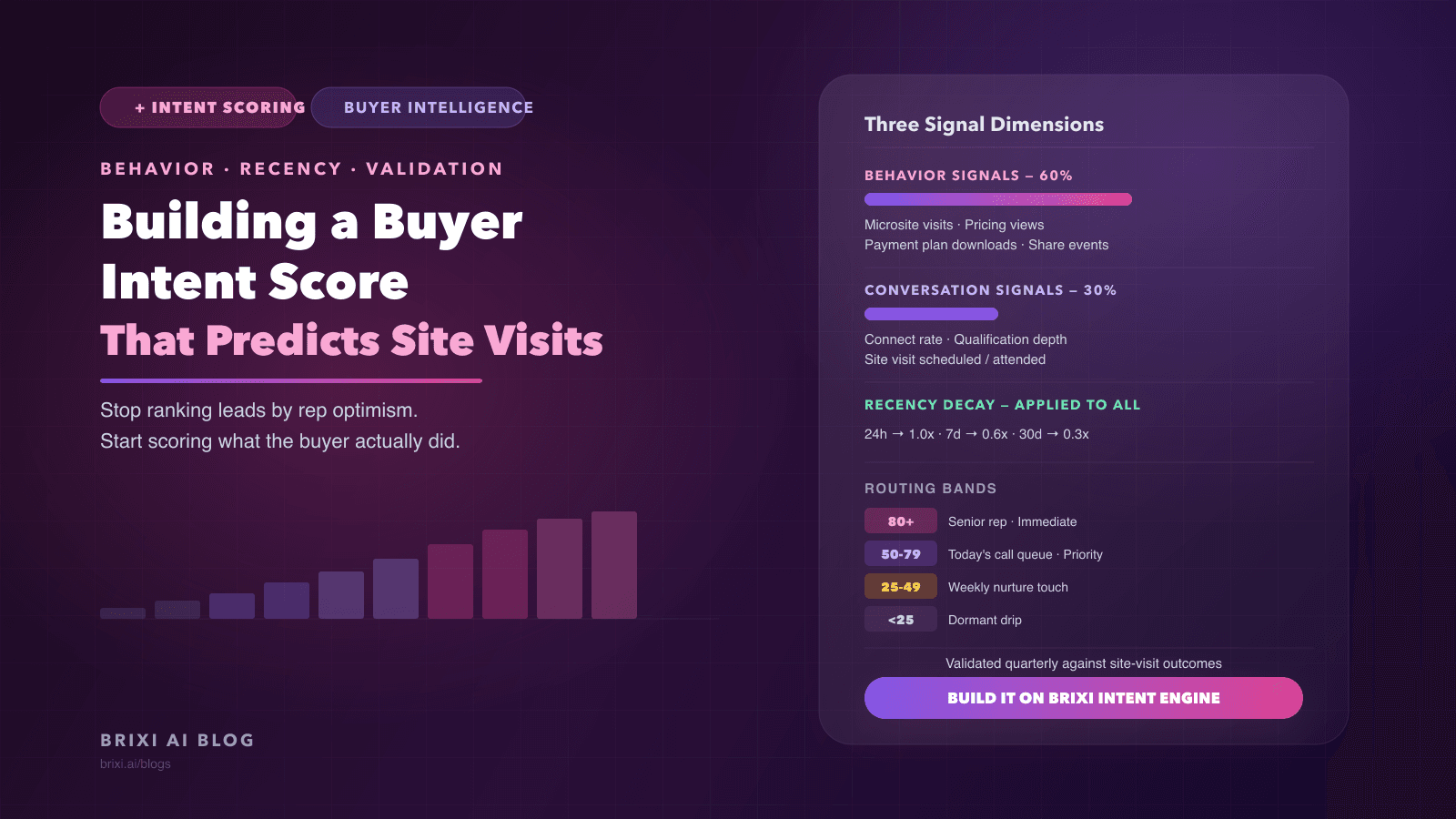
Most lead scores in real estate reflect rep optimism, not buyer behavior. A real buyer intent score combines microsite engagement, conversation signals, and recency decay into a single number that predicts which leads will show up for site visits. Here is how to build one that actually works.
Jaya runs sales for a mid-size residential developer in Bhopal. On a Tuesday afternoon in March, her senior rep Ravi spent three hours working through a call list of "hot" leads flagged by their CRM. He reached seven people. Two were genuinely interested. Five had lost interest weeks ago. The list had been tagged hot by another rep who connected with them in February and never updated the score.
Jaya’s problem is not that her reps are lazy. It is that her lead score is a photograph pretending to be a live feed. It captures a single moment of rep opinion and holds that snapshot until someone manually changes it. By the time Ravi is calling, the score is not describing these buyers. It is describing how an earlier rep felt about them weeks ago.
This is the core failure of most real estate buyer intent scores: they are static, rep-entered, and never validated against the one outcome that matters, which is whether the buyer actually shows up for a site visit. Fixing this requires a different architecture entirely.
Why does the standard "hot/warm/cold" system fail real estate sales?
Three structural problems run through every manual lead-scoring system we see in real estate. Each one compounds the others.
First: rep-entered scores reflect the rep, not the buyer. When a rep has a good conversation with someone, they tag that lead hot. When the conversation is awkward, they tag it warm even if the buyer was clearly interested. The scoring system becomes a record of social rapport, not purchase intent.
Second: scores do not decay. A buyer who was engaged three weeks ago and has since gone completely quiet should not carry the same score as a buyer who visited the payment plan page twice yesterday. Without recency decay built into the model, old leads crowd out new ones and the prioritization collapses.
Third: most scores over-weight profile completeness. A lead with a full name, confirmed budget, and city entered gets a high score. A lead whose form only captured a phone number gets a low one. But in practice, buyers who are early-stage and serious often give minimal information. Incomplete profiles are not a reliable proxy for low intent.
What is the Intent Pressure Index and why does it outperform a static score?
The framework we use internally is called the Intent Pressure Index. The name is deliberate. "Pressure" captures two things: the weight of accumulated signals and the sense that this pressure changes over time. A high Intent Pressure Index means a buyer is generating strong, recent, multi-channel signals. A low one means the signals have gone quiet or were weak to begin with.
Unlike a static rating, the Intent Pressure Index is computed continuously from three input streams: behavior signals from digital engagement, conversation signals from rep and AI interactions, and recency multipliers that adjust every signal based on how recently it occurred. The result is a number that moves when the buyer moves, and drops when they go quiet.
The litmus test for any real estate intent score
Sort your leads by score and divide them into ten equal buckets. If the top bucket does not show a site-visit attendance rate at least five times higher than the bottom bucket, the score is decorative. A real buyer intent score is predictive or it is not a score at all.
Which behavior signals carry the most weight in a real estate intent score?
Behavior signals are the highest-quality inputs because they represent the buyer choosing to engage without any prompting from a rep. A buyer who opens a project microsite at 10pm on a Sunday and spends twelve minutes on the payment plan section is telling you something. That action needs to be captured and weighted accordingly.
In deployments we see across real estate teams, the following behavior signals consistently correlate with site visit attendance. Treat these as a starting point, not a final list: every project and buyer segment will calibrate differently.
- Microsite sessions: each distinct visit contributes, with diminishing returns after the fourth or fifth session.
- Pricing and payment plan page views: buyers looking at pricing are further into the decision than buyers looking at amenity photos. These carry the highest per-event weight.
- Payment plan downloads or brochure requests: a deliberate download action is one of the strongest single-event signals in the set.
- Time in active engagement: total minutes spent on the microsite with genuine interaction, not idle time from a tab left open.
- Commercial section repeat visits: a buyer returning to the pricing page three times across two sessions is signaling serious evaluation.
- Share events: the buyer forwards the microsite or floor plan to another contact. This predicts family-level decision-making and correlates strongly with site visit attendance.
- Off-hours sessions: evening and weekend engagement indicates the buyer is researching on personal time, not during a quick work-hour scroll.
How do conversation signals fit into the buyer intent score model?
Conversation signals are valuable but noisier than behavior signals. They depend on rep quality, call timing, and how well the qualification was conducted. The same buyer can produce very different conversation signals depending on which rep spoke to them and how.
That said, some conversation signals are strong enough to dominate the score when they appear. A confirmed site visit date is the highest-value single signal in the entire model. A buyer who has scheduled a site visit and given a confirmed time has crossed a threshold that most other signals cannot replicate.
- First connect success: reaching the buyer on the first attempt is a positive signal. It means the number is real and the buyer picked up.
- Qualification call duration above 45 seconds: short calls often mean the buyer disengaged quickly. Longer calls indicate genuine discussion.
- Complete qualification captured: budget range, purchase timeline, and buyer type are all documented, not just partially answered.
- Objections raised: a buyer who says "need to discuss with spouse" or "want to see the construction stage" is engaged enough to have real objections. Silence is a weaker signal.
- Site visit scheduled and confirmed: the single strongest conversation signal. Weight it accordingly.
- WhatsApp reply within 12 hours: quick replies to non-automated messages indicate an attentive, interested buyer.
How should recency decay be applied to the Intent Pressure Index?
Recency decay is not optional. Without it, every score becomes a historical high-water mark rather than a real-time read on buying temperature. A buyer who was very active three weeks ago and has since gone completely dark should not carry the same score as a buyer who just spent eight minutes on the floor plan page.
A practical recency multiplier structure that works across most real estate lead volumes looks like this: signals from the last 24 hours apply at full weight. Signals from one to seven days ago apply at 60 percent. Signals from seven to 30 days ago apply at 25 to 30 percent. Signals older than 30 days apply at 10 percent or are excluded from the active calculation entirely.
The practical effect is that a pricing page view from yesterday contributes much more to the Intent Pressure Index than the same action from ten days ago. This means the score moves with the buyer. When a previously quiet lead suddenly re-engages, the score rises quickly. When an active lead goes dark, the score falls over days. The score becomes a live signal rather than a label.
What does score validation look like in practice?
A real estate team that has never validated their lead score is operating on faith. Validation is straightforward but requires committing to a process.
At the end of each week, snapshot the Intent Pressure Index for every active lead and store it. Two weeks later, record whether each lead in that snapshot attended a site visit. Sort the snapshot scores into ten equal buckets. Plot site visit attendance rate against each bucket.
A predictive score produces a line that rises steadily from the lowest bucket to the highest. The top bucket should show an attendance rate meaningfully higher than the middle, and the bottom bucket should show the lowest. If the line is flat or inconsistent, the score is not correlating with the outcome you care about. The correct response is to reweight the signals, not to discard the approach.
Most teams find that behavior signals, especially repeat pricing page views and share events, are more predictive than they expected. Conversation signals like call duration are often weaker predictors than assumed because they depend heavily on rep skill. Validating against actual outcomes removes the guesswork from these weighting decisions.
Which anti-patterns destroy a buyer intent score over time?
There are five specific anti-patterns that degrade intent scores in real estate. Each one has a name because naming makes them easier to catch.
- The Ceiling Problem: every moderately engaged lead hits the score maximum, leaving no room to distinguish a genuinely serious buyer from a casually interested one. Fix this by testing your score distribution and moving the ceiling up or spreading the weights.
- Silent Penalty Absence: the score only goes up. An explicit "not interested" disposition, a request to remove from contact, or three weeks of complete silence add no negative weight. The whole database drifts high and the score stops prioritizing.
- Rep Override Rot: reps can change the score to reflect their intuition. The overrides are never tracked. Over months, the database is half computed and half manually edited, and nobody knows which parts are which.
- Microsite Thinness: the project microsite is a static PDF or a three-page site with no tracking. Behavior signals cannot be captured. The entire behavior dimension of the score goes empty and the model runs only on conversation signals, which is a much weaker foundation.
- Quarterly Staleness: the weights are set once at launch and never retuned. Buyer behavior shifts across launch cycles, seasons, and ad creative changes. A model that was well-tuned in October may be meaningfully off by April.
What changes after a quarter of running a real buyer intent score?
The first thing that changes is the pipeline review. Before the Intent Pressure Index, Jaya’s team spent most of the weekly review with reps narrating how they felt about leads. "I have a good feeling about this one." "That couple seems serious." With a live score, the conversation changes completely. Managers ask specific questions: why has this lead been at 71 for two weeks without movement, why did this lead’s score jump 40 points overnight, why are we calling bucket four more often than bucket one.
The second change is that dead leads stop being defended. When a lead’s Intent Pressure Index has dropped from 85 to 18 over three weeks because the buyer has not engaged with anything, no rep defends that lead in a pipeline review. The score does the honest accounting. The manager does not have to be the one to say it.
The third change is rep behavior. Reps begin timing their calls differently. When they see a buyer’s score rise because of an evening microsite session, they call first thing the next morning. They stop calling mid-afternoon out of habit and start calling when the signal suggests the buyer is thinking about the project. In deployments where this kind of signal-to-call timing is tracked, the connect and conversation rates rise measurably.
The deeper bet: Jaya’s team is not buying a tool, it is changing what the rep does
Jaya’s problem on that Tuesday in March was not technology. It was information architecture. Her team was operating with a map drawn weeks ago in territory that had changed. The Intent Pressure Index gives her a current map.
The contrarian version of this argument is worth stating plainly: a buyer intent score is not about doing more with leads. It is about doing less with the wrong ones. The teams that benefit most from a real scoring model are not teams that dramatically increase their call volume. They are teams that concentrate their calls on the 20 percent of leads generating 80 percent of the behavioral signal, and let the rest stay in a well-designed nurture sequence until the score moves again.
Real estate sales has a specific version of this problem because the product decision is large, the cycle is long, and buyers often go quiet between research bursts. A good buyer intent score is not trying to identify who will buy. It is trying to identify who is in an active research burst right now. That is the moment a rep call has the highest chance of converting to a site visit. Everything else is waiting for that moment to arrive.
Want a score that tells you who to call before your competitor does?
Brixi captures behavior signals from personalized microsites, merges them with conversation intelligence from Voice AI and WhatsApp, and computes a live Intent Pressure Index on every lead. No manual scoring, no stale ratings, no rep guesswork.
See the Intent EngineFrequently Asked Questions
A buyer intent score is a quantitative measure built from what the buyer actually did: microsite visits, pricing page views, conversation signals, and how recently those actions occurred. Unlike a rep-entered hot or warm label, it updates continuously and correlates directly with site visit attendance when built correctly. The Intent Pressure Index framework described here combines all three dimensions into a single number that tells a rep who to call next.
The most predictive behavior signals are repeat pricing page views, payment plan downloads, share events where the buyer forwards the microsite, and off-hours engagement on evenings and weekends. On the conversation side, a confirmed site visit date is the strongest single signal. Call duration above 45 seconds and complete qualification data also contribute meaningfully. Recency multipliers apply to all of these, so a signal from yesterday outweighs the same signal from three weeks ago.
At the end of each week, snapshot the score for every active lead and store it. Two weeks later, record which leads attended a site visit. Sort the scores into ten equal buckets and plot the site visit rate per bucket. A predictive score produces a steadily rising line, with the top bucket showing a visit rate meaningfully higher than the bottom. If the line is flat, the score is not working and the signal weights need to be retuned against actual outcome data.
The score itself should update continuously as new signals arrive. A pricing page view at 9pm should move the score before the next business day. The underlying weights should be retuned every quarter using validated outcome data, because buyer behavior shifts with launch cycles, seasonality, and changes in ad creative. A model calibrated once at launch and never revisited will drift meaningfully out of alignment within a few months.