The Composite Score Trap: Why Fit and Intent Should Never Be the Same Number
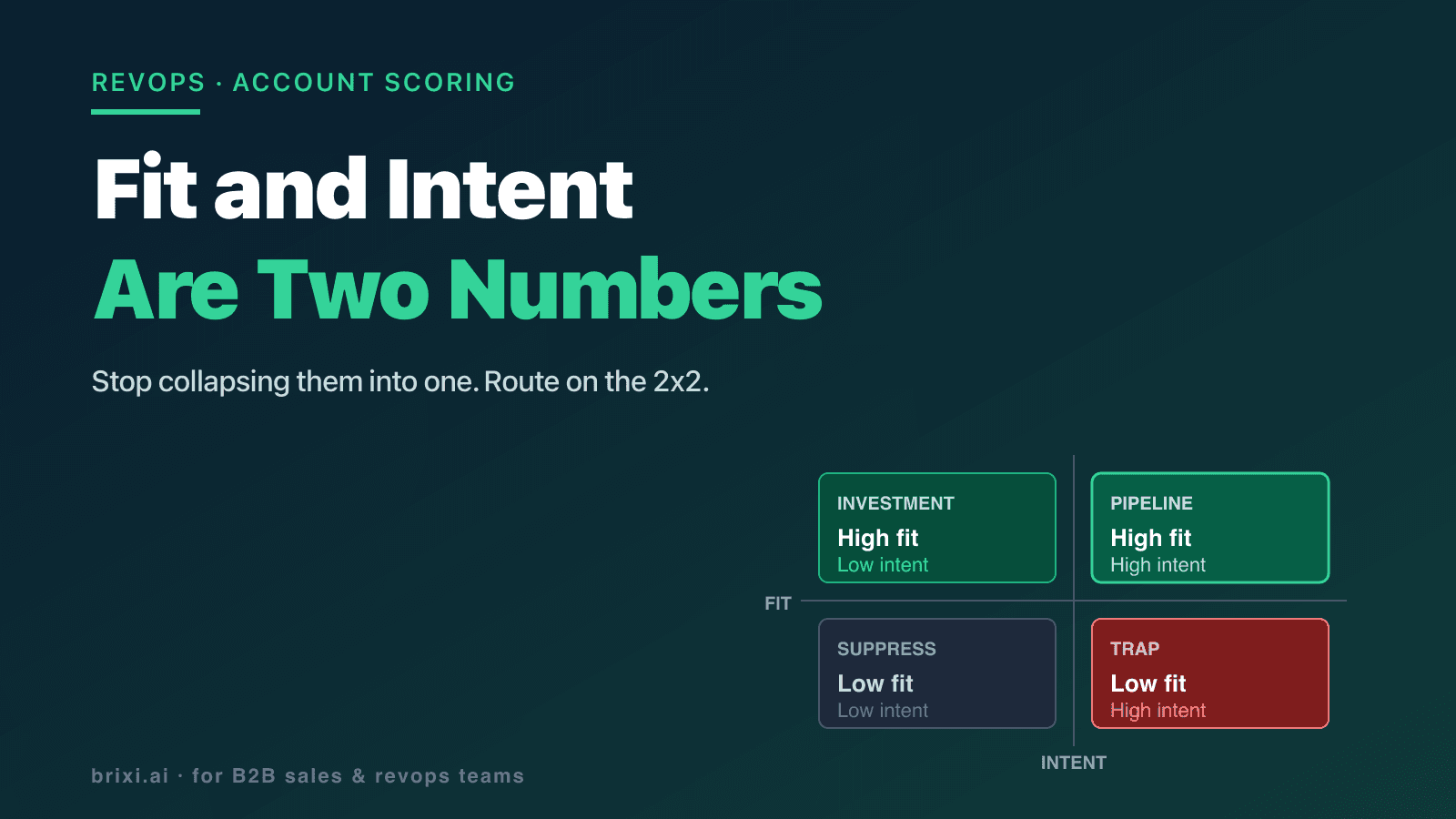
For fifteen years, B2B teams have collapsed fit and intent into a single "lead score" because their CRMs could only show one number. That was a tooling limitation, not a strategy. The teams that consistently hit pipeline are now treating fit and intent as two independent dimensions, and routing accordingly.
Walk into the Monday SDR standup at almost any B2B company. There is a shared screen with a list of accounts, sorted by a score. The score is a single number, sometimes called a lead score, sometimes an account score, sometimes an MQL grade, and it is supposed to tell the team which accounts to work first. It is wrong about half the time, and not by accident. It is wrong because it is collapsing two completely different questions into one number, and a single number cannot answer both.
The first question is whether this account is a good fit for what you sell, durable, structural, slow-changing. The second question is whether this account is in motion right now, volatile, behavioral, fast-changing. Each one has a different time horizon, different inputs, and a different correct play when the answer is yes. Forcing them into one composite number is a tooling artifact left over from when CRMs could only sort on one column. We call this the Composite Score Trap, and it is the single most common reason SDR queues feel busy and pipeline does not grow.
Where the composite score came from
Marketing automation platforms in the 2010s gave teams a way to add up signals, page visits, form fills, webinar attendance, email opens, firmographic match, and produce a single grade per lead. The grade was useful when the alternative was nothing, and the limitation was real: dashboards could not display a 2x2, sales could not be trained on one, and routing rules ran on a single threshold. The composite score was a workaround for the medium, not a model of the world.
A decade later, the workaround calcified into doctrine. Teams started defending the composite score as if it were a strategy. They added more weights, more inputs, more decimal places. The number got more sophisticated. It also got more wrong, because the thing it was trying to measure, "should we work this account today?", had two independent answers underneath it, and averaging them does not produce the right answer. It produces the wrong answer with high confidence.
What "fit" actually measures
Fit answers a single question: if this account decided to buy something in your category, would they buy from you? It is built from the patterns in your closed-won data, company size, geography, industry, regulatory profile, the presence of the role that owns the problem, the technographic stack that implies the buying motion is even possible. Fit is durable. It does not change in a week. It changes when your product changes, your pricing changes, or your win rate by segment changes, quarterly events.
- Firmographic match: revenue, headcount, geography, industry vertical.
- Technographic match: adjacent tools that imply this account already operates the way you serve.
- Org-design match: does the role that owns this problem exist at this company?
- Disqualifiers: segments where your historical churn rate is unacceptable.
Fit is the marketer's number. It changes the answer to "where should we spend pipeline budget next quarter?" It does not, on its own, change the answer to "what should the SDR call today?"
What "intent" actually measures
Intent answers a different question: is this account in motion right now? It is built from time-sensitive behavior, multiple users from the same domain on the pricing page, doc dives, repeat sessions, third-party research surge data, hiring activity in adjacent roles, conversational signals in chat or webinar Q&A. Intent is volatile. It can spike in a week and collapse the next. It needs to be refreshed daily, not quarterly, and it needs to be reasoned about in trajectories, not snapshots.
- First-party: pricing-page visits, doc dives, repeat sessions, multiple users from one domain in a short window.
- Third-party: research-surge data, review-site activity, competitive comparison searches, public earnings-call language.
- Hiring: open roles in adjacent functions that imply a project is being scoped.
- Conversational: questions in chat, support, or webinar Q&A that imply active evaluation, not casual research.
Intent is the seller's number. It changes the answer to "what should the SDR call today?" It does not, on its own, change the answer to "where should marketing invest next quarter?" Confusing these two is what produces sales-marketing conflict in most B2B orgs.
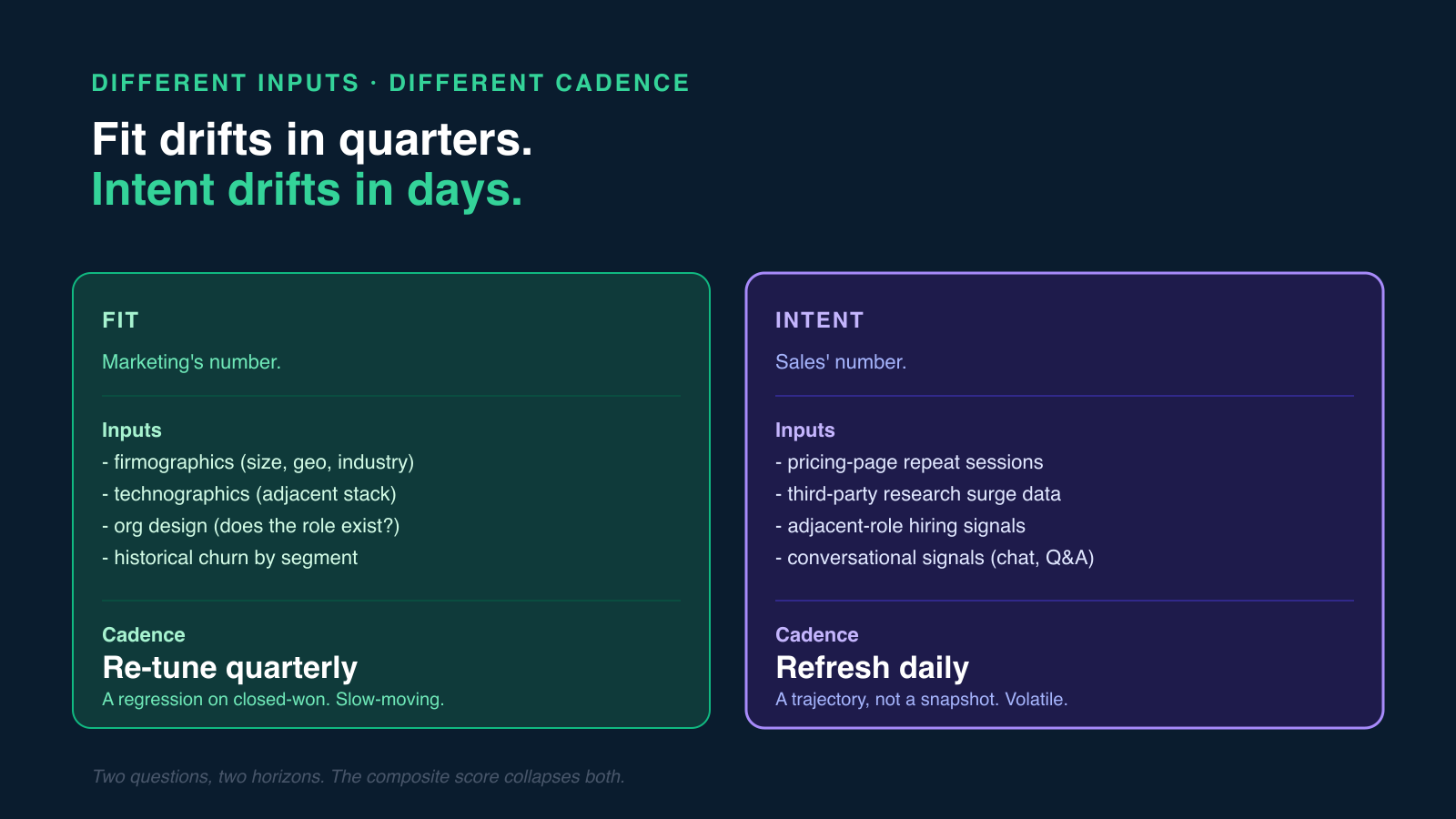
Fit drifts in quarters. Intent drifts in days. Two different cadences for two different jobs.
The 2x2 that should drive your routing
Once you score both, every account lands in one of four quadrants, and each quadrant has a different correct play. Most CRMs collapse this into a single score and lose the structure. Naming the quadrants is half the work, it forces the team to use them as routes, not just numbers.
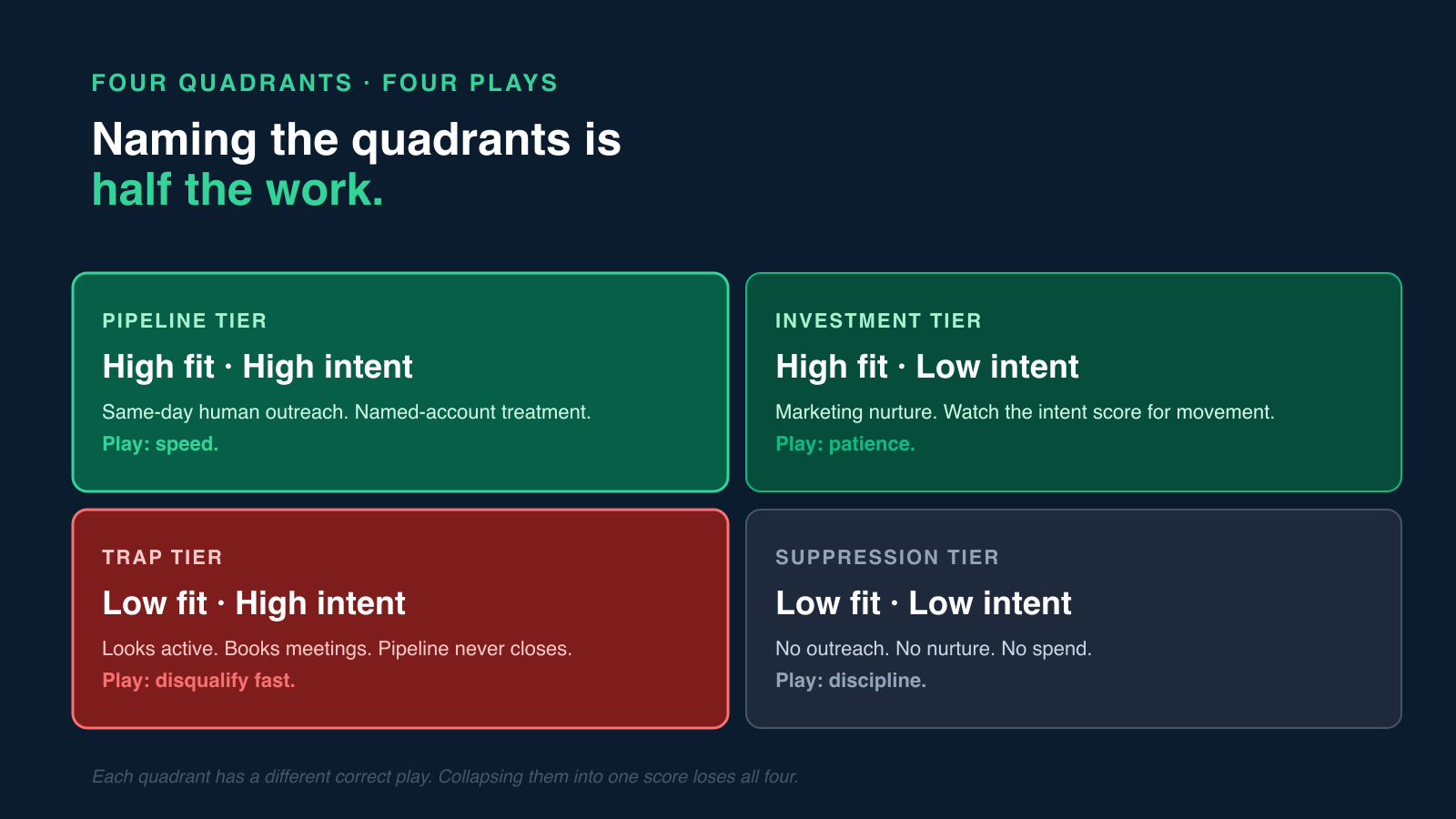
Four quadrants, four plays. Collapsing them into one score loses all four.
The Pipeline Tier: high fit, high intent
These are the accounts that should already be in pipeline. If they are not, your routing is broken. They get same-day human outreach, named-account treatment, AE involvement on the second touch, and a tight SLA on the first response. Anything slower than 24 hours and a competitor lands the meeting first, because they have the same intent feed. The play here is not creativity. It is speed.
The Investment Tier: high fit, low intent
These accounts will buy eventually but are not in-market today. The mistake is treating them as cold outbound, which wastes attention and degrades sender reputation. The right play is the marketing investment lane: owned content, light-touch sequences, peer-network introductions, watch the intent score for movement. The SDR's job here is not prospecting; it is patience. The reward for patience is a Pipeline Tier account 90 days from now.
The Trap Tier: low fit, high intent
This is where most SDR time silently leaks. The account looks active because someone there is doing research, but the account is structurally not the right buyer for you, wrong size, wrong stage, wrong problem. Reps love this quadrant because the account opens the email, books the meeting, and feels productive. The pipeline that comes out of it never closes, because the deal was never real. The discipline here is to disqualify fast, or pass to a partner if your channel motion supports it. Most teams need to actively name and watch this quadrant to stop bleeding into it.
The Suppression Tier: low fit, low intent
No outreach, no nurture, no spend. The discipline to ignore this quadrant is what frees the budget to do the first three quadrants well. It feels uncomfortable to actively suppress a list this large, which is why most teams do not, and which is why most teams have inflated cost-per-meeting numbers they cannot explain.
Note AI lives on the intent axis, not the fit axis
Fit is a regression on closed-won. AI does not really earn its keep there. AI earns its keep on intent, reading conversations, engagement patterns, public signals, and hiring data at a frequency no human queue can keep up with. Use the right tool for each axis. Most "AI scoring" products are quietly just intent products with marketing.
How RevOps operationalizes this without a year-long project
You do not need a perfect model on day one. You need a defensible split between the four quadrants and a routing rule for each. Most teams can get a usable v1 in three weeks, and the political work of agreeing on quadrant definitions is harder than the technical work of building the scores.
- Pull the last eight quarters of closed-won and closed-lost. Fit features fall out of a simple regression, you do not need a deep model for this.
- Wire intent inputs into a single intent score, refreshed daily, with a 30-day decay. Snapshot scores are misleading; trajectory matters more than instantaneous value.
- Define the routing rule per quadrant explicitly. Who gets the lead, in what SLA, with what playbook, with what disqualification path. Write it down.
- Audit the queue weekly. What share of SDR time was spent in each quadrant? What share of pipeline came out of each? The Trap Tier ratio is usually the most diagnostic number in the org.
- Re-tune fit quarterly, intent monthly. Fit drifts slowly with product and market. Intent drifts fast with seasonality, news cycles, and competitive moves.
What changes after a quarter
Teams that split fit and intent see two metrics move in tandem. SDR meeting-to-pipeline conversion goes up because the Pipeline Tier gets prioritized correctly and the Trap Tier stops eating the queue. Cost per qualified opportunity drops, sometimes sharply, because the same SDR seat is producing more pipeline by working a smaller list. Marketing's job changes too: the fit model now gives them a numerical answer to "which segments should we invest in next quarter?", instead of a debate about which logos look impressive on a slide.
The deeper organizational shift is harder to put on a dashboard but more durable. Sales and marketing stop arguing about lead quality, because the argument was always a side effect of confusing fit and intent. Marketing owns fit and is judged on segment-level pipeline ROI. Sales owns intent and is judged on speed-to-touch and conversion. The two functions can both be right at the same time, on different axes, which is the configuration that actually produces growth.
The deeper bet
The Composite Score Trap exists because for fifteen years it was easier to add numbers than to add columns. AI does not fix this by being smarter. AI fixes it by making one of the two numbers, intent, finally cheap enough to compute continuously, at the resolution the SDR queue actually needs. The work for RevOps is structural, not technical. Stop averaging two different questions. Score them separately. Route accordingly. The pipeline number does the rest.
Score fit and intent separately. Route accordingly.
Brixi gives RevOps a daily-refreshed fit and intent score per account, with the routing rules and conversation context the SDR team needs in one place.
See Brixi for RevOpsFrequently Asked Questions
Fit measures whether an account structurally matches your ideal customer profile, based on firmographics, technographics, and org design. Intent measures whether that account is actively in-market right now, based on behavioral signals like pricing-page visits, hiring activity, and research surges. Fit is durable and re-tuned quarterly; intent is volatile and should be refreshed daily.
Combining them into a single composite number forces two independent questions into one answer, which produces the wrong routing decision with high confidence. A high-intent, low-fit account is a trap that looks productive but never closes, while a high-fit, low-intent account needs patient nurture rather than aggressive outreach. Separate scores let each quadrant get the correct play.
The 2x2 plots fit on one axis and intent on the other, producing four quadrants: Pipeline Tier (high fit, high intent) gets same-day outreach; Investment Tier (high fit, low intent) gets patient nurture; Trap Tier (low fit, high intent) gets fast disqualification; Suppression Tier (low fit, low intent) gets no spend. Each quadrant has a different correct play that a single composite score cannot capture.
Most teams can reach a usable version one in three weeks. Pull the last eight quarters of closed-won and closed-lost data to derive fit features via a simple regression, then wire intent inputs into a daily-refreshed score with a 30-day decay. The harder work is agreeing on quadrant definitions and writing explicit routing rules, SLAs, and disqualification paths for each quadrant before launch.