Retell AI Pricing in 2026: What Teams Should Budget Before Scaling Calls
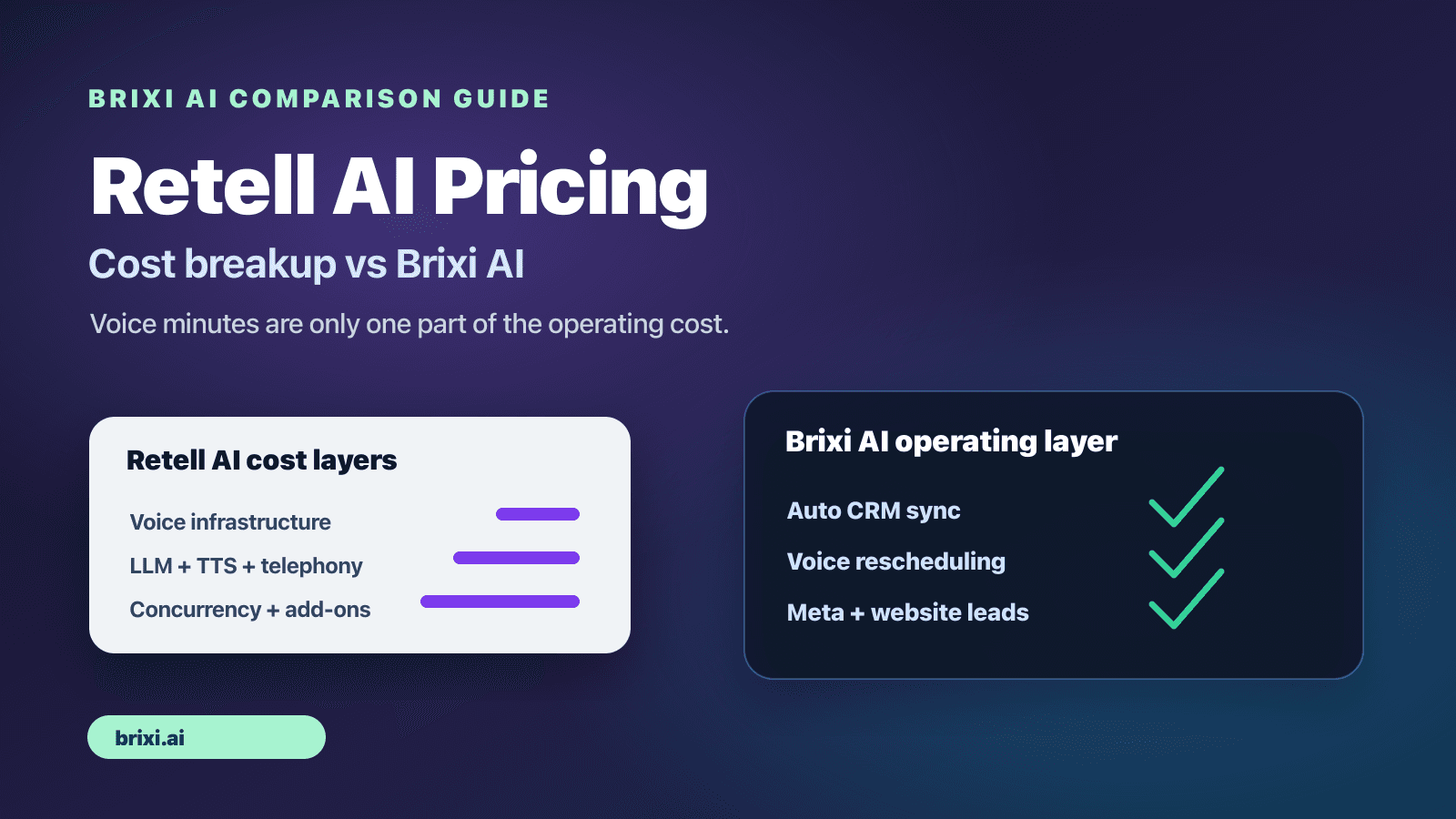
Retell AI pricing looks like a single per-minute rate. The number you actually pay includes engineering, CRM glue, and follow-up nobody quotes you. Here is the honest breakdown, and how Brixi AI compares at a flat $0.07/minute with the workflow included.
Retell AI pricing reads simply on the pricing page: a per-minute rate, a few free credits, and a block of included concurrency. That number is the easy part to budget. It is rarely the number you end up paying.
The gap is between the sticker minute and the all-in minute. The sticker minute is the rate Retell quotes. The all-in minute is that rate plus the engineering, the CRM sync, the phone-number strategy, and the follow-up that someone still has to build and keep running. Brixi AI starts at a flat $0.07/minute with that workflow already included, so for most teams the all-in cost stays close to the price on the page.
Retell AI pricing in 2026: an honest breakdown
Credit where it is due. Retell is a clean, flexible voice layer, and the published rate is fair for what it is. Retell lists pay-as-you-go voice agent pricing from $0.07 to $0.31 per minute, with $10 in free credits and 20 included concurrent calls. Enterprise pricing is custom.
That range is wide because the per-minute price is assembled from parts, and each part has its own list price. Here is the current stack from Retell’s pricing page.
| Component | Retell list price | What it covers |
|---|---|---|
| Voice infrastructure | $0.055/min | The Retell platform base, charged on every call. |
| Language model | $0.003 to $0.16/min | GPT-4.1, the recommended model, is $0.045/min. Frontier and realtime models cost more. |
| Text-to-speech | $0.015 to $0.04/min | Most voices are $0.015/min. ElevenLabs voices are $0.04/min. |
| Telephony | $0.015/min | Twilio for the US and most countries. Custom SIP is no charge. |
| Extra concurrency | $8 per slot/month | 20 concurrent calls included, then $8 for each added slot. |
| Verified numbers | $10 per number/month | Plus a one-time $10 fee. Standard Retell numbers are $2/month. |
Add the parts up and the floor is real but rare. A recommended build, the $0.055 platform with GPT-4.1 at $0.045, a $0.015 voice, and $0.015 Twilio telephony, lands around $0.13 per minute. Swap in ElevenLabs voices and a frontier model and you climb toward the $0.31 ceiling, before knowledge bases at $8/month each, branded caller ID at $0.10 per call, or PII removal at $0.01/min.
Price the all-in cost, not just the sticker minute
The all-in cost: what the per-minute price leaves out
A voice minute buys the conversation. It does not buy the outcome. For a developer team that wanted raw infrastructure, that distinction is fine. For a sales, admissions, or support team, the work that turns a call into a booked callback and an updated record is a second project, and it never appears on the pricing page.
Model that second project honestly and it often costs more across a year than the minutes do. This is the workflow glue tax: the engineering and operational time spent connecting a voice layer to the systems your revenue actually runs on. Here is where it hides.
| Cost the page does not quote | Why it lands on the real invoice |
|---|---|
| Integration build | CRM sync, routing, and reporting are custom work, then ongoing maintenance as the business changes. |
| CRM upkeep | Fields, owners, stages, and rules drift. Someone owns keeping them correct. |
| Number strategy | Outbound teams need verified numbers to protect pickup rates and avoid spam labeling. |
| Knowledge bases | Multiple products, locations, scripts, and policies add setup and usage complexity. |
| Manager visibility | Call logs are not pipeline. Reschedule volume and owner actions need real reporting. |
| Missed follow-up | The cost no one budgets: callbacks that never happen because nothing created the task. |
The cheapest voice AI is not the cheapest minute
Retell prices the minute. Brixi prices what happens after it. A voice layer stops working when the call ends. A customer platform starts working when the call ends. For an operating team, the cheaper option is the one that leaves the least manual work.
What a month of calls actually costs
Numbers make the gap obvious. Take a modest outbound program: 1,000 calls a month at four minutes each, or 4,000 minutes. Here is the same volume priced two ways. The figures are illustrative, and your mix of voice, model, country, and add-ons will move them, but the shape holds.
| 4,000 minutes per month | Retell AI (illustrative) | Brixi AI |
|---|---|---|
| Minutes at the floor rate | $280 at $0.07 | $280 at $0.07 |
| Realistic effective rate | $520 to $1,240 at $0.13 to $0.31 | $280, flat $0.07 |
| Concurrency, knowledge base, numbers | Extra monthly line items | Included |
| CRM sync, rescheduling, reporting | Build once, then maintain | Included |
| Meta, website, and WhatsApp context | Out of scope | Included |
The floor rates match. Everything below the first row is where a build-your-own voice layer and a workflow-included platform separate. On Retell the lines stack and the engineering hours compound. On Brixi they are already inside the $0.07.
Retell AI vs Brixi AI
The two are not really priced on the same axis. Retell prices voice components for builders. Brixi prices a connected customer workflow for the team that runs the calls.
| Decision point | Retell AI | Brixi AI |
|---|---|---|
| Built for | Developers assembling a voice stack. | Sales, admissions, support, and ops teams. |
| Setup | API-first configuration you own. | Connected customer platform, live in days. |
| Pricing lens | Voice components and add-ons, billed apart. | Flat from $0.07/minute, workflow and CRM included. |
| CRM sync | You build and maintain it. | Native call-outcome sync. |
| Rescheduling | Needs workflow logic you write. | Creates callbacks and owner actions automatically. |
| Meta + website | Out of scope. Voice only. | Meta, website, CRM, voice, and WhatsApp in one memory. |
See every call sync straight into your CRM
What Brixi includes that you would otherwise build
Everything below ships inside the $0.07/minute. On a voice-only layer, each one is a ticket in an engineer’s backlog and a line in next year’s budget.
Voice rescheduling that becomes a real task
When a lead says “call me tomorrow morning” or “call after lunch,” Brixi AI turns that into a callback task, updates the customer record, notifies the owner, and confirms the next step on the right channel. The reschedule leaves the transcript and enters the workflow.
Auto CRM sync the next human can trust
Brixi AI writes structured outcomes into the CRM: lead status, qualification notes, budget range, urgency, objection, next action, and owner context. The next person starts from a clean record instead of a recording they have to re-listen to.
Meta and website leads in the same memory
Brixi AI connects Meta leads, Instagram conversations, click-to-WhatsApp journeys, website forms, website chat, voice calls, CRM, and WhatsApp follow-up into one customer memory. The agent already knows the lead before it dials.
Who should pick Retell, and who should pick Brixi
| Option | Best for | What to plan for |
|---|---|---|
| Retell AI | Engineering teams that want to own and customize a voice stack. | Modular pricing, integration build, and ongoing maintenance. |
| Brixi AI | Revenue and ops teams that need voice, CRM, Meta, website, and WhatsApp working together. | Less suited to teams that only want a raw, programmable voice layer. |
If you have engineers who want to own a voice stack, Retell is a reasonable place to start. If you are a revenue or operations team, the per-minute rate is the smallest part of the decision, and the build you would have to staff around it is the largest. Brixi is built for that second team. Choose it when:
- You need calls to update CRM records automatically, with no cleanup pass.
- You want voice rescheduling to create real callback tasks, not transcript notes.
- You need Meta and website leads connected to the same record before the call.
- You want sales and ops to run the workflow without staffing a voice-infra project.
Turn reschedules, Meta leads, and enquiries into one workflow
Compare the all-in cost, not the sticker minute
Brixi AI starts at a flat $0.07/minute and connects voice, CRM, Meta leads, website enquiries, WhatsApp follow-up, and team handoffs in one customer platform.
See Brixi Voice AIFrequently Asked Questions
Retell AI lists pay-as-you-go voice agent pricing from $0.07 to $0.31 per minute, with $10 in free credits, 20 included concurrent calls, and custom enterprise pricing. The effective rate is assembled from parts: the Retell platform at $0.055/min, a language model from $0.003 to $0.16/min (GPT-4.1 is $0.045), text-to-speech at $0.015 to $0.04/min, and telephony at $0.015/min. A recommended GPT-4.1 build lands near $0.13/min before any add-ons.
On the sticker minute they can look similar, since both start near $0.07. The difference is the all-in cost. Retell is a voice layer, so CRM sync, rescheduling, and reporting are engineering work you build and maintain. Brixi AI includes that workflow in the flat $0.07/minute, so for an operating team the total cost is usually lower even when the headline minute is the same.
Retell lists add-ons that stack up: knowledge bases at $8/month each after the first ten, verified numbers at $10/month plus a one-time $10, branded caller ID at $0.10 per outbound call, PII removal at $0.01/min, and quality assurance at $0.10/min after the first 100 minutes. Then budget for what is not on the pricing page at all: the integration build (CRM sync, routing, reporting), ongoing CRM upkeep, and the revenue lost to follow-up that never gets created.
Yes, for teams that want voice AI as part of a connected customer platform rather than a standalone developer layer. Brixi AI starts at a flat $0.07/minute and combines voice agents, automatic CRM sync, rescheduling, Meta and website lead capture, WhatsApp follow-up, and team visibility, so non-engineering teams can run it without owning voice infrastructure.
Retell lists $10 in free credits for new accounts, which is enough to test a few hundred minutes depending on the voice and model you choose. There is no separate free plan after that; usage is pay-as-you-go on the per-minute rate plus any add-ons. Brixi AI runs demos and trials through its team so you can test the full workflow, not only the call minute.
Retell continues to list usage-based pricing from a roughly $0.07 floor, with the effective rate driven by voice, model choice, telephony, and add-ons. Usage-based vendors adjust component costs over time, so confirm the current numbers on Retell’s pricing page before you budget. The structural point does not change: the floor rate is not the all-in cost.