The Intake Bottleneck: Losing Patients Before the First Visit
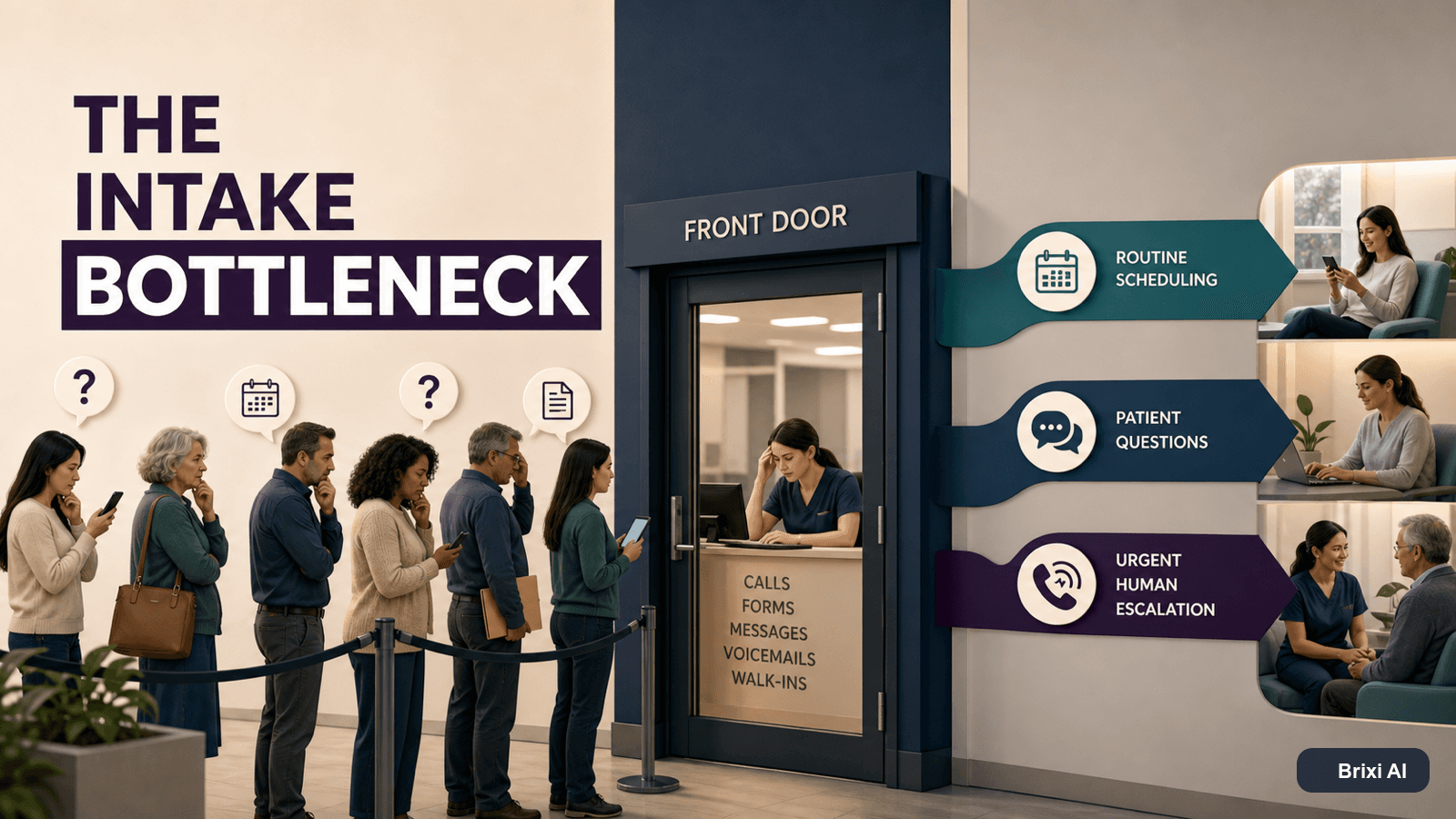
The first patient experience often happens before a clinician is involved. The Intake Bottleneck forms when calls, eligibility questions, scheduling, and reminders live in separate queues.
At 8:06 on Friday morning, a clinic receptionist has twelve missed calls, nine unread messages, two cancellation requests, and a waiting room already filling. One caller is a new patient trying to find the earliest appointment. Another needs urgent clinical guidance that the receptionist should not provide.
Both arrive in the same queue. The Intake Bottleneck appears when administrative demand, commercial opportunity, and clinical risk share one undifferentiated front door.
The Front-Door Mix combines work with different risk
Patient intake includes discovery, location questions, availability, insurance or payment questions, rescheduling, preparation, records, and symptoms. Treating every request as a booking task is unsafe and inefficient.
The system must separate administrative automation from clinical judgment. It should accelerate routine access while routing possible urgency to the appropriate qualified person or emergency guidance defined by the provider.
Intake should resolve identity, purpose, and urgency early
A short structured exchange can identify new or returning patient, requested service, location, language, timing, and whether escalation rules apply.
The goal is not diagnosis. It is safe navigation to the correct administrative or clinical path.
- Identify patient and relationship
- Clarify administrative purpose
- Apply provider-defined urgency boundaries
- Offer the correct next step and channel
Scheduling is a workflow, not an available slot
A booking may require provider, location, service length, referral, preparation, payment, or document rules. A slot that ignores these constraints creates rescheduling later.
Confirmation, reminders, change handling, and no-show recovery should remain connected to the same intake context.
Language and repetition shape patient trust
Patients may switch language, involve a caregiver, or repeat details across calls. Shared memory helps staff continue respectfully without overexposing sensitive information.
Access controls, consent, retention, and applicable healthcare requirements must be designed with qualified legal and security guidance for the provider's market.
Automate navigation, preserve clinical judgment
A safe intake system completes administrative work and escalates medical uncertainty instead of pretending to diagnose.
Brixi connects the administrative patient journey
Brixi can support voice, messaging, CRM context, scheduling workflows, reminders, and human routing in one operating layer. Provider-defined boundaries control what AI may answer or complete.
Staff receive the request, intake context, actions already taken, and reason for escalation. Patients avoid restarting the administrative journey at every channel.
- Multilingual administrative intake
- Scheduling and rescheduling workflows
- Provider-defined escalation boundaries
- Shared context for staff handoff
After a quarter, access becomes measurable
Measure abandoned calls, time to response, appropriate routing, booking completion, rescheduling, no-show, escalation, and staff workload.
Review errors and edge cases frequently. Healthcare automation should expand only when evidence shows that policy, data access, and escalation remain reliable.
- Fewer abandoned intake attempts
- Faster administrative resolution
- Better routing of urgent or sensitive requests
- Lower repetitive workload for front-desk teams
The deeper bet is a continuous access layer
Healthcare access will remain human-centered, but it does not need to remain queue-centered. Routine navigation can be available continuously while clinical judgment stays protected.
The best systems will make care easier to enter without making unsafe decisions or stripping context from the people responsible for patients.
Remove administrative friction from patient access
See how Brixi connects intake conversations, scheduling workflows, reminders, and safe human escalation.
Explore Brixi for HealthcareFrequently Asked Questions
AI can support approved administrative intake, scheduling, reminders, and routing. Clinical advice and urgent cases require provider-defined safeguards and qualified human oversight.
Avoid diagnosis, unsupported clinical advice, excessive data access, ambiguous escalation, and workflows that do not follow applicable privacy and healthcare requirements.
Track abandonment, response time, booking and rescheduling completion, no-shows, appropriate escalations, errors, patient complaints, and staff workload.