The Customer Platform ROI Model: What to Measure in 90 Days
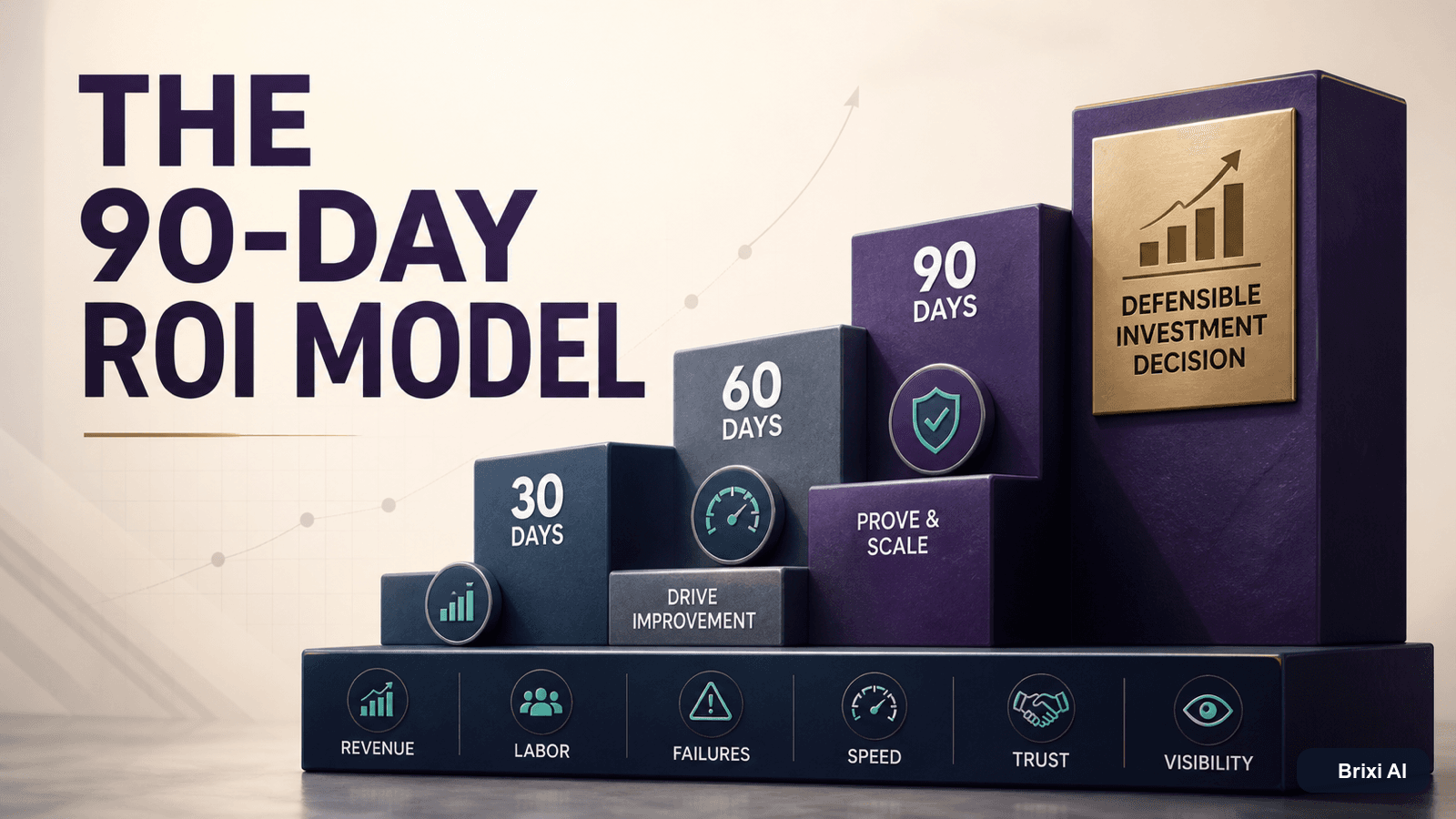
A platform business case should not depend on vague productivity claims. The Customer Platform ROI Model connects workflow change to revenue, labor, failures, speed, trust, and visibility.
At 4:00 on the final Monday of the month, a leadership team reviews an AI customer platform pilot. The vendor reports thousands of automated conversations. Finance asks the only question that matters: what changed economically? No one has a baseline.
Automation volume is not return on investment. The Customer Platform ROI Model measures how the operating system changes revenue capture, labor leverage, failure cost, speed, customer trust, and management visibility.
The Activity ROI Trap confuses output with value
Calls completed, messages sent, and summaries created are intermediate outputs. The Activity ROI Trap assigns value to them without proving that customers reached better outcomes or that the organization spent less effort.
A credible model begins with one journey, a baseline, a counterfactual, and a clear value equation. It also includes new platform and operating costs.
Measure six value pools separately
Revenue capture includes more qualified opportunities, recovered demand, attendance, conversion, retention, or collection. Labor leverage measures capacity released or growth absorbed without proportional hiring.
Failure reduction covers missed handoffs, duplicates, errors, returns, stale leads, and incident repair. Speed, trust, and visibility influence value but should not be double-counted.
- Revenue captured or protected
- Labor capacity and avoided hiring
- Failure and rework reduction
- Faster customer and workflow cycles
- Trust indicators such as complaints and repetition
- Manager visibility and decision time
Build the baseline before changing the workflow
Measure current volume, completion, median and tail time, manual touches, failures, conversion, and operating cost. Sample the real work instead of relying on ideal process documentation.
Define which external factors may influence the result, including seasonality, campaign mix, staffing, and price changes.
Use a 30, 60, and 90 day evidence ladder
The first month proves connectivity and safe completion. The second proves repeatability and operator adoption. The third tests business outcomes and identifies where the workflow should expand.
Do not annualize the best week. Use a stable period, include exceptions, and show confidence ranges where attribution is uncertain.
Count outcomes, subtract the operating cost
ROI is the value of changed customer outcomes and released capacity minus platform, implementation, oversight, and exception costs.
Brixi makes workflow outcomes measurable in one layer
Brixi connects CRM, conversations, AI actions, routing, workflows, human tasks, buyer intent, and analytics. The operating trail makes it possible to connect a signal with an action and outcome.
Teams can begin with one journey, establish the baseline, and expand after evidence shows where automation and shared context create value.
- Journey-level action and outcome history
- AI and human work in one measurement model
- Failure, escalation, and recovery visibility
- Cross-channel conversion and speed analysis
At day 90, the decision should be specific
Leadership should know which intents are safe to automate, which handoffs improved, where people gained capacity, which customer outcomes changed, and what costs remain.
The result can justify expansion, redesign, or stopping. A disciplined no is more valuable than scaling activity without evidence.
- Verified value by workflow
- Known implementation and oversight cost
- Clear autonomy and escalation boundaries
- Prioritized roadmap for expansion
The deeper bet is operational compounding
A connected platform creates value beyond one automation because every conversation, decision, exception, and outcome improves shared memory and future workflow design.
The long-term return is not merely cheaper tasks. It is an organization that learns from customer work and turns that learning into more reliable execution.
Build a customer platform business case with evidence
Map one journey, establish the baseline, and measure Brixi against revenue, labor, failure, speed, trust, and visibility.
Plan your 90-day pilotFrequently Asked Questions
Add revenue captured or protected, labor capacity, avoided hiring, failure reduction, and other defensible value, then subtract platform, implementation, oversight, and exception costs.
A focused workflow can prove connectivity, safe completion, adoption, speed, failure reduction, capacity effects, and early conversion or recovery outcomes.
Choose the metric closest to the workflow purpose, such as qualified meetings, attended appointments, recovered orders, resolved requests, or reduced manual handling.