CRM With WhatsApp and Voice AI: The 2026 Buyer Checklist
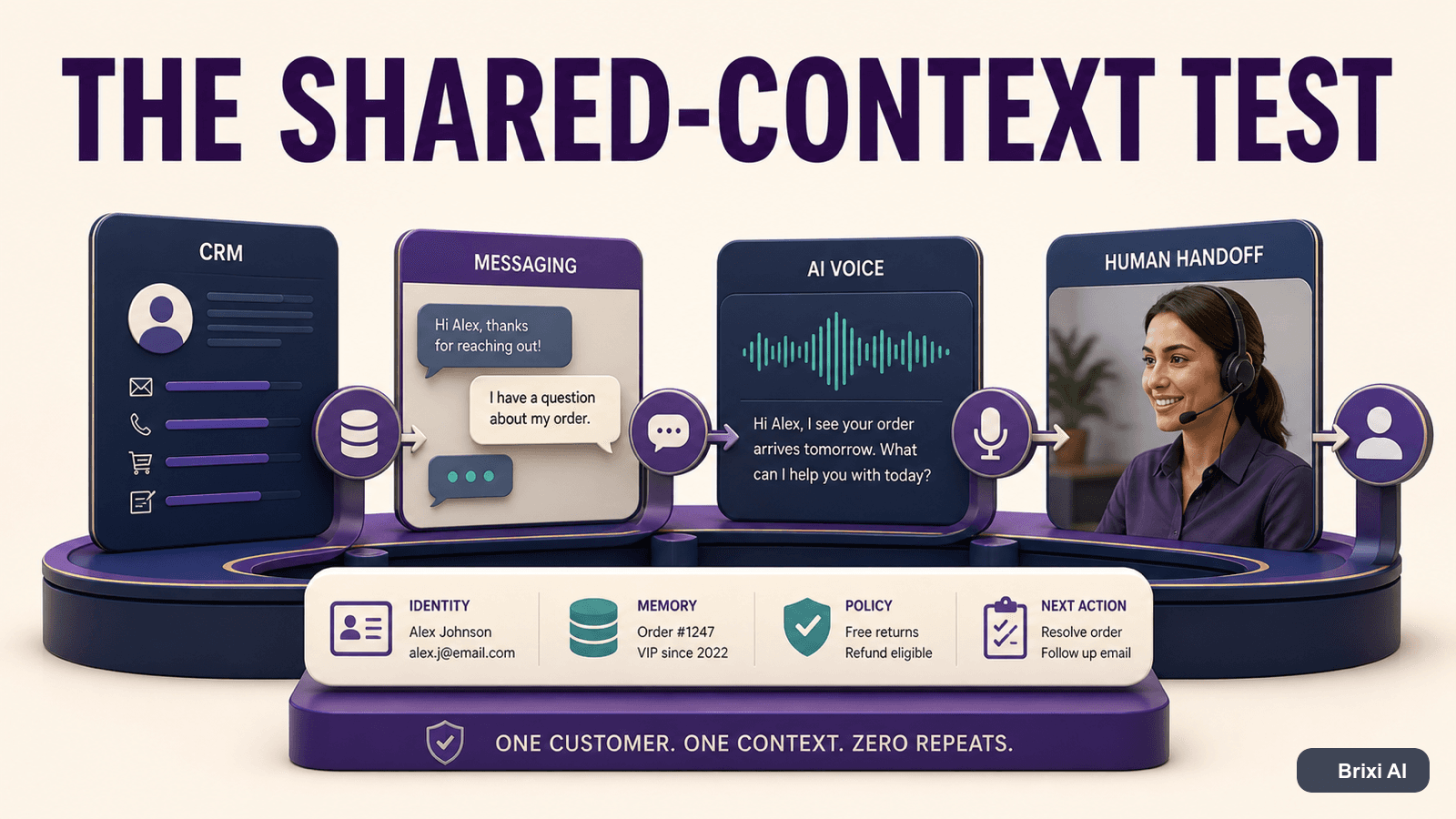
Three channel logos on a pricing page do not create one customer journey. This buyer checklist tests whether CRM, WhatsApp, and Voice AI actually share context and execution.
At 11:00 on Friday, a buying committee watches a platform demonstration. A CRM record appears, a WhatsApp message is sent, and an AI agent makes a call. Every box is checked. No one asks whether the call outcome changes the WhatsApp workflow or whether the next rep sees both conversations.
Feature presence is not integration. The Shared-Context Test determines whether the product behaves as one customer platform or three tools behind one login.
The Shared-Context Test should lead the evaluation
Ask the vendor to begin a journey on one channel, change the customer's intent, continue on another, escalate to a person, and show how the outcome updates the next action.
If context must be copied, mapped, summarized manually, or reconstructed from separate tabs, the product has channel access without channel continuity.
Identity and memory come before automation
The platform should recognize one customer across phone numbers, email, WhatsApp, forms, and existing CRM records while handling duplicates safely.
Memory must include preferences, consent, promises, intent, objections, ownership, and outcomes, not only message history.
- How are identities matched and merged?
- Which context is available across channels?
- How are consent and preferences enforced?
- Can teams inspect the source of an AI decision?
Workflows need actions, exceptions, and accountability
Ask what happens after qualification, a missed call, reschedule, complaint, opt-out, high-value inquiry, or failed integration. Happy-path demos hide production cost.
Every workflow needs an owner, deadline, fallback, audit trail, and recovery path.
Commercial comparison must use total operating cost
Include implementation, integrations, templates, telephony, usage, support, maintenance, reporting, and internal operations. Headline seat or minute prices are incomplete.
Compare the cost and speed of changing a real journey after launch. Customer operations change continuously.
Three channels are not omnichannel
Omnichannel exists when identity, memory, policy, ownership, and next action survive the channel change.
Brixi is designed as one AI-native customer platform
Brixi combines CRM, WhatsApp, Voice AI, email, web conversations, AI assistants, workflows, buyer intent, conversation intelligence, and team execution.
The same customer context informs response, qualification, routing, follow-up, escalation, and reporting across the journey.
- Unified customer identity and memory
- Native voice and messaging workflows
- Shared AI and human ownership
- Intent, conversation, and outcome intelligence
A serious pilot should test change and failure
Choose one high-value journey and run normal cases, channel switches, duplicates, opt-outs, failures, escalations, and reporting. Include the people who will operate it.
Measure time to launch, completion, exception handling, context continuity, change effort, and total operating cost.
- Evidence of cross-channel continuity
- Clear production ownership
- Known exception and recovery behavior
- Defensible total-cost comparison
The deeper bet is platform consolidation around the customer
Companies will keep specialist systems, but customer memory and execution will consolidate. AI makes fragmented context more expensive because decisions depend on the whole relationship.
The winning CRM will not be the one with the longest feature list. It will be the platform that keeps customer intent and team action coherent.
Run the Shared-Context Test
See CRM, WhatsApp, Voice AI, workflows, buyer intent, and human teams operate as one Brixi journey.
Book a platform evaluationFrequently Asked Questions
Look for shared identity, memory, consent, workflows, routing, human escalation, analytics, audit history, and reliable exception handling.
Demonstrate one journey across channels, test failures and changes, and calculate implementation plus ongoing operating cost.
Multichannel offers several channels. Omnichannel preserves identity, context, policy, ownership, and next action when the customer changes channel.