The PACE Framework: Turning Lead Behavior Into Sales Prioritization
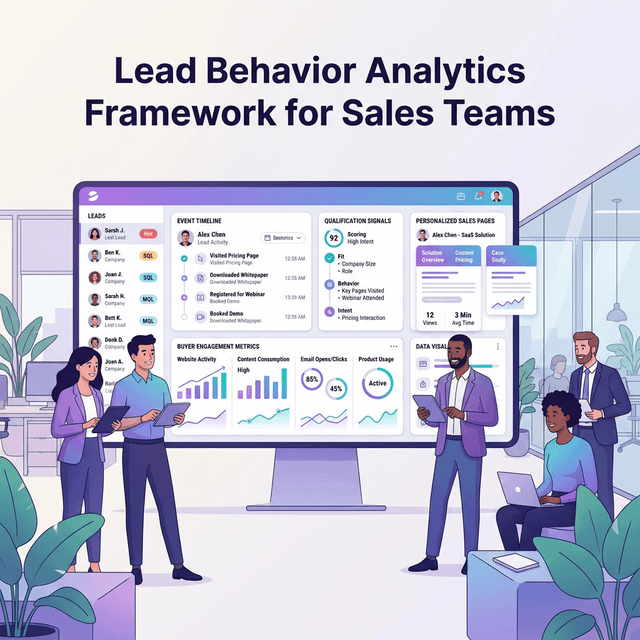
Lead behavior analytics only becomes operationally useful when it is organized into a framework a team can actually run. The PACE Framework gives RevOps and inside sales leads a four-stage model for converting raw buyer signals into a prioritized, coachable pipeline.
The premise of lead behavior analytics is deceptively simple: buyers signal their readiness through actions, not through attributes. A prospect who matches your ideal customer profile perfectly but has not revisited your proposal in two weeks is not a better bet than a prospect who just returned to your pricing page for the third time in 48 hours. The profile is static. The behavior is live. Any prioritization model that ignores behavior in favor of fit is systematically misprioritizing the pipeline, and most teams are doing exactly that.
The PACE Framework is a four-stage model for turning raw buyer behavior data into a prioritized, coachable sales process. PACE stands for Pattern, Acceleration, Context, and Execution. Each stage has a defined input, a decision it produces, and an owner. The framework is designed to be adopted by a RevOps lead or a senior inside sales manager without requiring a complete tooling overhaul. What it does require is a shared vocabulary and a weekly calibration habit.
This post lays out each stage in enough detail to be operational. It also makes a contrarian argument: the reason most lead behavior analytics initiatives fail is not a data problem. Teams typically have more behavioral data than they know what to do with. The failure is a framework problem. Unstructured behavioral data produces noise. Structured behavioral data, organized into stages with decision rules, produces pipeline clarity.
Why does profile-first qualification keep producing the wrong priority order?
Profile-first qualification ranks leads by who they are: job title, company size, geography, product category, source. These attributes are real predictors of whether someone could buy. They are poor predictors of whether someone is buying right now. The distinction matters because sales capacity is not infinite. A rep who spends the morning calling the five highest-profile leads in the pipeline may be systematically ignoring the three lower-profile leads who are actively evaluating.
The deeper problem is that profile-first models create a perverse incentive. Because profile attributes do not change, the same leads sit at the top of the priority list week after week until someone marks them lost. Behavior-first models are self-correcting: a lead that stops engaging falls in priority automatically. A lead that starts engaging rises immediately. This is what makes behavior-driven sales prioritization substantially more accurate than profile-first scoring over a full pipeline cycle.
Stage 1, Pattern: What has this buyer done, and does it mean anything?
The Pattern stage asks: across all the behavioral data your team collects, which signals carry actual predictive weight, and which are noise? Every behavioral analytics effort starts here because without a defined signal taxonomy, teams treat all behavior as equivalent. An email open and a return visit to a pricing page land in the same CRM activity log and carry the same implicit weight. They should not.
The output of the Pattern stage is a written signal taxonomy: a short list of buyer actions, each categorized by its predictive tier. This taxonomy is not a permanent document. It should be reviewed against actual conversion outcomes every four to six weeks and updated when the data says a signal is over- or under-weighted.
- Curiosity signals (low predictive weight): first page visit, welcome email open, single WhatsApp message read, one link click from a broadcast.
- Evaluation signals (moderate predictive weight): second or third visit to a product or pricing page, time spent on implementation detail or case study content, clicking through to a comparison section from a follow-up message.
- Decision signals (high predictive weight): return visit within 24 hours of a sales call or demo, repeat opens of commercial terms or proposal content, forwarding a microsite or proposal link to a second contact, buyer-initiated questions about timelines or pricing bands.
The contrarian claim in the Pattern stage is this: most teams have too many signals in their taxonomy, not too few. A list of thirty behavior events is operationally useless because reps cannot hold it in memory and cannot act on it consistently. Three to five high-confidence signals, clearly defined and consistently tracked, outperform a comprehensive signal library that nobody uses. Start with the signals your team can actually observe today, not with the signals a vendor dashboard can theoretically produce.
Stage 2, Acceleration: Is this buyer moving, and how fast?
A single decision signal is valuable. A sequence of signals within a compressed time window is significantly more valuable. The Acceleration stage measures velocity: not just what a buyer did, but how quickly they are progressing through evaluation behavior. A buyer who triggered one evaluation signal two weeks ago is at a different position than a buyer who triggered three signals in the past 48 hours.
Acceleration is operationalized through two rules. The first is a recency window: signals older than a defined threshold decay in weight. A common choice is seven days for evaluation signals and three days for decision signals, though the right window varies by sales cycle length. The second is a velocity trigger: a defined number of signals within a defined period that elevates a lead to immediate-response status. For most inside sales teams, two or more decision-tier signals within 48 hours should trigger same-day outreach from a senior rep.
Personalized microsites and proposal tracking tools are especially useful at the Acceleration stage because they concentrate buyer interaction in a single observable environment. When a buyer returns to a microsite three times in one evening, reviews the pricing section twice, and shares the link with a colleague, those three events are logged on a single URL. They are trivially visible as an acceleration pattern. The same buyer doing equivalent research across five scattered touchpoints would look like low-level curiosity in a fragmented CRM.
Stage 3, Context: What does this signal mean for this specific buyer?
The same behavior signal carries different meaning depending on where a buyer sits in the relationship, what product line they are evaluating, and what vertical they operate in. A decision-tier signal from a buyer who has already had two discovery calls means something different from the same signal from a buyer your team has never spoken to. The Context stage is where the PACE Framework avoids the failure mode of raw signal-chasing: treating every high-signal lead as identical regardless of relationship history.
Context has three inputs. Relationship stage: what is the current state of the buyer relationship based on logged interactions? Vertical fit: does this buyer type historically convert from this signal combination, or does this vertical tend to browse without buying? Competitive situation: is there any evidence this buyer is evaluating alternatives, such as simultaneous engagement with a competitor case study? None of these inputs changes the signal tier. They change the recommended response, which is the input to the Execution stage.
Rule The PACE principle on context
A signal tells you a buyer is moving. Context tells you where they are moving to. Responding to acceleration without context produces fast outreach that lands wrong. The rep who calls a high-acceleration lead to pitch a product the buyer already ruled out has wasted the hottest moment in the pipeline.
Stage 4, Execution: What does the rep do, and in what window?
The Execution stage converts the output of the first three stages into a specific rep action with a specific time constraint. It answers three questions: which rep should handle this lead, what should their opening message or call framing be, and how long do they have before the signal goes stale? Without defined answers to these questions, behavioral data produces urgency without direction. Reps know something is happening but do not know what to do about it.
A practical Execution stage has a response-window rule tied to signal tier. Decision-tier acceleration should reach a senior rep within two hours. Evaluation-tier signals warrant same-day contact. Curiosity-tier signals feed into the standard nurture sequence without interrupting rep capacity. This tiered response model prevents the common failure where every behavioral alert gets treated as equally urgent, burning rep attention on low-signal noise and desensitizing the team to genuine acceleration events.
- Decision-tier acceleration (two or more decision signals within 48 hours): assign to a senior rep, two-hour response window, opening framing anchored to what the buyer specifically reviewed.
- Evaluation-tier signals: assign to any qualified rep, same-day response window, opening framing acknowledges the buyer is in research mode without being intrusive.
- Curiosity-tier signals: route to automated nurture sequence, no rep capacity consumed.
- Competitive context flag: add competitive differentiation point to opening framing, escalate to senior rep regardless of signal tier.
- Stakeholder-sharing event: treat as decision-tier regardless of prior signal history, route immediately.
The Execution stage is also where sales engagement analytics earns its value. Over time, the data from this stage answers questions that cannot be answered from a single deal: which opening framing after a pricing-page visit produces the highest meeting-booking rate, which follow-up channel (call versus WhatsApp versus email) works best for a specific product and segment combination, and which time of day reaches buyers in an active evaluation mindset. This is the layer that makes PACE a learning system rather than a static protocol.
How do you calibrate PACE without starting from scratch each quarter?
The operational discipline that makes PACE durable is a weekly calibration meeting. It does not need to be long. Its purpose is to compare the signals that fired last week against the deals that closed or advanced last week, and ask three questions: did the signals that fired as decision-tier actually correlate with advancement? Did any deals advance or close without a prior acceleration signal, and if so, what did the buyer do that went unlogged? Did any high-acceleration leads go cold, and why?
These three questions produce a specific output: updates to the signal taxonomy, updates to the recency windows, and updates to the Execution stage response rules. A team that runs this calibration consistently for eight to twelve weeks will have a substantially more accurate framework than any vendor-default scoring model, because the signal definitions and response rules will be tuned to their actual buyers rather than to a generic industry benchmark.
The common failure mode here is treating calibration as optional. Teams that skip the calibration meeting for four consecutive weeks find that reps have informally overridden the framework with personal intuition, and the shared vocabulary has decayed. PACE requires the calibration meeting not because the framework is fragile, but because all behavioral data drifts as buyer behavior and market conditions change. A framework without a review cycle is a framework that becomes irrelevant.
What does the pipeline look like after a quarter of running PACE?
Teams that operate PACE for a full quarter typically report three structural shifts. First, the pipeline becomes shorter and more accurate. Leads that would previously have sat in an active stage for weeks without behavioral signals get moved to a lower-priority or nurture state earlier. This is not a bad outcome; it is a signal that the pipeline is describing reality rather than optimism. Second, forecasting becomes more defensible. When a manager asks why a deal is in the pipeline at a given confidence level, the answer is a behavioral evidence trail rather than a rep's gut feeling about the relationship.
The third shift is less obvious but arguably more important: coaching changes character. In a profile-first model, coaching conversations are reconstructions. A manager looks at a lost deal and asks what the rep should have done differently, with only call logs and stage labels as evidence. In a PACE-driven model, the behavior timeline is available. The manager can see that the buyer accelerated on day three, that the rep called on day five rather than day three, and that by day five the buyer had gone quiet. The coaching conversation is grounded in a specific, traceable decision, not in a retrospective guess.
The argument this post is making is that lead behavior analytics is not primarily a technology investment. It is a framework investment. A team that has Brixi or any comparable behavioral tracking tool but no shared signal taxonomy, no recency rules, no response-window protocol, and no calibration habit will collect data and change nothing. A team that builds PACE on top of whatever behavioral data it already has will improve pipeline clarity, call quality, and forecast accuracy before it upgrades a single tool.
Which leads in your pipeline are actually accelerating right now?
Brixi surfaces buyer intent signals in real time, maps behavior across every channel your team uses, and routes high-acceleration leads to the right rep before the window closes.
See the Buyer Intent EngineFrequently Asked Questions
In the PACE Framework, seriousness shows up at the Acceleration stage: a buyer who returns to pricing or commercial content more than once within a short window, particularly within 24 to 48 hours of a rep interaction, is exhibiting evaluation behavior. A buyer who has only triggered a single Pattern signal (one page visit, one email open) is still at curiosity level. The practical rule is to hold off a direct call until at least one Acceleration signal has fired, unless a Profile stage filter already puts the lead in a fast-track segment.
Lead scoring assigns a number based on a weighted mix of profile attributes and activity volume. Buyer intent tracking focuses on behavioral sequence: which content a buyer engaged, in what order, how recently, and whether they involved another stakeholder. The critical difference is that a high lead score can be driven entirely by rep activity and marketing engagement that has nothing to do with purchase readiness, while buyer intent tracking specifically filters for actions the buyer took on their own initiative. The PACE Framework uses intent tracking to populate the Pattern and Acceleration stages; it uses profile data only to set context, not to drive prioritization.
Across real estate, lending, and B2B SaaS teams, the most consistently predictive signals are: return visits to pricing or commercial terms pages within a 48-hour window, re-engagement within 24 hours after a sales call or demo, stakeholder sharing of a proposal or microsite link to a second contact, and buyer-initiated questions about timelines, pricing bands, or implementation scope. Single-event signals like a first email open or a single page visit are curiosity markers, not qualification events. Reliable qualification requires at least one Acceleration-stage signal in the PACE Framework before a rep escalates outreach.
Sales engagement analytics answers the Execution stage question: given what the buyer just did, what is the right response, and when? It identifies patterns like which follow-up format after a pricing visit produces the highest reply rate, or which time-of-day contact works for a specific segment. In the PACE Framework, Execution-stage decisions are driven by this analytics layer rather than by rep intuition or default cadence rules. Teams that instrument this stage typically discover that their default follow-up timing is misaligned with when their buyers are actually paying attention.