Best AI Tools for Small Business in 2026
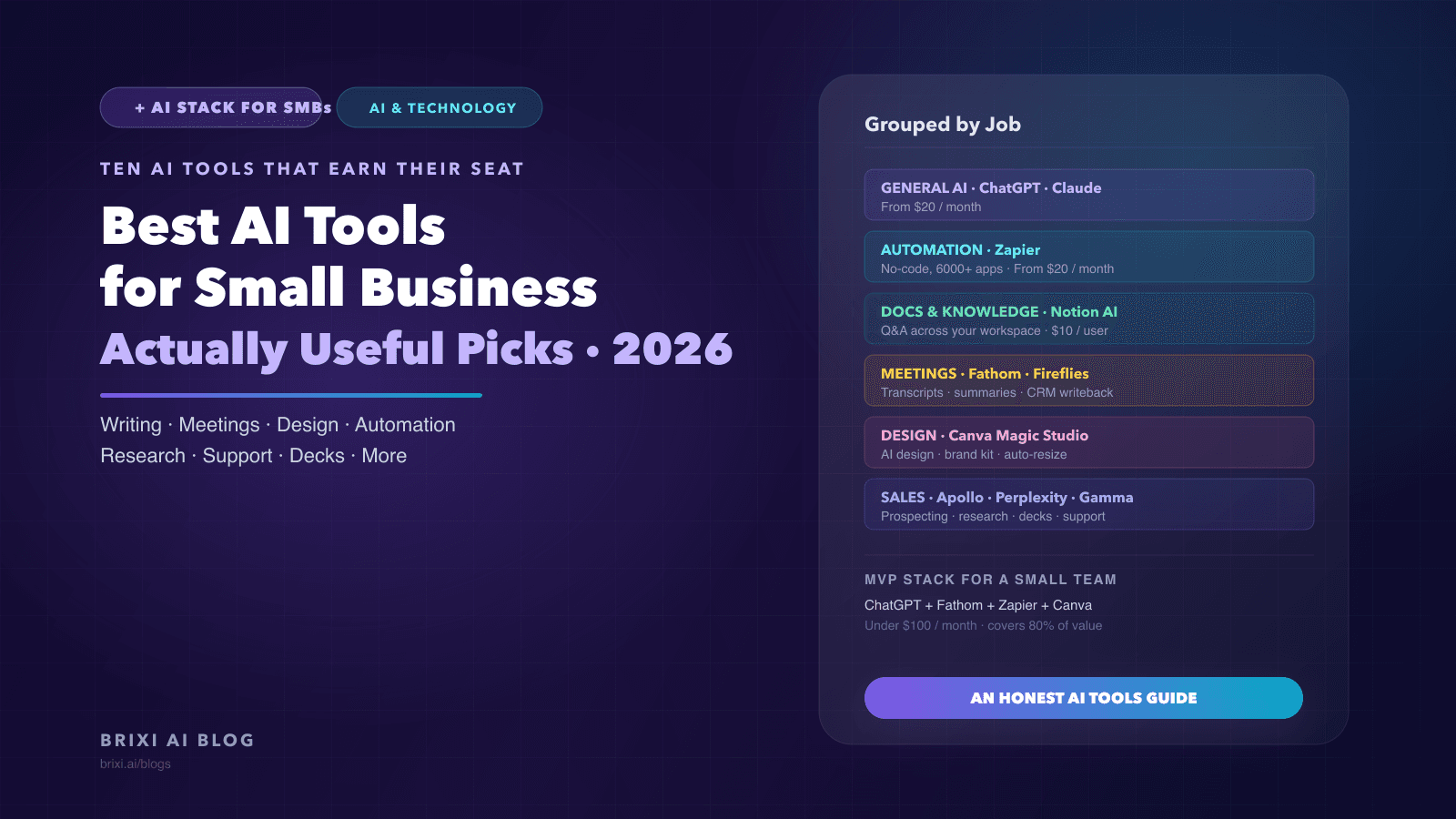
Thousands of AI tools launched between 2023 and 2026. Most vanish from small-business stacks within 90 days. This guide identifies the tools that earn Stack Permanence: the ones Indian SMBs actually renew, across sales, automation, customer communication, and knowledge work.
Esha runs operations for a 14-person educational consultancy in Indore. In early 2025 she trialled eleven AI tools over six months. By December, nine had been cancelled. The two that survived: an AI meeting notetaker and an AI CRM with buyer-intent tracking. The other nine produced impressive demos and then quietly became line items she deleted during a budget review.
That pattern is the real story of AI for small businesses in 2026. The market has grown from roughly a dozen credible products in 2023 to several thousand today. Most listicles rank tools by feature count or by which affiliate program pays more. This guide ranks by a different metric: Stack Permanence.
What is Stack Permanence and why does it matter for SMBs?
Stack Permanence is whether a tool is still active in your billing account 90 days after adoption. It is a harder bar than "useful in week one." Many AI tools pass the week-one bar because novelty feels like value. Very few pass the 90-day bar because that requires the tool to replace a task that recurs every week, not just a task that impressed you once.
For an SMB, the cost of low Stack Permanence is not just the subscription fee. It is the onboarding time, the workflow you built around the tool, and the month you lost waiting for it to prove itself. The question to ask before buying any AI tool is: does it eliminate a weekly recurring task, or does it create a new interesting thing I open occasionally?
Is a general AI assistant the right first purchase for an SMB?
The contrarian answer is: probably not. ChatGPT and Claude are the default recommendation in every AI round-up, and they are genuinely capable. But most SMB teams that subscribe to a general AI assistant in their first month use it intensely for a week, then drift to opening it every few days for miscellaneous tasks. The tool survives, but its ROI is hard to measure and easy to question at renewal.
The higher-ROI starting point for most Indian SMBs is a vertical AI tool that sits inside a workflow they run every day: a CRM with AI lead scoring, an AI voice agent on the inbound line, or a WhatsApp automation layer on the sales sequence. These tools touch revenue directly. A general assistant touches productivity indirectly. Both have a place, but the vertical tool earns Stack Permanence faster.
Which AI tools for sales actually survive the 90-day mark?
In sales, the tools with the highest Stack Permanence share one trait: they reduce the time between a lead showing interest and a rep starting a real conversation. The anti-pattern is the AI tool that generates more leads without helping the rep prioritise them. More leads with no prioritisation is not a solution; it is a louder version of the same problem.
The specific tools that survive in Indian SMB sales stacks are: AI CRMs with built-in buyer-intent signals, AI meeting notetakers that push summaries into the CRM automatically, and AI voice agents that handle the first inbound call when the rep is busy. These three cover the full lead lifecycle from first signal to first conversation.
- AI CRM with buyer-intent scoring: surfaces the leads most likely to convert this week, so reps call in priority order rather than random order.
- AI meeting notetaker: removes manual note entry after every call; action items go to CRM fields automatically.
- AI voice agent on inbound: answers calls when reps are on other calls, qualifies the lead, and books a callback slot.
- WhatsApp AI automation: sends follow-up sequences based on where the lead is in the funnel, not on a fixed broadcast schedule.
What AI automation tools do small business teams actually keep?
No-code automation platforms like Zapier and Make have the broadest theoretical value and one of the highest cancellation rates in SMB stacks. The reason: building automations takes longer than most SMBs expect, and maintaining them when APIs change is a recurring tax. Teams that get lasting value from automation tools tend to start with pre-built templates rather than blank workflows, and with integrations between tools they already use daily.
The anti-pattern to avoid here is the "automation sprawl" trap: a team that builds 20 Zapier workflows in the first month, breaks three of them when a connected API changes, and spends the next two months debugging instead of selling. Automation tools earn Stack Permanence when the team treats them as utilities rather than projects. Three reliable workflows running every day beat twenty fragile ones that require monitoring.
The automations with the highest Stack Permanence in Indian SMB teams are: new lead notification from a web form to WhatsApp, payment received to CRM status update, and meeting summary from notetaker to CRM contact record. These three automations are narrow enough to be reliable and valuable enough to justify the monthly fee. They also share a trait: each one removes a manual step that was previously done by a human in the first 10 minutes after an event occurred.
Does AI for customer support actually work for a 10-person SMB?
AI customer support bots crossed a quality threshold in 2025. In deployments we see across SMBs, a well-configured support bot handles between 40 and 65 percent of Tier 1 queries without escalation. For a 10-person team where one person manages support alongside other responsibilities, that is a meaningful reduction in reactive work.
The named anti-pattern here is the "coverage bot": a support bot deployed to the website chat widget but never integrated with the actual knowledge base, so it gives generic answers that increase user frustration and escalation rates. The difference between a bot that reduces support load and one that increases it is almost entirely whether it was connected to real product documentation.
Stack Permanence: the real split
Tools that replace a task you do every week earn their seat. Tools that replace a task you do once a month become line items you delete at renewal. For most Indian SMBs, sales workflow AI earns a permanent seat faster than general productivity AI.
What is the minimum viable AI stack for an Indian SMB in 2026?
The minimum viable AI stack is not the cheapest possible combination. It is the smallest set of tools that covers the highest-frequency workflows without creating integration debt. For most Indian SMBs in sales-led industries, that stack is three layers.
- Layer 1: AI CRM with buyer-intent tracking. This is the revenue layer. It tells reps who to call, logs what was said, and surfaces which leads are warming up based on engagement signals. Cost varies by vendor; most Indian SMB-focused CRMs price between 800 and 2500 rupees per user per month.
- Layer 2: AI meeting notetaker. This is the memory layer. Every call is transcribed, summarised, and synced to the CRM contact record. Reps stop writing manual notes and managers can review call quality without listening to recordings. Many teams use Fireflies or a built-in CRM notetaker.
- Layer 3: WhatsApp and voice AI for follow-up. This is the coverage layer. It ensures every lead gets a response within minutes, even outside business hours, and that follow-up sequences continue without manual reminders.
A general AI assistant like ChatGPT or Claude is a useful addition but sits outside the minimum viable stack. Add it when the team has stabilised on the revenue and memory layers. At that point it becomes the drafting and research layer: writing proposals, summarising competitor briefs, generating email templates. In that sequence, it earns Stack Permanence because the team already has enough context to use it well.
Which AI tools are overrated for SMBs in 2026?
Three categories consistently underperform for small teams despite significant marketing spend. Identifying these matters as much as identifying what works, because a cancelled subscription is not just a budget line recovered: it is also the opportunity cost of the three months spent waiting for the tool to prove itself.
First: standalone AI writing tools. In 2024 and early 2025 these had a strong value proposition. By 2026 most of their core features are built into the general AI assistants already in the stack. A separate subscription to an AI writing tool is redundant for most SMBs unless the team has a very high volume of structured content output.
Second: AI social media schedulers. These generate posts and schedule them, but the volume of low-quality AI-generated social content has made organic social less effective for most SMBs. Teams that invest in AI social tools often discover after 90 days that post volume increased but engagement did not. The exception is teams with a genuine content strategy and an editor who refines the AI output before publishing.
Third: AI outbound lead generation tools that scrape contact data and generate cold email sequences at scale. Indian SMBs in regulated sectors like lending and healthcare face deliverability and compliance risk from cold outbound at scale. More broadly, the return on AI-generated cold outreach has declined as inboxes became saturated. Intent-based inbound is a higher-ROI use of AI budget for most SMBs.
What changes in the SMB AI stack after one quarter of use?
At the 90-day mark, the teams that got value from AI tools share a consistent pattern: they narrowed their stack rather than expanded it. Most teams start the quarter with five or six AI subscriptions and end it with two or three. The ones that survive are the ones running on data the team actually produces every day: call recordings, CRM entries, WhatsApp threads, meeting notes. The tools that get cancelled are the ones that required the team to generate new types of data specifically to feed the AI.
A concrete example of this pattern in Indian real estate teams: an AI analytics tool that promised deep funnel insights was adopted alongside an AI CRM. After 90 days, the analytics tool was cancelled and the CRM remained. The reason was not that the analytics tool lacked features; it surfaced genuinely useful charts. The reason was that the CRM changed how reps spent their mornings. The analytics tool changed how the manager spent 30 minutes on Friday afternoons reviewing reports. One touched a daily recurring task; the other touched a weekly review that was already optional.
The tools that get cancelled at 90 days are the ones that required the team to change its input behaviour to produce AI outputs. If a tool needs the team to log data in a specific new format, or to use a new interface the team did not previously touch, it rarely survives. The winners are the tools that sit inside existing workflows and produce outputs without asking the team to work differently.
At the 90-day mark, teams also start making their second-order request: not just "show me which leads are warm" but "show me why this lead went cold and what we should have done differently." The AI tools that survive long-term are the ones that answer the second-order question, not just the first.
The deeper bet: why AI tools are a distribution question, not a software question
Esha cancelled nine AI tools not because they were bad software. Most of them did what they advertised. She cancelled them because they were tools in search of a workflow, not tools that fit an existing one. The two that survived did not just automate tasks; they changed how leads flowed through her team. The meeting notetaker meant that every conversation was documented and searchable. The AI CRM with buyer-intent tracking meant that her two sales staff called leads in the order most likely to produce a booking, not in the order they happened to check their queue.
The real question for any Indian SMB evaluating AI tools in 2026 is not "what can this tool do" but "does this tool change the order in which my team works." Stack Permanence is not about features. It is about whether the tool restructures the daily workflow enough that working without it would feel like a step backwards. That is the bar worth measuring against.
Which AI tools in your stack are actually moving revenue?
Brixi combines buyer-intent tracking, AI CRM, voice AI, and WhatsApp automation in one platform built for Indian SMB sales teams. See how it fits the workflows your team already runs.
Explore the Brixi PlatformFrequently Asked Questions
The highest Stack Permanence tools for Indian SMBs are AI CRMs with buyer-intent scoring, AI meeting notetakers that sync to the CRM, and WhatsApp plus voice AI for automated follow-up. General AI assistants like ChatGPT are useful additions once the sales workflow layer is in place. The tools that survive the 90-day mark are the ones that reduce time between a lead showing interest and a rep starting a real conversation.
A minimum viable AI stack for an Indian SMB covers three layers: an AI CRM with intent tracking (roughly 800 to 2500 rupees per user per month depending on vendor), an AI meeting notetaker (many have free tiers for small teams), and a WhatsApp or voice automation layer. Total cost for a 5-person team typically runs between 5000 and 15000 rupees per month. A general AI assistant adds another 1500 to 2000 rupees per user on top.
Yes, but only if the tool fits a workflow the team runs at least weekly. For a team under 10 people, the highest-ROI AI tools are the ones that remove manual tasks from the sales process: note-taking after calls, lead prioritisation, and follow-up sequencing. These produce measurable time savings without requiring the team to adopt new inputs or change how they work.
The most common mistake is subscribing to five or six AI tools in the same quarter without a clear workflow plan for each. Most SMB teams that take that approach end up with three or four subscriptions they rarely open and one or two they depend on. The better approach is to start with one AI tool in the highest-frequency workflow, get it to Stack Permanence at 90 days, and then add the next layer. Broad adoption before deep adoption produces cancelled subscriptions, not productivity gains.