AI Voice Stack vs Customer Platform: What Are You Buying?
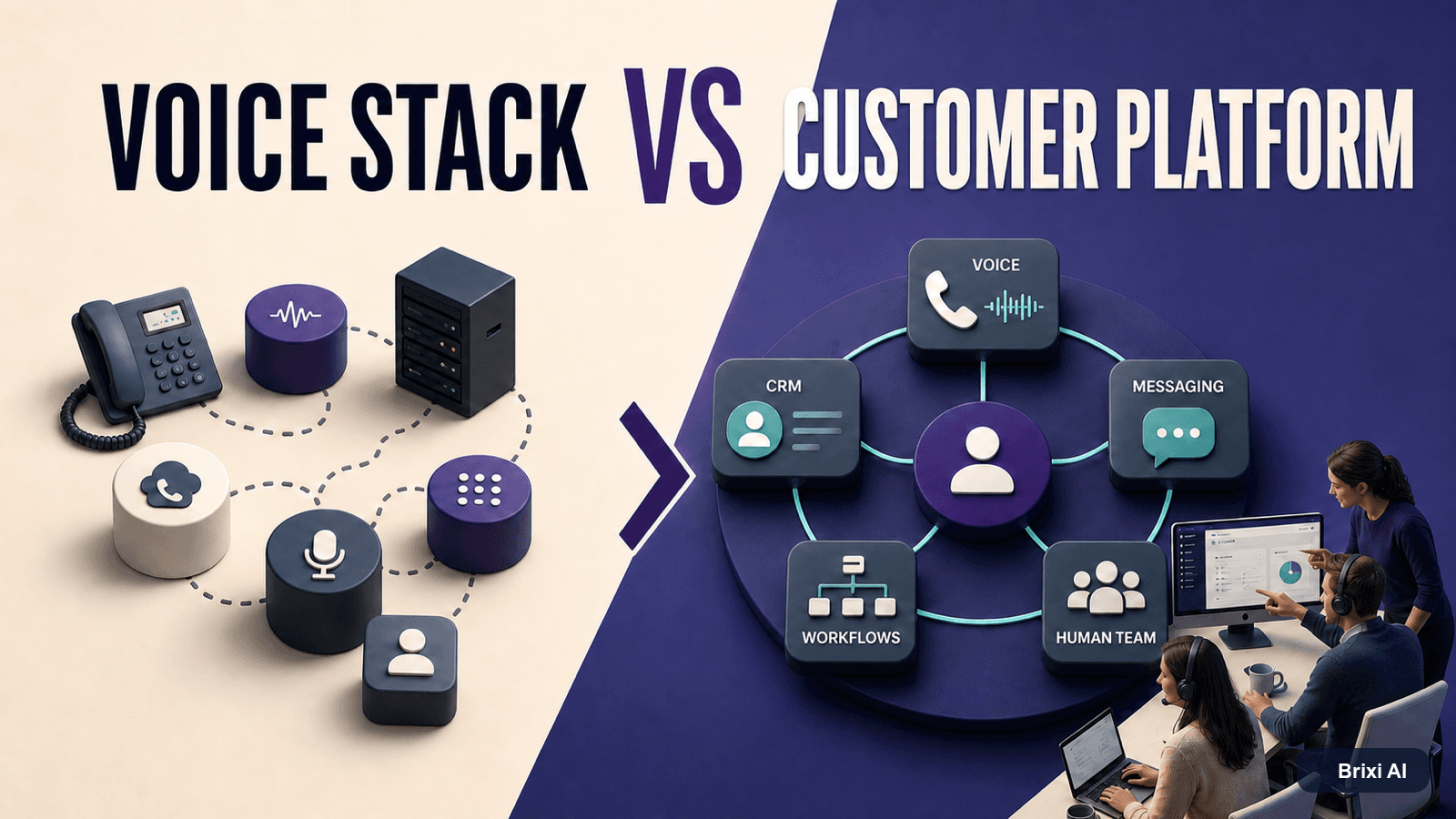
A voice demo proves that an agent can speak. Production asks whether the system can remember, act, route, recover, and remain accountable across the customer journey.
At 2:45 on Thursday, a product team completes an impressive Voice AI demo. The agent handles interruptions, sounds natural, and books a meeting. The next planning session adds CRM sync, retries, WhatsApp follow-up, consent, analytics, ownership, escalation, monitoring, and support.
The call was the visible layer. The operating system around the call is the purchase. That distinction separates an assembled AI Voice Stack from an AI Customer Platform.
The Demo Surface hides the production system
Buyers compare latency, voices, models, and per-minute rates because those features are easy to demonstrate. The Demo Surface does not show who maintains integrations, resolves failures, governs actions, or preserves context after the call.
A stack gives builders components and flexibility. A platform provides an operating model for customer outcomes. The right choice depends on whether the organization wants to engineer infrastructure or operate customer journeys.
A voice stack optimizes component control
Teams can select telephony, speech, language model, orchestration, data, and monitoring components. This suits organizations with specialized requirements and durable engineering ownership.
The trade-off is responsibility for identity, memory, permissions, workflows, testing, failure recovery, and cross-channel continuity.
A customer platform optimizes time to reliable operation
A platform connects voice with CRM, messaging, workflows, routing, conversation intelligence, and human teams. Shared context and governance are part of the product.
The trade-off is less component-level freedom in exchange for fewer systems to design and maintain.
- Who owns production incidents?
- Where does customer memory live?
- How do actions and escalations work?
- Can the journey continue across channels?
- What is the total cost per resolved outcome?
The decision should follow operating differentiation
Build where infrastructure creates unique advantage and the company will fund long-term ownership. Buy where the desired workflow is important but not proprietary.
A hybrid can work when specialized voice components extend a platform while CRM memory, customer workflows, and team execution stay centralized.
The call is one moment. The customer journey is the system.
Compare ownership, recovery, and total customer outcomes before comparing the price of a minute.
Brixi treats Voice AI as part of the complete customer platform
Brixi connects inbound and outbound AI voice with CRM, WhatsApp, email, web conversations, workflows, routing, intent, analytics, and human teams.
Calls can qualify, update context, trigger actions, schedule, escalate, and continue on another channel without a custom integration holding every step together.
- Voice and CRM memory in one platform
- Native follow-up and workflow actions
- AI-to-human escalation with context
- Conversation intelligence and outcome analytics
A quarter should expose total operating cost
Pilot a complete journey, including failures and handoffs, rather than a set of ideal calls. Track engineering time, exceptions, manual repair, customer outcomes, and change effort.
The cheaper option is the one that reliably produces the required outcome at the desired level of control, not the one with the lowest headline rate.
- Clearer build-versus-buy economics
- Faster production workflow changes
- Fewer disconnected handoffs
- More complete voice outcome measurement
The deeper bet is that voice becomes a platform capability
Voice AI will become less differentiated as a standalone interface. Differentiation will move to customer memory, decisions, workflows, governance, and team coordination.
The strongest systems will not merely conduct calls. They will connect each conversation to everything the organization must do next.
Evaluate the system around the call
See how Brixi combines Voice AI with CRM, omnichannel follow-up, workflows, intelligence, and human execution.
Book a Voice AI platform demoFrequently Asked Questions
Build when component-level control is strategically important and the company can own integration, security, monitoring, governance, failures, and ongoing change.
Choose a platform when the priority is operating complete customer journeys quickly with shared memory, workflows, channels, analytics, and team handoffs.
Compare infrastructure, engineering, maintenance, monitoring, incident recovery, integrations, human operations, and cost per resolved customer outcome.